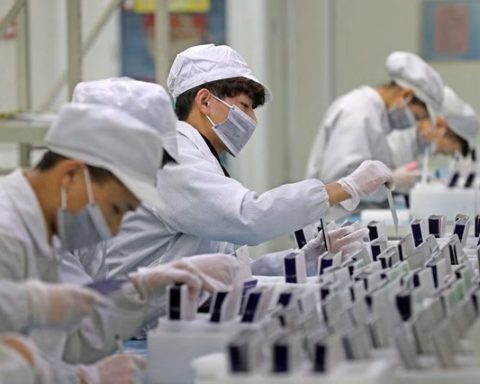
Chinese manufacturing activity contracted for the third consecutive month in June, underscoring the persistent challenges facing the world’s second-largest economy despite a temporary easing in trade tensions with the United States. According to official data reported by the Financial Times, the manufacturing purchasing managers’ index (PMI) stood at 49.7 in June, slightly up from May’s 49.5 but still below the 50-point threshold that signals growth.
The latest figures from China’s National Bureau of Statistics reflect ongoing headwinds for the country’s industrial sector, which has been grappling with a drawn-out trade war, a struggling property market, and weak domestic demand. Manufacturing PMIs have remained in contraction territory since April, when the US raised tariffs on Chinese goods to as much as 145 percent, triggering widespread disruption across supply chains.
Although a recent truce between Washington and Beijing has led to some tariff reductions, the broader trade outlook remains uncertain. A 90-day suspension on additional US tariffs affecting dozens of countries, including China, is set to expire next Wednesday, adding to the unease among exporters.
“Policymakers [are likely to wait] and monitor the development of [the] trade war,” said Zhiwei Zhang, chief economist at Pinpoint Asset Management, in comments to the Financial Times. While he noted slight improvements in export performance, Zhang warned that “deflationary pressure is persistent and the labour market is under stress.”
Indeed, while China’s overall exports continued to grow in May, shipments to the US plunged by their largest margin since the onset of the COVID-19 pandemic. The figure for new export orders, a key sub-index of the PMI, came in at 47.7 in June — still signaling contraction, but an improvement from April’s post-2022 low.
Domestically, signs of uneven recovery persist. Retail sales posted an unexpected jump in May, offering a glimmer of resilience in consumer spending. However, ongoing weakness in the housing sector continues to drag on broader economic sentiment. Authorities have responded by cutting interest rates and boosting fiscal support, especially for infrastructure projects.
The non-manufacturing PMI, which includes services and construction, edged up to 50.5 in June from 50.3 in May. The uptick was driven primarily by a rise in construction activity, with the construction PMI reaching 52.8.
“Fiscal support looks to have continued to support infrastructure spending, while the downturn in property construction seems to have eased last month,” said Zichun Huang, China economist at Capital Economics, in remarks cited by the Financial Times.
As Beijing walks a tightrope between managing geopolitical tensions and reviving domestic demand, analysts say the coming months will be critical in determining whether recent policy measures can stabilize China’s fragile recovery — or whether further stimulus will be required.