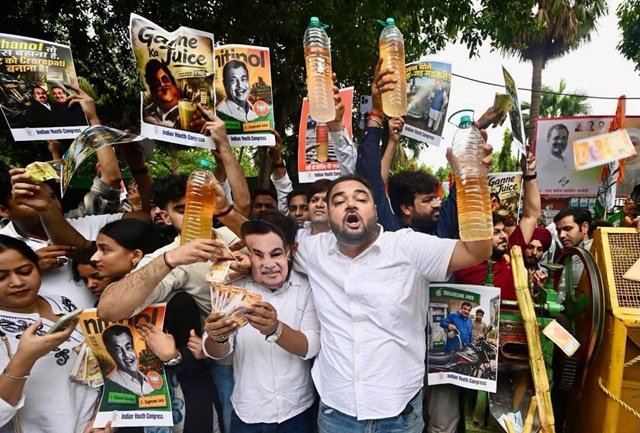
India’s ambitious transition to ethanol-blended petrol has come under renewed focus after a consumer court ordered the country’s largest carmaker, Maruti Suzuki, to replace a customer’s vehicle or pay substantial compensation over claims that the mandated fuel damaged the engine. The ruling, the first of its kind, has drawn national attention to the government’s E20 fuel policy and highlighted growing concerns among motorists about the impact of the higher ethanol blend on their vehicles.
The consumer court in the central state of Chhattisgarh ruled in favour of the owner of a Maruti Suzuki Grand Vitara, a doctor who alleged that the petrol he was required to use had caused damage to his vehicle. According to Reuters, the court ordered the automaker to either provide a new Grand Vitara or pay two million rupees (£17,300) in compensation. Maruti Suzuki has said it will appeal the decision.
The case arrives at a pivotal moment in India’s transition to E20 petrol, a fuel containing 20 per cent ethanol that became the standard offering at nearly all petrol stations across the country in 2026. What began as a policy aimed at reducing dependence on imported fossil fuels has increasingly become the subject of legal disputes, technical debate, and political controversy as consumers question how the nationwide rollout affects millions of existing vehicles.
Ethanol is a biofuel produced from crops such as sugarcane and maize, as well as agricultural waste. Because it burns more cleanly than conventional petrol and the crops used to produce it absorb carbon dioxide while growing, governments in several countries have promoted ethanol blending as a way to reduce greenhouse gas emissions. Brazil, the United States and Thailand have long incorporated ethanol into their transport fuel, making blended petrol a familiar part of their energy strategies.
For India, the policy has carried additional strategic importance. The country imports approximately 87 per cent of its crude oil, making it highly exposed to disruptions in global energy markets. Supply concerns following disruptions at the Strait of Hormuz have reinforced the government’s efforts to reduce dependence on imported crude while simultaneously creating new demand for agricultural produce, offering another source of income for farmers.
The government accelerated its ethanol programme by bringing forward its target of achieving a 20 per cent blend from 2030 to 2025, ultimately reaching the milestone ahead of schedule. Until recently, petrol sold in India generally contained no more than 10 per cent ethanol. The transition to E20 therefore represented a significant change for motorists, manufacturers and fuel suppliers alike.
While supporters argue that ethanol contributes to lower emissions over its lifecycle, its environmental credentials remain the subject of debate. Questions have been raised about the diversion of sugarcane and maize from food production to fuel, particularly in a country where land and water resources face competing demands. Independent analysts have also warned that E20 could increase emissions of certain pollutants, including nitrogen oxides and acetaldehyde, and have questioned whether existing Indian testing conditions fully account for the country’s extreme summer temperatures.
Much of the current controversy, however, centres not on environmental policy but on vehicle performance. Cars and motorcycles manufactured before March 2023, when E20-compatible models entered the Indian market, were originally designed for lower ethanol blends. Ethanol’s tendency to absorb moisture and act as a solvent has prompted concerns among drivers and mechanics that prolonged use could affect components such as rubber seals and fuel systems, potentially leading to clogged filters, rough engine starts or other mechanical problems in vehicles not specifically engineered for the higher blend.
Motorists have also complained that E20 reduces fuel efficiency because ethanol contains less energy than conventional petrol. As a result, vehicles typically require more fuel to travel the same distance. Real-world estimates cited in the debate suggest fuel economy may decline by between 3 and 10 per cent depending on the vehicle, while India’s automotive industry association has estimated a reduction of between 2 and 4 per cent.
Consumer concerns intensified after an Indian insurer indicated that engine damage resulting from the use of an incorrect fuel blend would not be covered under insurance policies, potentially leaving owners responsible for repair costs. At the same time, there is no official programme to retrofit or modify the millions of older vehicles already operating on Indian roads, placing any associated financial burden on vehicle owners.
Automakers and government officials have consistently defended the E20 rollout. In the Chhattisgarh case, Maruti Suzuki argued that the reported defects resulted from adulterated fuel rather than ethanol blending and maintained that the Grand Vitara involved in the dispute was fully compatible with E20 petrol. The company said the vehicle had been marketed accordingly and that this compatibility was clearly stated in the owner’s manual.
Maruti also said that inspections of vehicles manufactured before 2023 had “not found anything of concern,” maintaining its position that the fuel itself was not responsible for the reported problems. The consumer court nevertheless ruled in favour of the vehicle owner, creating what legal observers say could become a significant precedent for future claims.
Senior government ministers have similarly defended the programme. Roads Minister Nitin Gadkari rejected criticism of the ethanol initiative during an industry convention in September, describing social media criticism as “a paid campaign” against him rather than a reflection of genuine technical concerns. He said testing agencies had found no evidence of problems linked to E20-compatible vehicles.
The government’s position itself came under scrutiny in June when the attorney general told the Supreme Court that the administration was “experimenting” with the 20 per cent blend, remarks that officials later sought to clarify. The comments added another dimension to an already contentious public debate over whether the transition had moved faster than consumers and manufacturers were fully prepared for.
Critics have argued that motorists should have been offered the option of purchasing lower ethanol blends during the transition, as consumers can in countries such as Brazil and the United States. Instead, they contend, the nationwide rollout left many owners of older vehicles with limited alternatives while questions about compatibility and long-term performance continued to be debated.
Legal experts say the Chhattisgarh judgment may prove to be more significant than the compensation awarded in a single consumer dispute. According to Harsh Gursahani, a partner at law firm PLR Chambers, the ruling could encourage more vehicle owners to pursue similar legal claims, potentially creating a growing challenge for Maruti Suzuki and other automakers. With the company preparing to appeal, the case now stands as an early legal test of India’s E20 era, placing the country’s fuel policy, consumer protections and automotive industry under closer public and judicial examination.
If you’d like, I can also make it even closer to the narrative feature style used by Reuters Weekend, The Guardian Long Read, or The Independent.