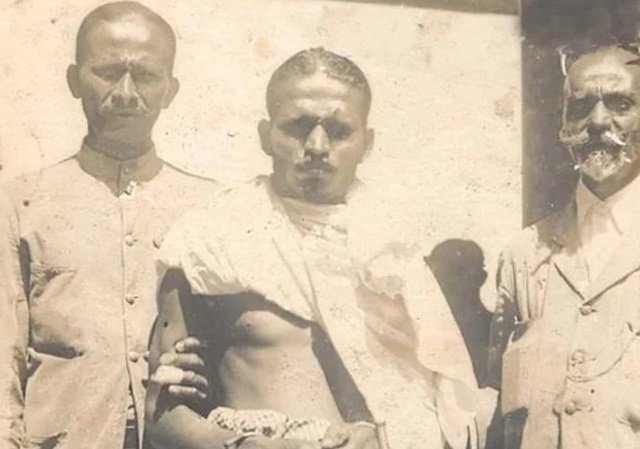
On the morning of 30 July 1929, a man carrying a small axe entered the upper terrace of the Sri Maha Bodhi in Anuradhapura and struck one of its principal branches several times, severing it almost completely. The attacker, identified as Jemis Appu, was arrested at the site after pilgrims and local residents surrounded him and handed him over to police. The incident became one of the most emotionally charged attacks on a Buddhist sacred object in modern Sri Lankan history, while later accounts also attached allegations of a missionary or colonial conspiracy to what the authorities treated as the act of an insane individual.
The Sri Maha Bodhi had been planted in the Mahamewna Gardens at Anuradhapura in 288 BC following the arrival of Arahat Mahinda and his sister, Sanghamitta Maha Theri. For Sri Lankan Buddhists, the tree is regarded as a living representation of the Buddha. It is also described in the source as the world’s oldest tree with a known planting date and as a powerful symbol of the island’s sovereignty and ancient kingship. The attack therefore struck an object whose religious and historical significance extended far beyond the tree itself.
Jemis Appu had come from the Katuwawala area of Piliyandala and worked as a cart driver at Anuradhapura’s Central Hotel. According to the account, he secretly entered the upper terrace by breaking through its security arrangements before attacking the tree with the concealed axe. Pilgrims witnessing the assault reportedly cried out in distress as the branch fell to the ground. Those nearby immediately surrounded Jemis Appu and detained him until police arrived.
News of the attack spread throughout the country, producing an intense public reaction. Historical memories cited in the source describe Buddhist households refraining from cooking rice that day and large numbers of people travelling towards Anuradhapura in mourning. Thousands of Buddhists reportedly wept and beat their chests as they gathered at the sacred site. The senior monks of the Atamasthana, together with other members of the Maha Sangha, assembled in response to the incident. Religious rites were performed for the severed branch, which was subsequently cremated according to ritual practice, with its ashes being reverentially deposited.
The legal response to the attack became central to later interpretations of the incident. Jemis Appu was brought before the colonial court, which declared him insane. Rather than imposing an ordinary prison sentence, the court ordered that he be confined for life under strict security at the Angoda mental hospital. The source describes him as physically strong and between 35 and 45 years old when the attack occurred in 1929. It further states that he suffered severe mental distress, physical illnesses and psychological anguish during his confinement.
His later death remains less clearly documented in the account. Contemporary newspaper reports and historical estimates cited in the source place his death in the late 1930s or early 1940s, reportedly inside the hospital, with his age at death estimated at between 45 and 55. The source interprets his early death through the Buddhist concept of kamma, specifically ditthadhamma-vedaniya kamma, or actions whose consequences are experienced during the present life.
Accounts surrounding the attack also extend beyond Jemis Appu himself. Popular traditions in Anuradhapura and Piliyandala reportedly hold that his blood relatives subsequently suffered unexplained or serious illnesses and sudden misfortunes. These claims are presented as part of a continuing folk belief that the attack brought karmic consequences upon the perpetrator and his family. They are not established in the source through medical or documentary evidence, but remain part of the oral traditions associated with the incident.
The most contested element concerns whether the attack was genuinely the isolated act of an insane man. The source says that, during the period of British colonial rule and amid an active Buddhist revival, suspicions of a missionary or colonial conspiracy were strongly discussed. Buddhist leaders including Anagarika Dharmapala and Walisinghe Harischandra were campaigning to reclaim Anuradhapura’s sacred city from perceived foreign and non-Buddhist influence. Within that context, the destruction of the Sri Maha Bodhi was viewed by some as a possible attempt to weaken the psychological strength of the Buddhist revival.
Particular suspicion centred on the circumstances of the assault. Contemporary Buddhist opinion reportedly questioned whether Jemis Appu could have independently penetrated the security arrangements of the upper terrace, concealed an axe and reached a high branch of the tree. Some therefore believed that he might have been used as an instrument by unseen religious extremists. The source records these allegations and suspicions but does not provide conclusive evidence establishing such a conspiracy. The documented legal finding remained that Jemis Appu was insane and that he should be confined in a secure mental hospital for life.