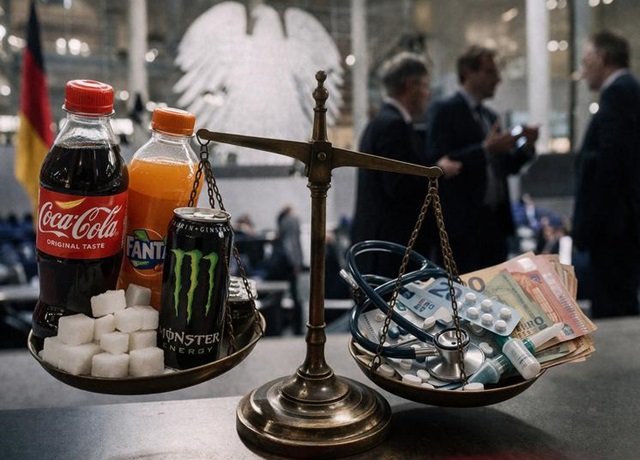
What began as a proposal to discourage excessive sugar consumption and raise money for Germany’s statutory health insurance has developed into a wider dispute within the government, with competing calculations over revenue, objections from members of the Union and questions about Chancellor Friedrich Merz’s ability to keep his coalition together.
The dispute centres on a draft law sent on Monday by Finance Minister Lars Klingbeil to his cabinet colleagues. Officials in the Finance Ministry proposed taxing drinks containing at least five grams of sugar per 100 millilitres, including drinks such as cola. The proposed rate would be graduated: €0.26 per litre initially, rising to €0.32 for drinks containing at least seven grams and €0.38 for those containing at least 10 grams.
The proposal followed a recommendation made in April last year by a commission appointed by the then Health Minister Nina Warken, a member of the CDU. The commission argued for a sugar levy whose proceeds would benefit Germany’s statutory health insurance system. The government has been working since then on how such a measure could be implemented.
But the draft has now become the focus of a political dispute. On Thursday, Bild reported, citing government sources, that the Chancellery had effectively stopped the proposal. The report followed the public release of the draft on Wednesday. According to Die Zeit, which reported on the dispute, the episode has become a symbol of a government struggling to reach agreement even on relatively simple legislation.
The immediate disagreement concerns the expected revenue. Bild reported that Klingbeil had increased the proposed annual yield from the €450 million originally envisaged by the commission to €1.2 billion in 2028, potentially increasing the burden on consumers and businesses. CDU MP Caroline Bosbach described the Finance Minister’s plans as a “provocation” in the Tagesspiegel and said she would not approve the legislation in that form.
The Finance Ministry has a different calculation. The commission initially estimated revenue of €450 million in the following year, but Warken increased the target to €650 million in June this year. That figure was also included in legislation agreed by both coalition partners that month to finance the statutory health insurance system. Because the tax is not expected to enter force until 1 July 2027, it could be collected for only six months during its first year. The ministry therefore calculates that €650 million over six months would correspond to roughly €1.2 billion over a full year, broadly matching the amount projected for 2028, before collection costs are deducted.
Klingbeil nevertheless faces criticism over the way the tax rates were designed. A sugar levy is intended not only to raise revenue but also to change consumer behaviour. If the tax is too high, consumers may sharply reduce their purchases of taxed drinks, potentially reducing revenue. If it is too low, the government may collect more money while producing a smaller behavioural effect. The commission had proposed rates no higher than €0.32 per litre. Klingbeil’s proposed €0.38 rate for drinks containing more than 10 grams of sugar therefore creates a new tax tier beyond the commission’s recommendation.
Changes to draft legislation during inter-ministerial negotiations are routine. In this case, the Finance Ministry had already proposed taxing sugar substitutes so that manufacturers could not simply replace sugar with sweeteners. Klingbeil himself stopped that proposal.
The latest confrontation came on Wednesday, when state secretaries from the Health, Agriculture and Finance ministries met with the Chancellery to settle remaining details. According to the source, they failed to reach agreement. The Chancellor’s negotiators subsequently informed the Finance Ministry’s representatives by email that the draft departed from the commission’s specifications and therefore could not be approved in its existing form.
The resistance is particularly strong within the Union. Merz had promised tax relief rather than new taxes, leaving relatively few CDU politicians willing to publicly defend the levy. One exception is Schleswig-Holstein’s Minister-President Daniel Günther, who argued at the CDU party conference in February that obesity was a problem politics could not ignore. His proposal failed, amid criticism from within the party. Christina Stumpp, then the CDU’s deputy general secretary, accused him of pursuing “green paternalistic politics”.
Stumpp has since been forced from that post at Merz’s urging and now serves as the Bundestag’s spokeswoman for agriculture, food and homeland affairs. She also leads the Union parliamentary working group where resistance to the sugar tax is particularly strong. At the beginning of September, Union MPs again expressed fundamental objections to the levy. With the coalition holding a majority of only 12 seats in the Bundestag, substantial dissent could create a serious parliamentary problem.
The dispute has therefore moved beyond the technical design of a tax. Die Zeit reports that the confrontation has acquired a power-political dimension as the Union resists measures associated with its Social Democratic coalition partner. At the same time, the government needs the anticipated revenue to construct a budget. Further negotiations could still produce an agreement and allow the sugar tax to become law, but the conflict has already exposed the difficulty of maintaining coalition discipline when the parliamentary margin is narrow and the financial assumptions behind the budget are contested.