by Our Special Correspondent
The 30 September incident aboard a Flydubai flight from Dubai to Tel Aviv has revived memories of decades of aircraft hijackings and placed renewed scrutiny on aviation security, Islamist radicalisation and the possibility of attacks involving airline insiders. But as investigators examine the Omani co-pilot’s background and motives, the emerging picture remains contested: Israeli investigators have increasingly considered the possibility that he acted alone, while questions about possible outside direction, including an Iranian connection, have not been completely closed.
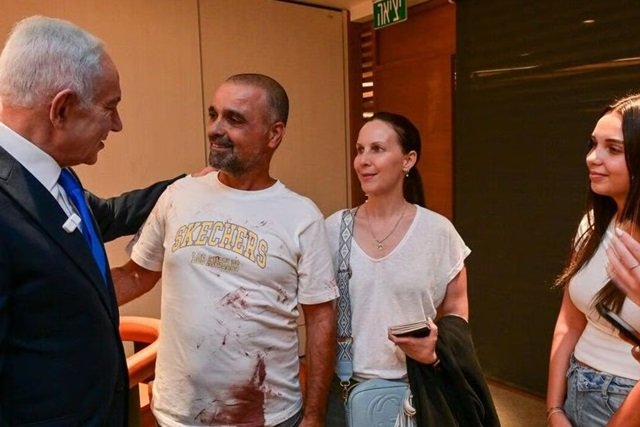
The 174 passengers aboard Flydubai Flight FZ1073 arrived in Israel on Wednesday night to scenes of tears, applause and waving national flags. Waiting for them at the old Terminal 1 of Ben-Gurion Airport were relatives, journalists and Prime Minister Benjamin Netanyahu, who personally met several of those involved in preventing what he described as a potential catastrophe on the scale of 11 September 2001.
One passenger, Yaniv Hayun, told Netanyahu that he had helped overpower the co-pilot. “I grabbed the terrorist and pulled him out of the cockpit. He was still trying to destroy the controls,” Hayun said. Bloodstains were visible on his white T-shirt in footage released by Netanyahu’s office.
Another passenger, Assaf Rajuan, told CNN that passengers heard screams before seeing the injured pilot open the cockpit door. Captain Smit Machchhar, an Indian pilot, was reportedly unable to speak and had collapsed with his hands raised after being attacked by the Omani co-pilot. Hayun, Rajuan and others entered the cockpit and restrained the attacker with headphone cables.
New footage broadcast by Israeli television has provided a more detailed account of the chaos. Passengers can be heard shouting that the attacker had tried to crash the aircraft, while others called for people to sit down and searched for a doctor. Machchhar, visibly wounded, later told those around him that the co-pilot had struck him repeatedly and that he could move his injured hand but could no longer close it properly.
The aircraft, a Boeing 737, transmitted an emergency signal while flying over the region and subsequently diverted towards Saudi Arabia. During the cockpit struggle, the aircraft descended sharply before control was restored. Two additional Flydubai pilots who happened to be travelling aboard the aircraft were able to take control and land safely at Tabuk in Saudi Arabia. Flight-tracking data reported by international media showed a dramatic loss of altitude during the incident.
The emergency landing initially left authorities with a basic but crucial question: was this a violent confrontation inside the cockpit, a deliberate attempt to hijack the aircraft, or a planned terrorist attack?
That question remains formally open, but the investigation has moved significantly since the first hours of the incident.
The United Arab Emirates has assumed jurisdiction over the case because the aircraft is registered in the UAE. Its attorney-general ordered a specialised investigation into the circumstances and motives, specifically including whether the incident involved terrorist activity, terrorist intent, prior planning or direction. The UAE has also stressed that official findings should be distinguished from speculation.
Saudi Arabia conducted the initial investigation after the aircraft landed in Tabuk. Its Interior Ministry said the preliminary findings showed that one pilot had assaulted the other, causing injuries to both. The pilots were subsequently transferred to the UAE with Emirati security personnel participating in the investigation.
Israeli investigators, meanwhile, have increasingly focused on evidence suggesting that the attack was deliberate.
Testimony from fellow pilots and Flydubai crew members has reportedly described the Omani co-pilot as a radical Islamist who refused to shake hands with women and frequently spoke in religious terms. Israel Hayom reported that at least one preliminary intelligence report indicated that the suspect had come under the influence of extremist preachers in Oman who promoted “istishhad”, a term used in some militant Islamist contexts for suicide attacks undertaken in the name of religion.
Israeli Prime Minister Benjamin Netanyahu has said that the co-pilot underwent a process of Islamist radicalisation. Israeli officials have also cited alleged material from the suspect’s social-media activity, although the full evidentiary basis for those claims has not been publicly released.
The investigation is nevertheless considering competing explanations, including the possibility that the attacker suffered from a mental disorder or acted independently rather than as part of an organised terrorist network.
One of the most significant developments is the reported movement towards a lone-attacker theory. According to an Israeli television report published on 1 October and updated early on 2 October, information obtained from the Saudi investigation indicated that the co-pilot had deliberately intended to carry out an attack and had undergone a radicalisation process during the preceding year. Israeli investigators were reportedly increasingly inclined towards the view that he acted independently for a nationalist or ideological motive, while continuing to examine whether a terrorist organisation had directed him. The same reporting said indications were growing that Iran was not responsible, although there was no definitive conclusion.
That represents a significant shift from the earlier hypothesis that the attacker might have been recruited specifically for the operation.
At one stage, investigators considered whether the co-pilot could have joined Flydubai nine months earlier as part of a longer-term operation, gaining the confidence of colleagues before being instructed to seize control of an aircraft flying to Israel. Under that scenario, the attack could have involved an Islamist organisation or even Iran’s Islamic Revolutionary Guard Corps.
An intelligence source cited in the earlier investigation said such a possibility would have required extensive preparation and the identification of a vulnerability within the airline’s security procedures. But investigators now appear to be examining whether the evidence points instead to an individual who radicalised over time and independently decided to act.
The intended destination of the aircraft during the alleged attack is another unresolved question.
Investigators are examining whether the co-pilot intended simply to crash the aircraft in the Jordanian or Saudi desert, or whether he sought to strike a strategic target. Israeli reporting has raised the possibility of a US military installation along the aircraft’s route, as well as Israeli targets including the Dimona nuclear facility or an Israeli Air Force base.
These remain hypotheses rather than established findings. The interrogation of the suspect is expected to be central to determining what he intended to do after gaining control of the aircraft.
The suspect’s reported words after being subdued have also attracted attention. According to Hayun, the co-pilot repeatedly shouted, “Kill me, kill me,” after passengers had restrained him. In footage released by the Israeli Government Press Office, Hayun described the statement as evidence that the attacker knew his mission had failed. Netanyahu subsequently referred to the same account when discussing the suspect’s alleged suicidal intentions.
The possibility of an Iranian connection has meanwhile become a separate political issue.
US President Donald Trump said Thursday that, based on information he was hearing, he believed there could be an Iranian connection, although he stressed that the matter was still being investigated and gave no details of the intelligence involved. He later warned that Iran would face severe consequences if it were established that Tehran was responsible. No public evidence has so far established Iranian involvement.
At the same time, Iranian and pro-Iranian media have promoted a radically different explanation.
Iranian security officials were reported as accusing Israel of planning a “false flag” operation designed to blame Iran and create a pretext for further confrontation. Press TV and other Iranian outlets circulated claims that the incident formed part of a wider Israeli plan. Such allegations have not been accompanied by independently verifiable evidence linking Israel to the attack.
The claims quickly became part of a wider online information battle. False-flag allegations accusing Israel, Mossad, Netanyahu or Jews of staging the incident appeared on social media within little more than an hour of the emergency. The Combat Antisemitism Movement reported identifying 2,963 posts making such accusations during a 12-hour monitoring period. ABC News Verify also documented fake material, including an apparent AI-generated video falsely presented as a BBC report.
The spread of those claims illustrates a second dimension of the incident: investigators are dealing not only with the physical evidence aboard Flight FZ1073 but also with competing narratives about responsibility before the official investigation has been completed.
The episode has also exposed questions about aviation-security procedures. Reports have raised concerns over how an Omani pilot from a country without diplomatic relations with Israel was permitted to serve on a route to Tel Aviv. Israeli media reported that dozens of Omani pilots had previously flown to Israel on Flydubai routes, despite restrictions affecting personnel from countries without formal relations with Israel. The reports have prompted scrutiny of whether Israeli authorities relied too heavily on airlines to enforce restrictions and whether additional background checks should have been conducted.
The incident has therefore become larger than the question of one pilot’s motive. It now encompasses the security of international aviation, airline recruitment and vetting, the vulnerability created by insiders, Islamist radicalisation, intelligence cooperation between Israel, Saudi Arabia and the UAE, and the rapid spread of politically motivated disinformation.
It has also reopened a long history of attacks involving aircraft travelling to or from Israel.
The first successful hijacking of an Israeli passenger aircraft occurred in July 1968, when the Popular Front for the Liberation of Palestine seized an El Al Boeing 707 travelling from London to Lod Airport via Rome and diverted it to Algeria. Thirty-nine days later, the 38 passengers and 10 crew members were released after negotiations in which Israel freed 24 prisoners.
Further hijackings followed. In August 1969, the PFLP seized a TWA Boeing 707 travelling from Los Angeles to Athens via Rome and diverted it to Damascus. Six Israelis were aboard; four women were subsequently released, while two Israeli men remained captive for about 100 days.
In September 1970, the PFLP seized several aircraft, including TWA and Swissair planes diverted to an airfield north of Amman. An attempted hijacking of an El Al flight was thwarted after crew members and passengers fought the attackers. Captain Uri Bar-Lev deliberately dived the aircraft to knock the assailants off balance, while an air marshal shot one attacker and passengers restrained Leila Khaled.
In 1972, four members of Black September hijacked Sabena Flight 571 and landed at Lod Airport, demanding the release of 317 Palestinian prisoners. Sayeret Matkal commandos stormed the aircraft disguised as technicians, killing two male hijackers and capturing two women. One passenger died from wounds sustained during the operation.
In 1976, Palestinian and German terrorists hijacked an Air France Airbus A300 and flew it to Uganda, leading to the Entebbe rescue operation six days later. Three hostages and Sayeret Matkal commander Yoni Netanyahu were killed.
Aircraft remained targets beyond the classic hijacking era. In 1969, terrorists fired on an El Al aircraft in Zurich, killing pilot Yoram Peres before air marshal Mordechai Rahamim fought back. In 2002, an Arkia flight in Kenya was targeted with a shoulder-fired missile. The deadliest aircraft-related terrorist attack came on 11 September 2001, when al-Qaida hijacked four passenger aircraft in the United States, killing nearly 3,000 people.
The Flydubai incident differs from those historical cases in one important respect: the alleged attacker was not an external group that seized an aircraft after boarding it as a passenger. He was a member of the flight crew. That distinction is likely to make questions about insider threats and personnel vetting central to the investigation.
For the moment, the available evidence establishes that a violent cockpit confrontation occurred, that the captain was seriously injured, that the aircraft suffered a dangerous descent, and that passengers and additional pilots intervened before it could end in disaster. The UAE investigation is now examining whether the incident constituted terrorism and whether it involved prior planning or outside direction.
What remains unresolved is the most consequential part of the story: whether the co-pilot was a radicalised individual acting alone, a recruit working for an organised terrorist network, or part of a broader operation.
The emerging Israeli assessment increasingly points towards an independent attack motivated by radicalisation, while the possibility of outside involvement has not been completely eliminated. The available public evidence does not establish an Iranian role, nor does it substantiate claims that Israel staged the incident.
The investigation therefore remains open. Its final conclusions will depend not on the competing narratives that emerged in the hours after the flight landed, but on the interrogation of the suspect, forensic evidence, his communications and financial records, his history within Flydubai, and intelligence obtained by Saudi, Emirati and Israeli authorities. Until those findings are released, Flight FZ1073 remains both a narrowly averted aviation catastrophe and an unresolved international security case.