


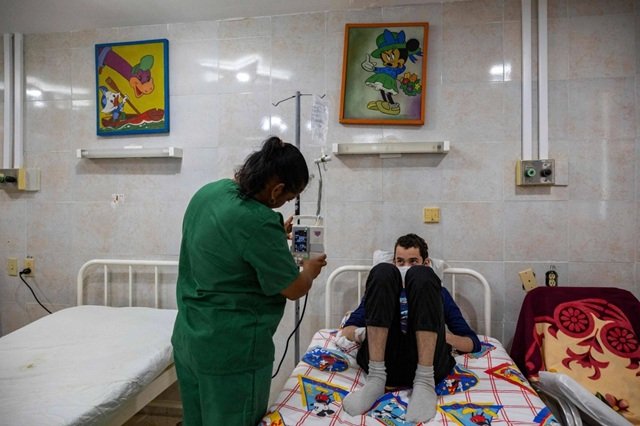
For nearly three weeks, Rosa Valentina Perez has remained in a bed at Cuba’s main cancer clinic, waiting for a CT scan that could determine whether the cancer she battled two years ago has spread to her spine. The 64-year-old breast cancer survivor has lost mobility in her legs, but doctors cannot confirm the cause because Havana’s only functioning CT scanner is located at another hospital with a lengthy waiting list.
“You can’t imagine what it’s like to have this pain, to know that your life span is being diminished, and to hear them say: ‘Let’s see when we can do that scan,’” Perez said.
Her wait reflects the wider strain facing Cuba’s healthcare system, once considered one of the defining achievements of the country’s revolution. After Fidel Castro and his supporters overthrew a U.S.-backed government and established a communist state, Cuba built a healthcare model based on free access to medical services and education. The system became a central symbol of the revolution, with Cuban doctors later sent abroad to demonstrate the country’s medical capabilities.
Today, that system is struggling under the combined pressure of the COVID-19 pandemic, intensified U.S. sanctions and an energy crisis worsened by a fuel blockade imposed by U.S. President Donald Trump’s administration, according to the source report.
Hospitals across the country are facing prolonged power outages, shortages of essential medicines, failing medical equipment and the departure of doctors, nurses and technicians seeking better-paid opportunities abroad or in private employment. The government has focused limited resources on priority areas such as cancer treatment, cardiology, kidney care and maternal and child health, but those services are also facing severe limitations.
At Havana’s National Institute of Oncology and Radiobiology, known as INOR, more than 1,200 patients are waiting for radiotherapy treatment. Institute director Luis Eduardo Martin said 80 percent of the equipment used for diagnosis and treatment is outdated or broken.
“We administer medication without at times being able to verify they are having the effect we expect … because we don’t have the reagents or the equipment to monitor them,” Martin said.
Children with cancer have also been affected despite receiving priority attention. Government data shows that childhood cancer survival rates have declined from 85 percent before the crisis to 65 percent currently.
Mariuska Forteza, head of INOR’s pediatric oncology unit, said routine blood tests have been reduced because of shortages of equipment and fuel needed to transport samples between hospitals.
“It’s very frustrating to know you can save the child, achieve a better survival rate, and you can’t do it because your hands are tied,” Forteza said.
Medical technicians have attempted to keep aging equipment functioning through constant repairs. Alexis Amado Dominguez, a hospital repair technician, said he is sometimes called in during the early hours of the morning to restore machines needed for cancer treatment.
“Sometimes I have to come to the hospital at midnight or 2:00 a.m. to repair equipment so the patient can begin their (cancer) treatment,” he said.
The crisis has also affected heart care. Jose Esteban Abreu, a doctor at the National Institute of Cardiology and Cardiovascular Surgery, said annual heart surgeries have dropped from more than 400 in 2018 to around 100 currently. About 130 patients are waiting for pacemaker procedures.
In the hospital’s maintenance department, technician Luis Alexis Duncan displayed equipment awaiting repair, including anesthesia machines, cardiopulmonary bypass systems and heart monitors. Some devices have been dismantled to provide spare parts for others.
“We’re always inventing, working, innovating,” Duncan said.
But repairs are increasingly difficult as equipment shortages combine with a lack of personnel. In a workshop responsible for repairing around 80 percent of Havana’s medical equipment, faulty incubators and neonatal ventilators continue to accumulate.
The shortage of healthcare workers has become one of the system’s most serious challenges. Many medical professionals have left because state salaries are paid in heavily devalued Cuban pesos, leaving hospitals with fewer staff to manage growing patient demands.
At Havana’s Hermanos Ameijeiras Hospital, a major medical facility, dialysis services have been affected by staffing pressures. Iamara Castro, head of nephrology, said some dialysis sessions have been reduced from four hours to two hours so more patients can receive treatment and the remaining staff are not overwhelmed.
“When you shorten the hemodialysis period, you are shortening life,” Castro said, adding that the service continues through the dedication of medical workers.
For patients such as 81-year-old Nelson Companioni, the decline in resources has created daily uncertainty. He said he worries that dialysis equipment could fail before his treatment is complete and described watching nurses attempt to restart malfunctioning machines.
“You see the nurses kneeling there, hitting it to get it working,” he said.
Across Cuba’s hospitals, medical workers continue trying to maintain services with limited resources, but patients are increasingly facing delays, reduced treatments and uncertainty as the country’s once-renowned healthcare system struggles to operate under mounting pressure.










