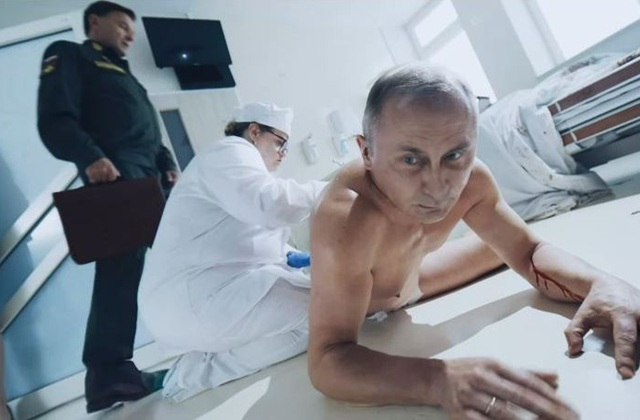
In what appears to be a provocative attempt to undermine Russian President Vladimir Putin’s image, a controversial AI-assisted biopic is set to premiere in Britain this month. Titled Putin (2025), the film by Polish director Patryk Vega takes extraordinary liberties with the life of the Russian leader, depicting him in deeply humiliating scenarios, including wearing soiled adult nappies and moonlighting as a taxi driver during the turbulent post-Soviet years.
A High-Tech Mockery of Putin
Using advanced AI technology, Vega superimposes Putin’s face onto the actor Slawomir Sobala, who meticulously studied the president’s mannerisms and body language. Vega claims his goal is to “expose” the man behind the Kremlin’s power, portraying him as a “terrified tiger” trapped by his own fears. However, critics argue that the film blurs the line between satire and misinformation, presenting fabrications alongside real events to craft a narrative that is as much propaganda as it is entertainment.
The film showcases Putin as a ruthless leader ordering political assassinations, orchestrating the bombing of Chechnya, and leading Russia’s invasion of Ukraine. These events, rooted in historical record, are juxtaposed with sensationalist scenes of him terminally ill in hospital or participating in morally questionable escapades. Vega openly admits to taking artistic license, weaving fictional elements with factual events to create a surreal, almost grotesque portrait of the Russian leader.
Controversy and Western Hypocrisy
The release of Putin (2025) comes amid ongoing Western campaigns against misinformation and disinformation, highlighting a stark irony. While Western media regularly decries the use of AI deepfakes in spreading falsehoods, this film uses the same technology to dramatize and ridicule a sitting world leader. Critics have questioned the ethical implications of using such tools to craft a narrative that may serve geopolitical agendas under the guise of entertainment.
Personal Life on Display
Vega’s biopic delves into Putin’s personal life, portraying him as a vengeful and self-absorbed man. Scenes include him humiliating his ex-wife Lyudmila by publicly embracing Alina Kabaeva, a former Olympic gymnast and rumored romantic partner. In one particularly contentious sequence, he declares to Lyudmila, “I am erasing you from the history books.”
Another scene shows Putin as part of a hunting party targeting scantily clad women, a wholly fictional scenario designed to amplify the film’s shock value. His earlier years as a taxi driver in the economically devastated 1990s are also dramatized, including a fabricated fistfight with a passenger.
Kremlin Response and Security Concerns
Unsurprisingly, the film has attracted the attention of the Kremlin. Vega claimed that Russian intelligence agents attempted to gather information about the production through dubious methods, including posing as U.S. officials offering significant sums for private screenings and scripts.
The film’s release is restricted to 35 countries, including Britain and Ukraine, with no plans for distribution in Russia. Vega also noted concerns from industry professionals, with one U.S. public relations firm reportedly refusing to work on the project, fearing retaliation from the Kremlin.
A $15 Million Provocation
Shot over 18 months with a $15 million budget, Putin (2025) combines footage from Poland, Israel, Syria, Jordan, Ukraine, and even undercover shots in Russia. Vega, known for his gritty portrayals of the criminal underworld, described his work as a bold attempt to challenge the aura of invincibility surrounding Putin.
Broader Implications
While the film may be marketed as a groundbreaking exploration of Putin’s psyche, its overt sensationalism raises significant questions about the West’s approach to countering authoritarian narratives. Can such dramatizations genuinely contribute to political discourse, or do they merely perpetuate the cycle of misinformation they claim to oppose?