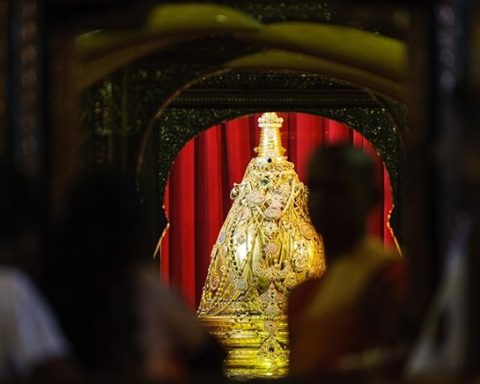
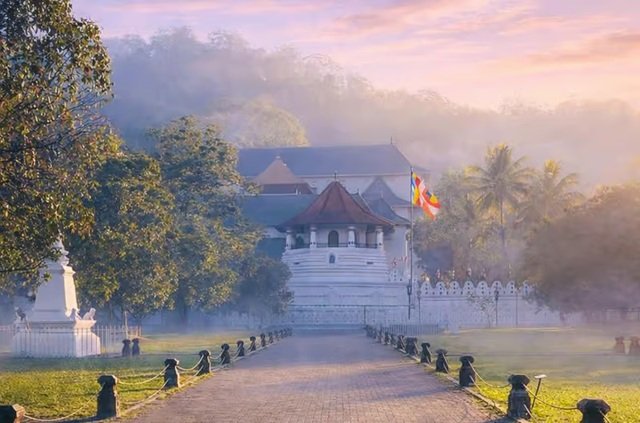
What is the truth behind the allegations being made by some people on social media these days that, during the JVP’s second insurrection (1986–1990), JVP insurgents launched an attack on 8 February 1989 to seize the Sacred Tooth Relic in Kandy?
The attack at the Sri Dalada Maligawa in Kandy was not carried out to seize the Sacred Tooth Relic, but to attack five police posts and steal weapons. To investigate this, about 20 years ago I travelled to Kandy and met all three people who had been arrested at the scene in connection with their involvement in the attack and subsequently prosecuted. I also spoke to the then-retired High Court Judge of Kandy, Nishshanka Udalagama, who had heard the case, members of the security forces, and several insurgents who had participated in the attack but escaped capture. The attack on the five police posts at the Sri Dalada Maligawa in Kandy took place on 8 February 1989.
During the JVP’s second insurrection, the JVP had divided the police divisions in the Kandy District into eight zones. These were Wattegama (Pathadumbara, Wattegama, Panwila and Alawathugoda), Ududumbara (Rangala, Ududumbara, Teldeniya, Madugoda and Hasalaka), Kundasale (Menikhinna and Kundasale/Pallekele), Kandy (Katugastota and Kandy), Harispattuwa (Harispattuwa, Ankumbura and Galagedara), Nawalapitiya (Gampola, Nawalapitiya and Pussellawa), Yatinuwara (Peradeniya, Daulagala and Kadugannawa), and Hewaheta (Talatuoya and part of Hanguranketha).
Of these zones, Kundasale produced the largest number of full-time cadres for the insurrection. By August 1989, there were 425 full-time cadres in the Kandy District alone, of whom 62 were women. Among the districts in which the JVP operated, Kandy was also the district where it managed to collect the largest number of firearms. Most of these weapons were distributed to other parts of the country. The JVP’s coordination offices operated from rented houses in Udaperadeniya and Agunawela, on Gampola Road.
On 8 February 1989, 43 insurgents belonging to five groups involved in the JVP’s second insurrection attacked five police posts at the Sri Dalada Maligawa in Kandy and seized 17 firearms, including nine T-81 rifles and two T-56 rifles. The meeting to plan the attack on the five police posts at the Sri Dalada Maligawa was held at the house of Sirisena of Kolongahawatta, Digana, an officer in the Department of Agriculture. Seven people attended the meeting, including the district political secretary, Upali Jayaweera, who led the planning and was also known as Manel, Kingsley or Nuwan, and Priyantha of Nikaweratiya, who led the attack.
Two days later, the weapons were seized from the police posts at the Dalada Maligawa. Of the 43 people involved, 12 were women. Among them were Ganga of Matale, Mangalika, Nadeeka, Lilanthi and Weerasinghe. Gunfire from the insurgents wounded an army soldier, Herath Mudiyanselage Muthu Banda, and Francis of Dingiththa Henayalage Gedara. A total of 17 firearms, including nine T-81 rifles and two T-56 rifles, were stolen. The weapons were subsequently hidden in a house in Maguldeniya, Rangala, and at the home of Upali Navaratne.
During the seizure of the weapons, Uduwela Monaragala Sudalikaarage Padma Chandani, also known as Thanuja; Navaratna Banda of Diyathalawa Gedara, Urapola, whose full name was Heenkenda Mudiyanselage Navaratna Banda; and Tilak Bandula Wijesiri of Kengalla, Menikhinna, were arrested. Bandula Wijesiri, who had studied at Rajasinghe Maha Vidyalaya in Panwila, joined the JVP through Seneviratne of Kundasale, who lived in Warapitiya, Kandy.
Following the trial before the Kandy High Court, presided over by High Court Judge Nishshanka Udalagama, Bandula Wijesiri was acquitted on 19 October 1994. Copies of the orders in the three relevant High Court cases are attached for your reference. These facts make it clear that the attack at the Sri Dalada Maligawa in Kandy was not intended to seize the Sacred Tooth Relic, but to attack five police posts and steal weapons.
On 28 November 1989, following the killing of Wijeweera, Police Headquarters announced a reward for information leading to the arrest of five people, including Upali Jayaweera, the district political secretary who had also led the planning of the attack on the five police posts at the Sri Dalada Maligawa.
Upali was arrested at 1.45 a.m. on 2 January 1990, along with a JVP leader from Hataraliyadda, Kandy, at a housing complex in Hawa Eliya, Nuwara Eliya. After his arrest, Upali was taken to the security forces camp at Mattegoda, Colombo.
Upali was held at the Mattegoda camp until 6 January 1990. From that day, he was detained for approximately one month at an army supply corps camp near Udawattakele in Kandy. During this period, he was dressed in a “military-style uniform” and taken to numerous locations in the Kandy District where JVP insurgent activities had taken place. Another 21 JVP insurgents were being held at the same camp, handcuffed and tied to their beds. One of the officers in charge of the camp was Captain Karunaratne.
Later, on 9 February 1990, Upali and several other insurgents were taken to an army camp located at the Gam Udawa site in Pallekele. One of the officers in charge of that camp was Captain Ratnayake. Among the security personnel attached to its intelligence unit were Lieutenant Nalin Karunaratne, Mahinda of Bulathsinhala, Sapukotana of Kandy, Senaratne of Homagama, and G. P. D. A. Gunasekara of Matara, along with 12 others.
Upali was also taken to the Mattegoda camp twice. He was subjected to torture and subsequently returned to the Pallekele camp. Upali was killed at approximately 11.30 p.m. on 6 March 1990. His body was loaded into a white van, abandoned among the thorny bushes along Dulwatta Road in Madugoda, and disposed of.
Upali Jayaweera’s wife was Hemawathi Rathnayake Mudiyanselage, an Assistant Medical Practitioner (AMP), later designated a Registered Medical Officer (RMO). She had attended Dambagalla Piyarathna School and had become his girlfriend during that period. On 12 March 1989, Upali Jayaweera married Hemawathi in Kandy under the name Nuwan Jayaweera. Their wedding photograph was taken at Saman Studio in Pilimathalawa. His sister Susila and other family members attended the occasion.
At the time of Upali’s death, his wife was pregnant. Their son, Chathura Vimukthi, was born on 22 June 1990. Upali’s widowed wife later married Nihal Galappaththi, a Member of Parliament representing the Hambantota District.
Hemalatha worked for a time at several hospitals, including the Padiyathalawa Hospital in Ampara, the Nakulugamuwa Hospital in Dikwella, and the Mawanawele Hospital in Dehiattakandiya. Dr Hemalatha, who earned the affection of her patients throughout her professional career, also passed away after succumbing to cancer in January 2020.