


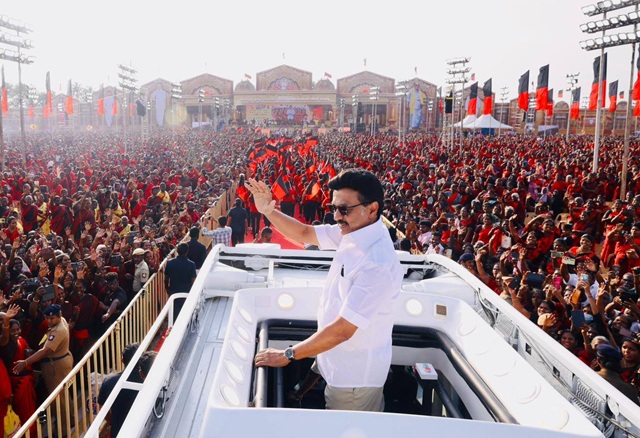
During the last five years, Tamil Nadu has been virtually governed by family groups at various levels. At the top is the family of the Chief Minister, followed by the families of ministers, then those of MLAs of the DMK, and further down the families of district secretaries and similar functionaries. At every level of administration, these family groups ensure that they have a say in all matters.
Most government officials oblige the demands of these family groups, as they cannot afford to antagonize them. For the same reason, most government tenders and contracts are cornered by these groups. It has become a precondition that such families at different levels must be kept in good humor for any public activity to be successfully executed, whether in the field of industry, education, or elsewhere. This sort of virtual family rule is against the basic principle of democracy and should not be allowed to prevail in a democratic country.
Any casual discussion with a cross-section of citizens in Tamil Nadu readily highlights the view that, in most cases, nothing can be done without paying bribes to officials at various levels in government departments. If there are instances of getting things done without paying bribe money, they are exceptions rather than the rule. Corruption starts at the top level of government and reaches the lowest levels of departments, often with the cooperation of senior officers who either participate in the corruption or remain unconcerned about it. It is common to hear officials who indulge in corruption say that they are collecting money to be passed on to higher authorities.
The level of corruption is so pervasive that even government officials sometimes pay bribes among themselves to get transfers, promotions, or to escape disciplinary action. In many cases, those who take bribes also end up giving them. It is difficult to imagine a worse situation.
Several ministers are being accused of collecting huge sums of money during recruitment processes for government departments. Allegations involving crores of rupees have become widely known to the public. Such corruption in recruitment makes government departments inefficient, with employees often remaining indifferent to public needs. Those who pay large sums to secure appointments inevitably attempt to recover their money through corrupt practices, thereby exploiting the public. Similarly, contractors who pay bribes to obtain government contracts often dilute the quality of work and display poor workmanship, leading to reports of newly built roads caving in and recently constructed buildings collapsing. These conditions raise serious concerns about maladministration.
Ministers and ruling party members at various levels appear to focus on criticizing Hindu religious traditions, questioning Sanatana Dharma, and claiming atheistic views. They are often perceived as being dismissive of Hindu practices and do not extend greetings during Hindu festivals, while being careful not to criticize other religions and readily offering greetings for their festivals. This is seen by critics as a partisan approach, which is unacceptable in a democratic welfare society where the government is expected to treat all religions with equal respect.
Hardly a day passes without media reports of people being caught carrying ganja or of students and youth addicted to drugs or liquor attacking innocent passersby. Addiction to liquor and drugs is spreading at an alarming rate, with the government itself being a major beneficiary through the sale of liquor via state-run outlets. Road accidents, murders linked to illicit relationships, and even attacks on police personnel in public places indicate a level of social decay attributed to the rapid spread of addiction. The government has not taken sufficient action to curb this dangerous trend. News frequently appears about women being attacked or abused within families by individuals under the influence of drugs or alcohol. Many people feel that law and order has deteriorated to such an extent that commuting feels unsafe and women are afraid to move around after dark.
During the last five years, several crores of rupees have been spent constructing memorials, installing statues in honor of departed leaders, conducting lavish public celebrations, and allocating scarce resources to unproductive activities. Large sums are also spent on providing freebies, with the objective of gaining political advantage and keeping the electorate satisfied despite administrative corruption and poor law and order conditions. With insufficient funds for such expenditures, the government has resorted to heavy borrowing, with total debt now exceeding ten lakh crore rupees, reportedly among the highest for any state. A significant portion of revenue is spent on paying interest, and loans are sometimes raised merely to service existing debt. Critics argue that the government appears unconcerned about the financial situation and lacks a clear plan for repayment.
The government frequently claims that rapid industrial growth is taking place in the state. The Chief Minister, ministers, and bureaucrats travel abroad to attract investment, and large investors’ conferences are organized at great expense. However, there is little clarity about how many announced memoranda of understanding actually materialize, as announcements are no substitute for implementation. While highlighting new industries, there is little discussion about those that have closed. Reports suggest that over 300 textile mills have shut down in recent years. Official data indicated that in 2021–2022 Tamil Nadu had 2,773 textile mills, of which 2,121 were operational, while by 2023–24 the number had fallen to 2,455, with only 1,672 in operation. Calls for a white paper detailing actual industrial progress have not been addressed.
Several public sector undertakings, including the Electricity Board and transport corporations, continue to incur heavy losses year after year, even as free travel schemes and subsidies are extended. Industrial operators often complain that local elements harass them for customary payments. In recent months, large quantities of harvested paddy have been spoiled due to inadequate storage facilities, leaving them exposed to rain and sun and affecting quality. Farmers repeatedly claim that bribes must be paid at fixed rates to procure paddy through official channels. Such practices represent a serious blow to farmers’ welfare.
While many believe that the current ruling party must be replaced to protect the long-term interests of Tamil Nadu, the pressing question remains whether any alternative would be better. There is a perception among some sections that the administration of the earlier ruling party in the post-Jayalalithaa era was less harmful than the present one. In a democratic system where political parties form shifting alliances with little connection to consistent policies or principles, the future after the 2026 election remains uncertain. Nevertheless, there is a growing sentiment that a change in government is necessary.











Good read. To the point. Regrettably, same is the situation in other states also. Political mess.