A ruling by an Egyptian court has cast a shadow over the future of St Catherine’s Monastery in Sinai — the world’s oldest continuously operating Christian monastic community — raising fears of its imminent closure after nearly 1,500 years of unbroken tradition.
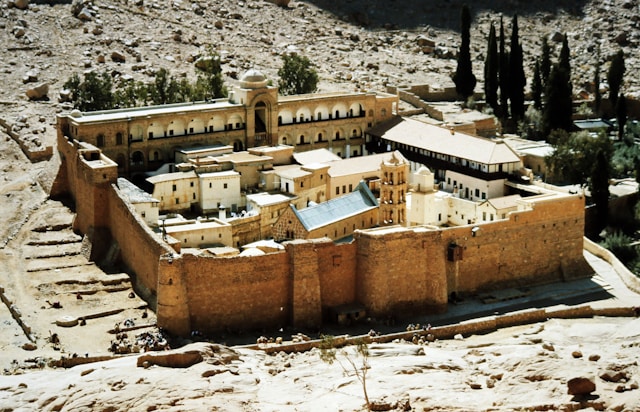
Located at the foot of Mount Sinai and built between AD 548 and 565 on the site believed to be where Moses encountered the biblical burning bush, the monastery has served as a spiritual refuge and pilgrimage site for Christians, Jews, and Muslims alike. Reputed for its unparalleled heritage, the site is affiliated with the Greek Orthodox Church and is listed as a UNESCO World Heritage Site.
Reports in Greek media claim that the court’s decision includes transferring the monastery’s assets to the Egyptian state and potentially evicting its resident monks — a move widely condemned by religious leaders and cultural preservationists.
Archbishop Ieronymos II, head of the Greek Orthodox Church, expressed “immense sorrow and justifiable anger” at the ruling. “This spiritual lighthouse of Orthodoxy and Hellenism is now facing a question of real survival,” he said, accusing Egyptian authorities of seizing sacred property.
The monastery, home to more than 3,300 manuscripts and 16,000 rare books, including the Codex Sinaiticus — one of the oldest biblical texts — is seen not only as a religious monument but also as a guardian of irreplaceable cultural heritage.
The Greek Ministry of Foreign Affairs has requested urgent clarification from Cairo, while international religious institutions prepare to rally in support of the monks. Greek Orthodox leaders say they will seek backing from Christian denominations and other monotheistic faiths to protect the monastery from state appropriation.
Although Egyptian authorities deny that the monastery is at risk, insisting it remains operational, longstanding tensions over its landholdings have simmered for years. A 2015 challenge by the then-governor of South Sinai questioned the monastery’s ownership of more than 70 properties, including gardens, guesthouses, and farmland — citing their lack of legal status under Egyptian law.
A tentative agreement between Greek and Egyptian officials to recognize the monastery’s property rights and integrate it into Egypt’s antiquities oversight has remained unfinalized.
President Abdel Fattah el-Sisi recently attempted to calm concerns during a visit by Greek Prime Minister Kyriakos Mitsotakis, reaffirming Egypt’s commitment to protecting the monastery. Yet the court’s decision appears to contradict those assurances.
The symbolic timing of the ruling — issued on May 29, the anniversary of the fall of Constantinople in 1453 — has further inflamed tensions, resonating deeply with the Orthodox Christian community.
St Catherine’s Monastery, enclosed by protective Byzantine walls, has withstood centuries of conquests, political change, and religious conflict without interruption. If carried through, the court decision could mark the first forced closure in its 1,475-year history — a moment mourned as much for its religious implications as for its cultural loss.