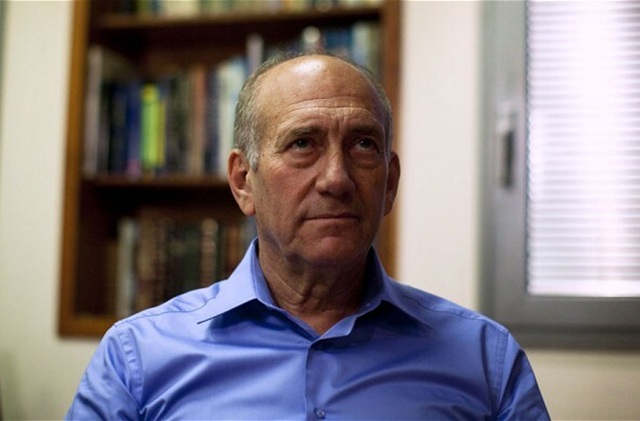
Ehud Olmert, Israel’s former prime minister, has told Times UK that only U.S. President Donald Trump possesses the influence and authority to achieve a two-state solution in Israel and Gaza, warning that his successor as prime minister, Benjamin Netanyahu, will eventually collapse under political pressures.
Speaking from his Tel Aviv office, Olmert, 80, stressed that the historic changes necessary to end the ongoing conflict in Gaza depend on stabilizing the fragile ceasefire and advancing Palestinian statehood. He highlighted Trump’s 20-point Gaza peace plan, recently ratified by the United Nations Security Council, as a unique opportunity to resolve a conflict that has eluded American presidents for decades.
“Netanyahu doesn’t dare say anything against Trump because he can’t afford to,” Olmert said. “Trump is now building momentum towards a Palestinian state as the only possible way to move forward. If Biden said what Trump said now, Bibi would have killed him.” Olmert argued that Netanyahu’s personal and political limitations, including a corruption trial and the challenges of holding together a coalition of ultranationalists, make him incapable of leading Israel toward a two-state solution.
Olmert, who served as prime minister from 2006 to 2009, described his own efforts to negotiate peace, including 36 sessions with Palestinian counterparts and a proposal for a demilitarized Palestinian state connected to Gaza. He said that, despite the ceasefire holding for now, both Hamas and elements within Israel threaten to undermine stability. “Hamas wants to break the ceasefire,” he said. “Bibi wants to break it so he will not have to follow up with all the other consequences.”
The former leader emphasized that Trump is uniquely positioned to steer the process due to his power, influence, and status in international politics. “No other world leader has the power, the means, the influence and the status,” Olmert said. He suggested regional leaders should appeal to Trump to advance Palestinian statehood, expanding the Abraham Accords from Saudi Arabia to the Emirates, Bahrain, and North Africa.
Olmert also reflected on the broader societal challenge, noting that Israelis must recognize the recurring cycles of violence and the need to create opportunities for peace. “There is only one alternative that can promise something else. And this is two states,” he said, underscoring the urgency of achieving a sustainable resolution in the region.