When a politician promises to give you something for nothing, they must first confiscate that wealth from you — either by direct taxes, indirect tax, or by inflationary pricing arising from more debt. ~ John Wayne.
Election time is a bonanza for the public’s hearing pleasure. Besides the carnival-like atmosphere, with one side attempting to outdo the other in crowd numbers and the extravagance that the country can scarcely afford — unless funded by sources with their own expectations in return — election promises are dished out to the resounding cheers of political rallies.
Past post-election experiences demonstrate that most election promises made on political platforms are either not kept or presented in watered-down forms. Election manifestos face a similar fate. In the current presidential election, the NPP has at least gone a step further and rightly termed its manifesto a social and economic contract between them and the public. However, this contract is not legally enforceable and remains a mere statement of intent, not much different from other political promises made at rallies or in the media. Ideally, if the NPP wished to distinguish itself, it could have stated that, should their candidate win the election, they would present their manifesto as a Parliamentary bill for approval by the newly elected Parliament. If passed, it would have given the manifesto legal status, enabling the public to seek legal redress if any item in it was not implemented by the government.
Other parties, including the SJB, the SLPP, and independent candidate incumbent President Ranil Wickremasinghe, are expected to release their formal manifestos. It is unlikely that these will differ significantly from past or present manifestos, as none of them will inform the public of how their promises will be funded without affecting other expenditure lines, raising new taxes, or increasing existing ones.
This raises questions about accountability, responsibility, and the duty of any presidential candidate to refrain from making untenable promises that are simply unaffordable and cannot be kept in the current economic climate. Fulfilling such promises could have severe consequences for the country’s economy, particularly as the manifestos do not specify any revenue-raising measures. The public needs to understand how these promises will be kept and how funds will be raised without impacting the country’s economy.
This is where an independent economic entity becomes crucial — to cost promises made by all candidates and present their findings to the public well before election day. This would foster a serious discussion about the feasibility of promises, their affordability, and their role in setting the stage for a better economic future for the country.
The country has endured very tough times, and thanks to the financial discipline imposed as a condition for IMF support, along with the agreed debt restructuring, Sri Lanka now has a four-year window to work towards becoming a more financially disciplined and stable nation. This opportunity is available to whomever becomes the next President. If the incumbent President wins, he could build on what he has already achieved. To President Wickremasinghe’s credit, he has consistently maintained that the country is not out of the woods yet, though it is no longer lost, as it was two years ago, not knowing what to do or which direction to go. When others failed to steer the leaking boat, he took over and guided it to relative safety.
The election provides an opportunity for other candidates to explain what they will do if elected and how they will find the resources to fulfil their promises. The culture of Sri Lankan elections has historically been about promises that raise voter expectations but deliver little of what was pledged. Some years ago, for instance, a promise was made that rice would be brought even from the Moon during a rice shortage in Sri Lanka.
The need for an independent economic entity to undertake the costing of election promises and assess their impact on the country’s economic situation has never been more critical. Sri Lanka has just emerged from bankruptcy and is on the path toward greater economic stability.
Although its foreign reserves, meagre compared to other countries in the region, are healthier than before, they are still less than 6% of its GDP. Tourism is flourishing, exports are increasing, foreign investment is on the rise (though not to the extent expected), and rupee income is improving. However, these gains are small compared to what is needed to provide a platform of stability and growth. Any potential winning candidate must show how they will strengthen this platform and leverage the opportunities available over the next four years.
Sri Lanka’s excessive debt, both foreign and domestic, and its recent bankruptcy experience are akin to a Sword of Damocles hanging over the country. This presents a real threat of future funding cuts unless the country manages its economy well and builds its own reserves. This cannot be achieved by making populist election promises that would further strain the country’s limited resources. Economic priorities should focus on investments that increase GDP, reduce debt, boost local and foreign earnings, and grow reserves while providing relief to those genuinely in hardship. These should be the top priorities for any presidential candidate.
While President Wickremasinghe has consistently stressed these priorities and invited others to formulate a national economic plan, many other candidates have offered populist promises that are not aligned with the essential economic priorities of the country.
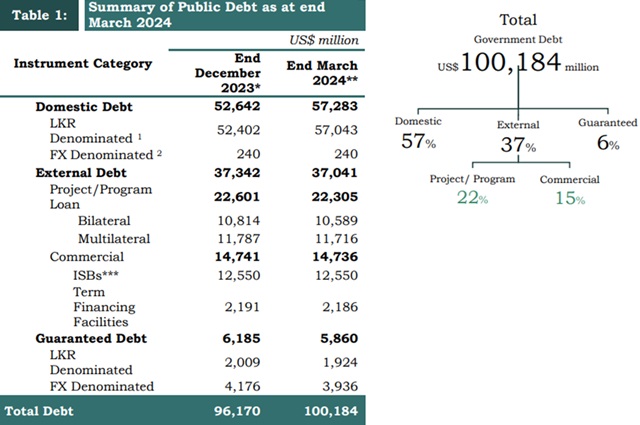
According to the Quarterly Debt Bulletin (2024 First Quarter), the debt summary as of March 2024 shows domestic debt comprising 57% of the total debt, with external debt making up 37%. The total government debt is USD 100.184 billion. With a GDP of USD 84.36 billion in 2023, this equates to a debt-to-GDP ratio of nearly 120%, meaning the country owes 20% more than its total economic output.
The Central Bank of Sri Lanka’s Annual Economic Review for 2023 reveals that the government spent LKR 5,357 billion (USD 17.83 billion), with LKR 2,456 billion (43%) allocated to interest payments on existing debt. The remaining government expenditure was funded through borrowings, increasing the total government debt and ultimately raising the interest burden.
The government has made progress, increasing its revenue to 10.2% of GDP in 2023, up from 8.4% in 2022. However, a report from Verité Research highlights a 14% shortfall in projected revenue for 2024, a concerning trend given the existing debt and expenditure pressures.
Election promises must, therefore, take into account the Central Bank’s debt analysis and the projected revenue shortfall. If the country’s revenue drops, Sri Lanka will be forced to borrow more, exacerbating the debt cycle. Future generations will bear the consequences of this short-sightedness.
Election manifestos should be more realistic, accountable, and affordable. They should become a legally binding social contract through an Act of Parliament. This Act should establish an independent body to cost election promises, monitor their implementation, and submit periodic reports to Parliament. The public, entering into a contract with a victorious President and government, should then be able to hold them accountable through the courts if they fail to uphold the contract.