by Nil
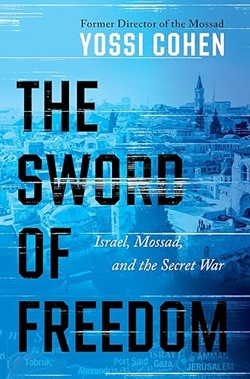
Yossi Cohen’s The Sword of Freedom is far more than an intelligence memoir; it is an erudite dissection of geopolitics, a meditation on destiny, and a confessional reflection on the costs of vigilance. The book is written with the sinewy authority of a man who has lived not at the margins of power but at its volatile epicentre. Cohen, the former director of Mossad and national security adviser, writes with the temperament of a philosopher and the discipline of a spymaster, refusing the cheap consolations of myth or melodrama. From its opening epigraph — Ze’ev Jabotinsky’s assertion that “only an iron wall of Jewish force can guarantee the security of the Jewish settlement in the Land of Israel” — the work announces itself as an austere reckoning with the realpolitik of survival.
The introduction alone is a statement of intent, beginning with the assertion: “Modern wars no longer end in absolute victory or abject surrender, yet the state of Israel must win any conflict it enters.” This is not mere rhetoric but a framing device that governs the book’s intellectual thrust. Cohen situates Israel’s predicament within an unbroken continuum of vulnerability, invoking the two thousand years of dispossession and massacre endured by the Jewish people — “our lands were confiscated and conquered by so many enemies … the slaughter of six million Jews in the Second World War was the largest Holocaust, but not the first one.” This insistence on existential stakes gives the book a solemn gravity. Cohen does not permit the reader to view intelligence work as mere chess-playing; it is an enterprise tethered to survival itself.
What distinguishes Cohen’s narrative from other memoirs of the security establishment is its philosophical self-awareness. He insists that espionage is as much a moral crucible as it is a technical discipline. “I have a Mossad gene in my body,” he writes. “Self-sufficiency, ingenuity, and emotional intelligence are tested almost to the point of destruction from the earliest days of training.” This is not the language of bureaucratic manuals but of an ascetic describing initiation rites. Tutors, he notes, “challenge you, confront you, do anything they can to disorient or unbalance you.” The purpose is not merely skill acquisition but character refinement — the forging of an operative capable of entering the adversary’s mind, “insinuat[ing] ourselves into the minds of our enemies” and planning “assiduously, over the long term.”
The book is replete with vivid accounts of strategic operations that read with the tautness of a thriller yet retain a documentary integrity. The operation to exfiltrate Iran’s nuclear archive in 2018 is perhaps the book’s centrepiece, a capstone of Cohen’s tenure at Mossad. He recalls how colleagues doubted the feasibility of stealing an entire state archive from the heart of Tehran, but he insisted: “They must never be trusted again.” His faith in meticulous planning and audacious execution paid off, as the mission both exposed Iran’s duplicity and galvanised international opinion. What is striking is Cohen’s refusal to bask in triumphalism. Instead, he frames the episode as an exemplar of the intelligence ethos: patience, courage, lateral thinking. “There is no eureka moment in intelligence,” he reminds us. “It doesn’t happen that way. Instinct may say a particular piece of evidence is a game changer, but it is not that simple.”
The October 7 Hamas attack forms the book’s emotional and moral fulcrum. Cohen spares the reader neither the horror nor the shame. “Our darkest hour was just before dawn … several thousand Hamas terrorists broke through the border fence … Their intent was murderous, their methods depraved, their impact catastrophic.” His prose here is almost cinematic in its clarity, yet it avoids sensationalism. He subjects Israel’s intelligence community to an unsparing audit: “There was complacency where there should have been coordinated contingency planning, coziness where there should have been wariness, indecisiveness where there should have been urgency.” These are words sharpened on the whetstone of grief and fury, but they are also an appeal for institutional humility. Cohen repeatedly invokes what he calls “the mirror test” — the moral obligation to stand naked before one’s conscience and admit failure.
This moral seriousness sets Cohen apart from both political partisans and intelligence chroniclers who write merely to vindicate their own records. He praises acts of courage by individual soldiers yet refuses to exonerate the systemic lapses that permitted October 7 to happen. “Ignorance and inaction were inexcusable. Knowledge is power. God forbid that I would not know what runners from a particular terrorist group were planning for our embassies abroad.” The tone here is almost prophetic, calling down judgment on complacency while reaffirming the sacred duty to know.
Throughout the memoir, Cohen insists that intelligence is as much about human nature as about data. “For every one of us who feels a little ill but carries on regardless, there is another who heads for the intensive-care unit … Same story, different responses.” This insistence on the human factor lends the work psychological depth. He is candid about his management style, his refusal to form close friendships within Mossad to preserve the clarity of judgment: “I could have coffee with staff members … but I could also shout at them, criticise their work, even fire them if necessary. There was no emotional contagion.” This is a portrait of leadership as lonely stewardship, a theme that recurs with an almost tragic regularity.
Cohen’s narrative is also distinguished by its diplomatic insight. His recollections of working with global leaders are neither gossip nor mere anecdote; they are miniature studies in the calculus of power. Of Vladimir Putin he writes: “He is a masterly geopolitician, a deeply strategic thinker, and natural leader.” Of Mohammed bin Salman he says: “I have great faith in MBS as a pivotal figure in the region … he has the potential to personify an era-defining shift in emphasis and expectation.” Such assessments are not hagiographic but measured, and they reveal Cohen’s conviction that Israel’s survival depends on cultivating unlikely alliances. The Abraham Accords receive particular emphasis, described as a “tangible legacy” of patient, clandestine diplomacy that demonstrated the capacity for Arab and Jewish leaders to reshape the region’s trajectory.
The journalistic power of the book lies in its refusal to dilute its arguments for the sake of international opinion. Cohen does not pander to the shibboleths of Western diplomacy. He calls Hamas’s October 7 atrocities “evil beyond comprehension” and dismisses the idea that such acts could advance Palestinian aspirations: “What did they gain from massacring 2,000 Israeli citizens … precisely nothing.” At the same time, he laments Israel’s failure to communicate effectively with the global public, noting that “for every pro-Israeli video on TikTok, there were fifty-four carrying the #freepalestine hashtag.” This media critique is penetrating, highlighting the new theatre of war — the battle for narrative dominance.
Where the book achieves its highest register is in its philosophical and historical reflections. Cohen situates Israel not merely as a state but as a vessel of collective memory, a defiant experiment in continuity after millennia of dispersal. “It is a kind of miracle we have survived as a people,” he writes, before celebrating “this beautiful creation, the state of Israel.” This is not the rhetoric of nationalism for its own sake but an articulation of metaphysical responsibility — Israel as a project of history itself. The book’s title becomes especially resonant in its conclusion: “Israel was not created in order to disappear … it honours the sword of freedom.” The phrase evokes a nation that must hold the sword not for conquest but for the preservation of its own breathing space in history.
Cohen’s style is not florid, but it is sophisticated, woven with uncommon diction and a journalistic rhythm that keeps the reader riveted. He does not sentimentalise war, but neither does he shy from its pathos. Describing the release of gaunt, traumatised hostages, he writes that their condition “summoned uniquely painful images of the past,” a subtle invocation of Holocaust memory without descending into cliché. His vocabulary is precise, his cadences controlled, lending the book a tone that is both elegiac and steely.
If there is a fault to be found, it may lie in Cohen’s unyielding confidence in Israel’s military and intelligence apparatus as the ultimate guarantor of security. He insists that “the only solution lies in our right of worship and our entitlement to build our own nation, without being subordinate to others,” a statement that, while stirring, offers little space for Palestinian narratives of dignity beyond the imperative to renounce violence. Yet even this limitation is revealing — it is the limitation of a man tasked with the brutal duty of safeguarding a nation in extremis, not that of a detached academic theorist.
In its totality, The Sword of Freedom is an intellectual and emotional gauntlet thrown before the reader. It demands engagement not only with the facts of Israel’s security dilemmas but with the ethical architecture that undergirds them. Cohen has produced a memoir that is as morally intricate as it is narratively compelling, one that marries the immediacy of journalism with the profundity of philosophy. It is a book that does not flinch, that stares unblinking into the abyss of violence, fanaticism, and human frailty, yet emerges with a defiant affirmation of life and liberty. For scholars of intelligence, for readers of history, and for anyone concerned with the fateful entanglements of power and morality, Cohen’s work is not just recommended but necessary. It is an artefact of our age, one that will be read long after the particular crises it recounts have faded, because it speaks to the perennial question that haunts every nation: how far must we go, and what must we sacrifice, to remain free?