
by Satchi
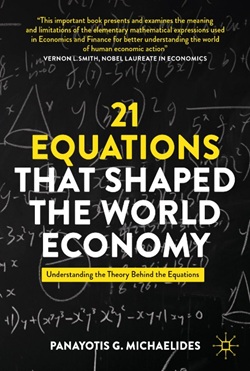
Panayotis G. Michaelides’ 21 Equations That Shaped the World Economy stands as a monumental endeavour to elucidate the profound role of mathematical formulations in economic thought. A work of precision and scholarly depth, this book masterfully explores how the world economy has been influenced by pivotal equations spanning centuries.
Michaelides, an esteemed scholar, offers a robust intellectual journey that delves into the interplay between mathematical theory and economic phenomena. His meticulous research illuminates the transformative power of equations, as he writes, “Equations illuminate the complexities of economic and financial dynamics, casting light on both visible and often concealed forces driving economic progress” (p. xxi). This book, therefore, serves as both a primer for novices and a refined treatise for seasoned economists.
The Essence of Mathematics in Economic Discourse
The author begins by grounding the reader in the philosophical underpinnings of equations as not merely tools but as “silent architects of our economic and financial systems” (p. xxii). By contextualising each equation historically and analytically, the narrative goes beyond mathematics to address their societal and policy implications. The discourse on the Compound Interest Formula—“a dynamic force that defies the linear nature of time” (p. 1)—sets the stage for the exploration of exponential growth and financial prudence.
Subsequent chapters explore diverse topics such as the Nash Equilibrium, Phillips Curve, and Black-Scholes Formula, each meticulously unpacked in its theoretical context and its tangible influence on economic policies. Michaelides’ analytical lens reveals the duality of equations: as tools of clarity and instruments of critique. As he notes, “equations… often rest on assumptions and simplifications that may not accurately capture the multifaceted reality of economic and financial interactions” (p. xxiii).
Inclusivity through Accessibility
One of the book’s notable achievements is its accessibility. While mathematical foundations are firmly present, Michaelides employs lucid explanations that make advanced concepts approachable. He acknowledges the intimidating aura of economic science, advocating for “a language that bridges the gap between experts and individuals from various backgrounds” (p. x). This inclusivity reflects his dedication to fostering interdisciplinary discourse.
The Mathematical Appendix in Chapter 23 and the illustrative examples, such as the detailed derivations of simple and compound interest, serve as gateways for readers unfamiliar with pre-university mathematics. For example, Michaelides contrasts simple and compound interest with an example that starkly illustrates the exponential difference: “With simple interest, a $1,000 investment at 5% over three years grows to $1,150, whereas compound interest achieves $1,157.63, amplifying returns” (p. 7).
Critique and Intellectual Depth
Michaelides does not shy away from critiquing the limitations of equation-centric economic thought. For instance, his treatment of the Normal Distribution addresses its inability to account for “fat tails” and the frequency of extreme events, such as financial crises, which occur more often than Gaussian models predict (p. 25). This reflection on inherent biases in equations lends the book a critical depth, reminding readers that mathematical elegance must not overshadow economic realities.
Moreover, his exploration of Chaos Theory highlights the unpredictability of economic systems, providing a counterpoint to deterministic models. The author writes, “Economic relationships often exhibit nonlinear patterns and non-constant variance, rendering traditional equations inadequate for capturing emergent complexities” (p. xxiii).
A Work of Historical and Contemporary Relevance
The historical breadth of the text—from the Code of Hammurabi’s early interest rate practices to the mathematical sophistication of modern finance—imbues the narrative with a timeless quality. Michaelides situates each equation within its historical epoch, offering context that enriches its relevance today.
The author’s reflections on monetary policies are particularly engaging, noting how central banks employ equations like the Fisher Equation and the Solow Growth Model to navigate inflationary pressures and long-term growth strategies. He astutely observes, “Interest rates are the not-so-‘invisible hands’ shaping the trajectory of economies” (p. 10).
Conclusion
21 Equations That Shaped the World Economy is a triumph in academic writing. Michaelides not only demystifies equations but also inspires readers to appreciate their intricate beauty and impact. With a balanced approach that blends historical context, mathematical rigour, and critical insight, the book becomes a touchstone for anyone seeking to understand the symbiotic relationship between mathematics and economic science.
For scholars and enthusiasts alike, this work is indispensable, embodying the author’s assertion that equations are “the compasses that guide policy decisions and the mirrors that reflect human behaviour” (p. xxii).