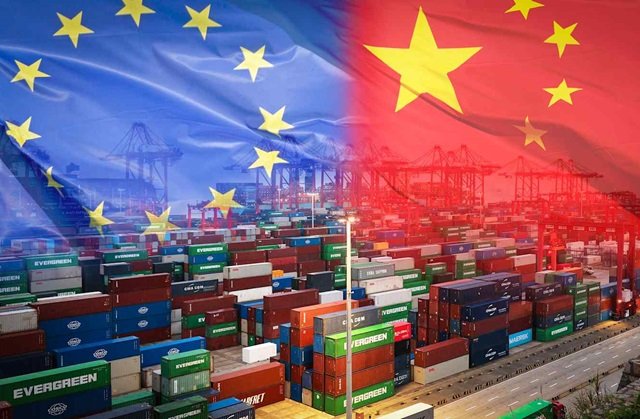
The European Union and China have marked October as a crucial point in their trade relationship. Negotiations are under way, and Brussels wants to see “tangible results” by then to begin addressing the major imbalances in trade with the Asian economic giant. The deficit between European exports and imports exceeded €370 billion in 2025 and is expected to grow further this year at the current pace.
The European Commission continues to insist that negotiation and agreement remain its priority. “It is an opportunity to strengthen this relationship through commitment and dialogue to make it fairer and more balanced,” a Commission spokesperson said. “But if dialogue fails, we will act.”
That warning reflects a gradual change in the European approach to China. A source within the EU institutions said there was now less resistance to taking measures against Beijing. Behind the shift are concerns over the scale of Chinese state support for industry. An International Monetary Fund report from late 2025 put Chinese subsidies at 4.5% of gross domestic product, compared with 2.2% in the EU. An OECD report published in June, including subsidies, tax deductions and cheap loans, found that Beijing provides between three and eight times more support depending on the industrial activity.
A 2025 Goldman Sachs report also estimated that China’s currency was artificially undervalued by around 25%, making Chinese exports cheaper and imports more expensive.
Against this backdrop, the Commission is preparing contingency measures should negotiations fail. They form part of a broader economic security strategy that already includes proposals to limit Chinese investment and require technology transfers, as well as measures due in September to give European companies greater preference in public procurement.
The first line of action would involve using existing legal instruments compatible with World Trade Organisation rules. These include anti-dumping and anti-subsidy investigations, such as the process launched in 2023 that eventually resulted in additional tariffs on Chinese electric vehicles, as well as safeguard measures that can be activated when large increases in imports of specific products distort the internal market.
EU member states broadly agree that existing instruments should be used before creating new ones. “Before activating new instruments, we should systematically use those we already have,” a veteran EU diplomat said. But this approach has limitations. Safeguard measures cannot legally discriminate between countries, meaning they could affect trading partners such as South Korea, Canada and Japan with whom the EU maintains more balanced relationships.
There is also the sheer scale of existing investigations involving China. The Commission opened 79 such investigations in 2022, 82 in 2023 and 85 in 2024, accounting for almost 60% of all investigations launched.
Brussels is therefore considering two new legal mechanisms. The first would seek to diversify the sources of supply for critical parts of European value chains. The proposal follows Commission President Ursula von der Leyen’s long-standing principle of “derisking, no decoupling”: reducing excessive dependence on Chinese supplies without seeking to eliminate them altogether.
The measure could oblige or encourage companies, sectors and countries to diversify their suppliers. Although it would not explicitly target China, its impact would be significant because of Beijing’s dominant position in some critical parts of global supply chains.
The second proposal would establish a compensation fund or mechanism to help countries or sectors disproportionately affected by Chinese retaliation. Three EU sources said the aim would be to preserve internal cohesion through solidarity among member states.
The Commission is aware that some governments remain reluctant to take tougher measures against Beijing because of the potential economic consequences. Spain is described as probably the most resistant. The proposed compensation mechanism is intended to address those concerns and draws on an approach previously used during difficult negotiations such as Brexit. Details remain limited, and the presentation of the new legal instruments has been delayed until the end of the year.
The Commission has nevertheless signalled that Europe intends to make greater use of the tools already available. Von der Leyen said in June that the EU would continue protecting its market against unfair practices and should use the instruments created in recent years “more proactively”. The German Government has also indicated support for expanding Europe’s defensive arsenal, including a new diversification instrument.
Jakob F. Kirkegaard, a researcher at Bruegel, said achieving tangible results by October would be difficult because China was likely to respond aggressively. Beijing has the capacity to retaliate through critical minerals and other measures, he said, pointing to its immediate response after the EU sanctioned 14 Chinese companies over links to Russia.
Sander Tordoir, chief economist at the Centre for European Reform, described many of the proposed measures as sensible reforms but warned they would matter only if the EU was prepared to use them. He argued that Beijing was employing a delaying strategy while expanding its market share and creating European dependence on cheaper Chinese products.
The debate is increasingly affecting major European industries. Reports on the impact of Chinese manufacturing exports on Germany and concerns over the future of the automobile sector have contributed to significant changes in Berlin’s position. Volkswagen’s chief executive, whose company has substantial investments in China, has even called for tariffs on Chinese plug-in hybrid vehicles, marking a sharp departure from the position taken only two years ago when additional duties were imposed on electric vehicles.
Tordoir believes the EU could ultimately benefit from a broader instrument modelled on the United States’ Section 301, which allows Washington to investigate a wide range of foreign practices considered discriminatory, including those that do not strictly violate WTO jurisprudence. But the experience of the Donald Trump administration has also demonstrated how such a tool can be used arbitrarily.
With October approaching, Brussels is therefore pursuing two tracks simultaneously: keeping negotiations with Beijing alive while preparing mechanisms to protect European industries and compensate member states if the talks fail. The outcome could determine whether the EU’s increasingly assertive economic approach towards China develops into a wider trade confrontation.