More than 100 million Europeans experienced temperatures above 35°C on Thursday as a severe heatwave swept across the continent, with authorities in several countries reporting deaths and rising pressure on health services.
At least 101 million people were exposed to extreme heat, according to calculations based on forecasts from the German weather service and 2025 population projections from the European Joint Research Centre. More than 380 million people were expected to face temperatures above 30°C.
Spain and France, among the countries most affected, began assessing the impact of the heatwave as temperatures reached record levels. In Spain, the MoMo mortality monitoring system reported that 212 deaths between Sunday and Wednesday could be linked to the heat.
In northern France, three deaths in the Pas-de-Calais region were considered “likely” to have been caused by extreme temperatures. French prosecutors also said a three-year-old boy was found dead inside a car in the Paris suburbs, where temperatures exceeded 40°C on Wednesday. Two other children died in similar circumstances in France during the same week.
The United Nations climate chief Simon Stiell said the heatwave, intensified by buildings and infrastructure not designed for such temperatures, showed the impact of the climate crisis. He said extreme heat would continue to worsen until global reliance on coal, oil and gas was reduced.
Samantha Burgess, deputy director of the European Union’s Copernicus Climate Change Service, attributed the hot conditions to a “heat dome” caused by trapped air from North Africa within a low-pressure high-pressure system that prevented cooler air from moving into the region. She said that while heat domes were natural weather events, human-caused climate change was making heatwaves more severe and increasing the likelihood of record temperatures.
In France, authorities introduced measures to reduce pressure on hospitals affected by the health consequences of the heat. Paris banned public alcohol consumption and sales from Friday, while Paris police prefect Patrice Faure said hospital facilities were reaching a “saturation point” as admissions continued to rise.
Health Minister Stephanie Rist’s office said Paris recorded 25 cardiac arrests within 24 hours on Wednesday, compared with fewer than 10 on average. Nationwide, officials reported a four-fold increase in emergency room visits linked to heat-related conditions.
The heatwave also disrupted daily life and public services across Europe. In Italy, courts in Palermo, Sicily, suspended non-urgent hearings until June 29 because of air-conditioning failures. Italian newspaper Corriere della Sera reported five heat-related deaths, including two farmworkers and a builder.
The Netherlands issued its first-ever red alert for heat, warning residents of dangerous conditions as some areas were forecast to approach 40°C. In Germany, where temperatures reached the high 30s and were expected to continue rising, outdoor events were cancelled, while rail operator Deutsche Bahn warned passengers of possible disruptions caused by wildfires, heavy rain and thunderstorms.
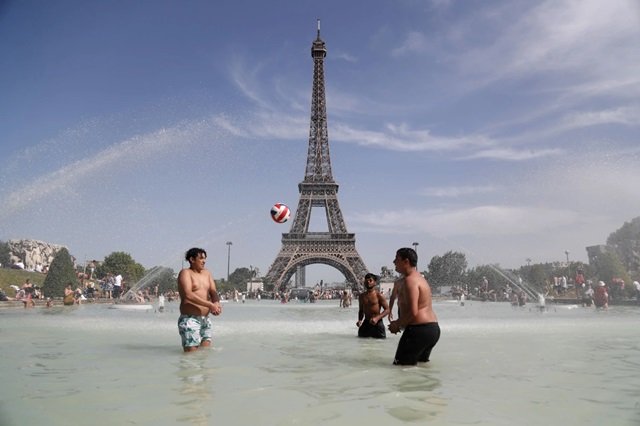
Residents across affected cities sought ways to escape the heat. In Paris, people slept outdoors in Buttes-Chaumont park, while others gathered at the Canal Saint-Martin after authorities allowed swimming there due to the extreme temperatures.
The impact of the heat was also felt in the United Kingdom, which recorded its hottest June day on Thursday, with temperatures reaching 36.7°C in the southwest. London’s ambulance service reported its highest number of life-threatening emergency calls in a single day due to extreme heat, responding to 642 category-one calls on Wednesday.
Temperatures were expected to ease in western Europe from Friday, but eastern Europe remained under red alerts as extreme heat continued into the weekend.