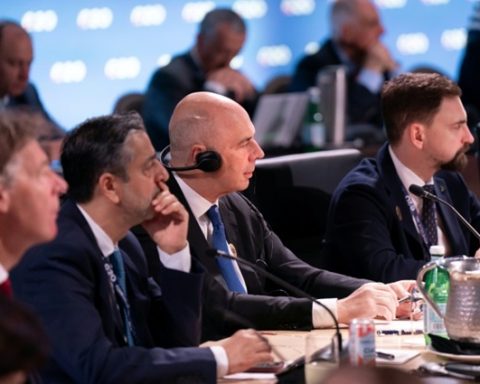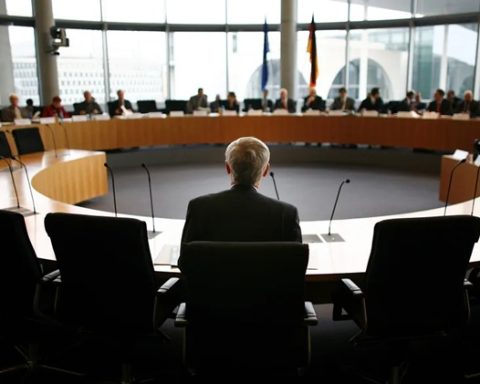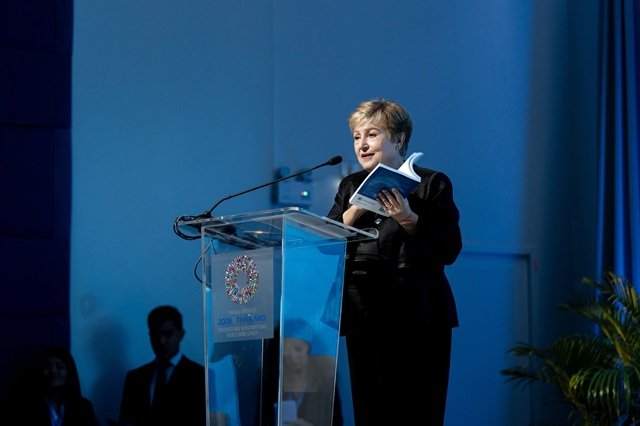
Nearly a dozen delegates walked out of a meeting of the International Monetary Fund’s steering committee on Saturday as Russian Finance Minister Anton Siluanov addressed the group in Russian, underscoring persistent divisions over Moscow’s role in international institutions more than four years after its full-scale invasion of Ukraine.
Three sources familiar with the matter told Reuters that several delegations left the meeting, including representatives of European Union member states. One source said many delegations had walked out, while a second official who was present put the number of departing delegates at nearly a dozen.
Delegates from Denmark, Sweden, Finland, Norway, Lithuania, Latvia and Estonia were among those who left the room, according to the official.
“The Ukraine war is existential for us in Europe,” one European diplomat told Reuters. “We cannot normalize relations with Russia.”
Russia’s invasion of Ukraine in February 2022 has repeatedly disrupted the work of the IMF’s International Monetary and Financial Committee, preventing it from issuing consensus statements in the years since the conflict began. The latest confrontation came during the annual meetings of the IMF and World Bank in Bangkok, where disagreements over Russia’s international participation coincided with renewed tensions between Washington and Kyiv.
The walkout reflects a broader dispute over whether engagement with Moscow should be maintained as a means of resolving international crises or resisted as a step towards normalising relations with a country continuing to wage war against Ukraine.
Germany warned on Thursday against attempts to bring Russia back onto the international stage after Siluanov attended a meeting of G20 finance ministers and central bank governors. His participation came just over a month after the United States hosted his first in-person G20 appearance since the invasion, at a meeting in Asheville, North Carolina.
Washington has defended Russia’s participation in international forums despite objections from European governments. US Treasury Undersecretary Erin Browne told Reuters on Thursday that the United States, which currently leads the G20, supported Moscow’s presence.
“We think it’s really important if you’re going to solve a crisis, you need to have open dialogue and open conversation,” Browne said. “And you can’t have … dialogue, and you can’t have resolution to conflict if no one’s talking to one another.”
The contrasting positions expose a continuing divide between the US approach, which emphasises communication as a prerequisite for resolving crises, and European concerns that renewed engagement could lend legitimacy to Russia while the war continues.
The dispute is unfolding against a difficult backdrop for Ukraine, as Russian missile and drone attacks continue to hit Ukrainian cities and Kyiv faces uncertainty over the future of US intelligence-sharing and military assistance.
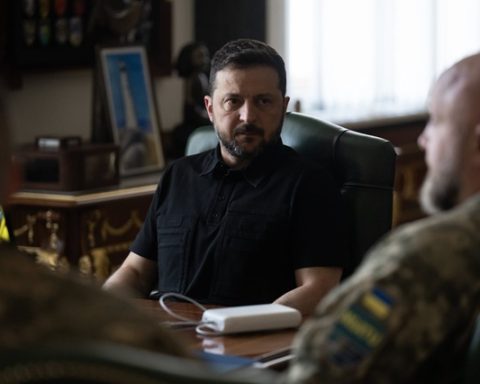
Ukrainian President Volodymyr Zelenskiy criticised US President Donald Trump’s diesel deal with Russia while addressing a European Union summit on Friday. He also welcomed the prospect of European allies taking a greater role in peace negotiations.
EU leaders rallied behind Zelenskiy after Trump again criticised Ukraine, describing its strikes on Russian oil refineries as a “disgrace”. The exchange highlighted growing friction between Washington and Kyiv over how to pursue an end to the war and the role Ukraine’s military operations should play in negotiations.
For European governments, the prospect of restoring Russia’s place in international forums remains closely tied to the conflict and its consequences for European security. The walkout at the IMF meeting demonstrated that, despite continued calls for dialogue from Washington, Moscow’s participation remains contentious among countries that view the war as a direct and enduring threat.