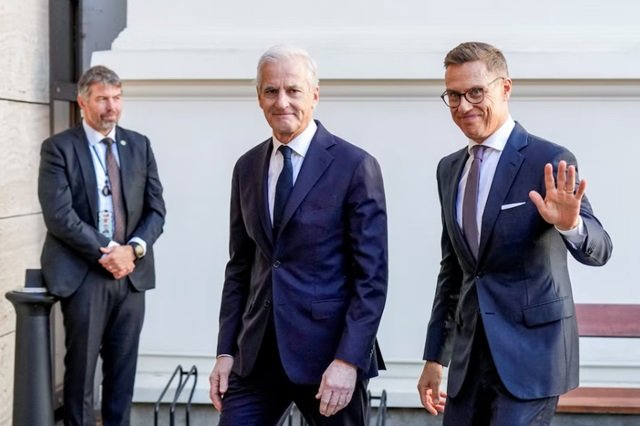
The leaders of Finland and Norway held a rare direct conversation with Russian President Vladimir Putin on Tuesday, urging him to end the war in Ukraine and seeking to influence peace efforts from which European governments have largely been sidelined.
Finnish President Alexander Stubb and Norwegian Prime Minister Jonas Gahr Stoere spoke to Putin for about 90 minutes before holding a separate conversation with Ukrainian President Volodymyr Zelenskiy, Stoere said. The initiative came amid changes in US President Donald Trump’s approach to the conflict and ahead of planned peace discussions involving Russian, Ukrainian and US officials in Abu Dhabi next month.
The talks would be the first such discussions since February. However, Moscow and Kyiv remain far apart over the terms of a settlement to the war, which began with Russia’s full-scale invasion in February 2022. Long-range attacks by both sides have intensified this year, while the front lines have remained largely unchanged.
Stubb said the discussions with Putin had been frank and substantive, arguing that Finland and Norway had a direct interest in ending the conflict because of their proximity to Russia and the implications for European security.
“Ending the war requires direct discussions,” he said.
Stoere said the two leaders had stressed the importance of de-escalation while maintaining strong support for Ukraine. Stubb later told Finnish journalists that Western allies had been consulted and that Ukraine had sought to establish a new channel of communication.
He argued that Europe could no longer remain a bystander in peace efforts by refusing direct contact with Moscow.
The initiative marked a departure from the approach adopted by most Western European leaders since Russia invaded Ukraine, when they largely avoided direct conversations with Putin in an effort to isolate the Kremlin. European governments have also found themselves marginalised as Trump pursues his own diplomatic approach, which many European capitals regard as unpredictable and potentially favourable to Moscow.
Recent developments have intensified those concerns. Putin agreed this month to supply Russian diesel to the United States, while Trump eased sanctions on Russia. Ukraine has also complained about disruptions to US intelligence-sharing and satellite internet services used by its military.
Despite the Nordic leaders’ intervention, the Kremlin gave no indication that Putin was prepared to soften his demands. Its account of the conversation said a lasting peace was possible only if Russia’s interests were fully taken into account, while accusing European Union and NATO countries of pursuing confrontational policies that prolonged the fighting.
Russian Foreign Minister Sergei Lavrov said the call had offered nothing new on the conflict and suggested European countries were seeking to secure a role in negotiations. An Austrian political analyst, Gerhard Mangott, described the initiative as an attempt to establish a dialogue channel after European governments had manoeuvred themselves into a diplomatic dead end.
Mangott also pointed to recent remarks by Kremlin aide Yuri Ushakov suggesting that Europe should participate in discussions, interpreting them as a possible shift from Moscow’s previous opposition to European involvement in negotiations.
Ukraine welcomed the initiative. Foreign Minister Andrii Sybiha said the call had been coordinated with Kyiv and described it as the right approach. He also expressed hope that a local ceasefire around the Russian-occupied town of Oleshky could help create conditions for further progress.
Other European leaders were more sceptical. Danish Prime Minister Mette Frederiksen said she saw no evidence that Russia wanted peace and urged European governments to remain united rather than pursue separate initiatives. Swedish Prime Minister Ulf Kristersson said other European leaders had not been informed of the talks and expressed low expectations of such conversations. Polish Prime Minister Donald Tusk urged Stubb and Stoere to exercise caution.
The Finnish and Norwegian leaders said they had acted on behalf of their own countries, not Europe as a whole, while maintaining that they had consulted their partners thoroughly.
A source close to the Kremlin said Putin had welcomed European involvement but insisted that any settlement must reflect “the realities on the ground”. The source interpreted that position as meaning Russia would not abandon its aim of capturing the whole of Ukraine’s Donbas region, while the Nordic leaders had insisted that any agreement must deliver a just peace.