A remarkable archaeological discovery in Austria is forcing a reassessment of the scale of Iron Age iron production and trade in Central Europe. The findings, reported in Antiquity, the international, peer-reviewed journal of world archaeology, concern more than 500 forged iron bars recovered from the Danube at Deinham in Upper Austria. The research, by Peter Trebsche of the University of Innsbruck and Marion Berranger of the Université de Technologie de Belfort Montbéliard, presents the assemblage as the largest mass find of prehistoric iron bars yet identified in Europe.
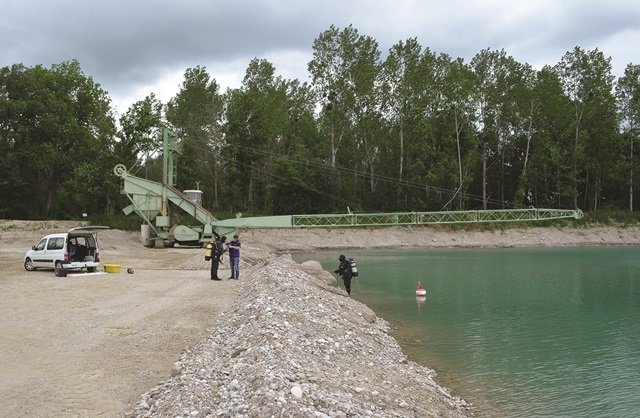
The discovery began in spring 2019, when workers extracting gravel at Deinham, in the municipality of Hartkirchen an der Donau in the district of Eferding, noticed numerous double-pointed iron objects being lifted by an excavator. The material was reported to the Federal Monuments Office, triggering the recovery and investigation of what would become an extraordinary Iron Age cargo. Because the gravel extraction had already destroyed the original archaeological context, which lay beneath the Danube’s water level, researchers had to reconstruct the circumstances of the deposit from the surviving material and the river environment.
The scale of the discovery is striking. A total of 540 fragments were recovered, which the researchers matched into 519 inventory numbers. On the basis of the more than half-preserved specimens, they established a minimum of exactly 500 bars. Of these, 193 were complete. The complete examples averaged 285mm in length, ranging from 222mm to 368mm, while their average weight was approximately 2.07kg. The preserved material weighed 1,065kg including gravel adhering to the iron, while the original iron content was estimated at about 1,035kg.
The objects are not conventional cast ingots. They are forged iron semi-products, made in a distinctive double-pointed or bipyramidal form. The researchers identify a previously unrecognised variant, designated BLD6, characterised by a regular rectangular cross-section and one flat end. Comparable examples have been identified at Manching, Maximiliansfelsen near Auerbach, Hohe Birga in Birgitz and Tiefenau near Bern. Their characteristics distinguish them from the much heavier and shorter Colmar-type iron semi-products known further west and dating to considerably earlier periods.
Scientific dating further strengthens the case for a Late Iron Age cargo. Researchers extracted carbon from the metallic iron and subjected it to accelerator mass spectrometry. The radiocarbon results produced ranges extending broadly from the fourth to the second centuries BC, with probability peaks in the second half of the fourth century BC and around the end of the third and second centuries BC. The latter fits the archaeological dating of comparable BLD6 examples. The discovery therefore provides evidence for a period when iron production in the Danube region was expanding substantially.
The river itself may explain why such an enormous quantity of iron came to rest at Deinham. The site lies on the right bank of the Danube, where the river enters the broad Eferding Basin. Before nineteenth-century regulation, this section contained braided channels, sandbanks and large stones that obstructed navigation. The archaeological evidence and the location strongly point towards a riverine loss rather than an ordinary terrestrial deposit. The researchers argue that the most plausible explanation is that the bars formed part of a ship’s cargo that sank and could not be recovered.
That interpretation has wider economic implications. A single tonne of iron represents a remarkable quantity of material for the Late Iron Age. It could have produced roughly 500 swords, assuming an average sword weight of 1.5–2kg and allowing for production losses. Alternatively, it could have produced as many as 8,000 iron nails weighing approximately 125g each. The researchers calculate that the latter quantity would have been enough to make almost half the wooden framework of the approximately 7km murus Gallicus defensive wall at Manching.
The comparison becomes even more striking at nearby Gründberg in Linz, the closest oppidum to Deinham on the Danube, about 29km to the east. Four iron deposits incorporated into the defensive wall there contain a combined total of only about 60kg. The Deinham cargo therefore contained more than 17 times as much iron as those deposits combined.
The researchers also place the cargo within the emerging monetary economy of the Late Iron Age. Celtic coinage appeared in the Bavarian and Upper Austrian Danube region around the Middle La Tène period, during the second century BC, making large economic transactions increasingly possible. The 443 gold coins weighing 3.7kg discovered at Manching, and the 384 gold coins from Großbissendorf, demonstrate the existence of substantial concentrations of wealth. The authors suggest that a tonne of iron may plausibly have represented an economic value comparable with such large coin hoards, although the exact exchange value cannot be established.
The likely origin of the iron lies upstream. Eastern Austrian iron-producing areas can be ruled out because they lie downstream from Deinham. Instead, the researchers identify Bavaria as the most plausible production zone, particularly the area between Manching, Kelheim and the Upper Palatinate, where comparable BLD6 bars have already been found. Kelheim lies about 220km upstream by river. Trace-element analyses are now being undertaken to determine whether the Deinham iron can be linked to particular ore sources.
What makes the discovery especially significant is not simply its size, but what it reveals about organisation. Earlier archaeological evidence has already indicated a rise in iron production during the third century BC and a further increase in the second century BC. The Deinham cargo provides unusually direct evidence that this production could generate more than a tonne of semi-finished iron that could be assembled into a single consignment and transported along one of Central Europe’s major waterways.
The research published in Antiquity therefore turns an apparently simple river find into evidence for a much larger economic system. Somewhere upstream, iron was extracted, smelted and forged; hundreds of semi-products were assembled; a cargo weighing more than a tonne was loaded for transport; and the material entered an exchange system whose scale is only now becoming visible. What sank in the Danube may consequently be one of the clearest surviving traces of how large-scale iron production and long-distance trade were becoming possible in Late Iron Age Europe.