

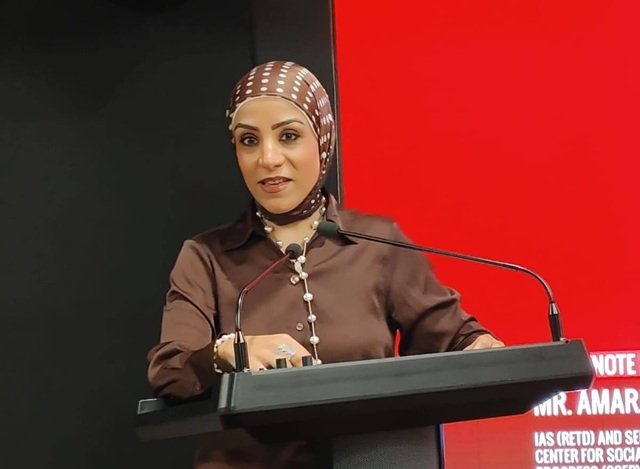
Is the Global South merely a relic of postcolonial discourse, or does it retain analytical potency? Are these nations passive victims of systemic inequities, or do domestic choices exacerbate their vulnerabilities? These were the incisive provocations posed by Prof. (Dr.) Hebatallah Adam, whose reflections challenge conventional binaries in development scholarship.
In our discussion, she emphasized that the Global South remains an indispensable conceptual apparatus: “It helps us in understanding the shared structural limitations and common geopolitical interests, particularly as countries in the South are becoming more aligned through such organizations and regional initiatives as BRICS.” Yet she simultaneously acknowledged the pitfalls of homogenization, cautioning that while systemic inequities unify the South analytically, its internal heterogeneity cannot be disregarded. On the asymmetries of crises, she noted, “The Global South is not made to be the victim of global crises, but the global system is designed in such a manner that adjustment costs are always transferred on it,” highlighting the structural externalities that disproportionately penalize less powerful economies.
Prof. Adam’s intellectual trajectory exemplifies a rare synthesis of theoretical acumen and praxis-oriented scholarship. With over two decades of expertise in International Economic Development, she currently holds the Chair of Professor at the School of Business, Horizon University College, UAE. Her previous appointments include Professor of Economics and Associate Dean for Academic Affairs at the Jindal School of International Affairs, O.P. Jindal Global University, India, as well as academic roles at Ain Shams University, the German University in Cairo, Badr University, and the Arab Academy for Science, Technology, and Maritime Transport. She is the founder of the Jindal Centre for the Global South, the Global South Research Foundation, and the Africa Dialogue Forum, platforms that advance cross-sectoral discourse on development, equity, and policy innovation.
Recently, I sat down with her to discuss the Global South and the ramifications of structural inequality, global crises, and emerging multipolarity.
Excerpts of the interview are as follows:
Question: Is the concept of the “Global South” still analytically valid, or has it become an outdated political slogan that obscures more than it explains?
Answer: Yes, the Global South still analytically valid. The Global South is not a geographic term; rather it is a structural category of group of countries. It is a concept that sums up the situation of many countries still in an underprivileged state of the world economy, conditioned by the past experiences of colonialism, unequal trade relations, and/or inadequate representation in the international institutions of economic governance such as the International Monetary Fund and the World Bank or even the United Nations itself.
Models like the Dependency Theory and World-Systems Theory continue to give explanations of some of the systematic trends in our today’s world such as the production of value in the South, but benefits are captured in the North in a disproportionate manner.
Despite that, we must admit that the criticism for the “Global South” concept holds some truth, because countries belonging to this group are extremely diverse. It comprises of the underdeveloped countries and large emergent powers or major oil producing countries. Therefore, the common people may think that the “Global South” as a concept is irrelevant anymore.
But it would be wrong to give up the idea of the Global South altogether. It helps us in understanding the shared structural limitations and common geopolitical interests, particularly as countries in the South are becoming more aligned through such organizations and regional initiatives as BRICS.
So, I can conclude and say that the Global South is not an irrelevant concept, it is a useful tool of analysis, but it should be used to recognize the diversity of the South and structural inequalities in the global system.
Question: Does the Global South framework unintentionally homogenize vastly different economies and erase internal inequalities within those countries?
Answer: Yes, that risk absolutely exists. But it depends on the context of its use and how it is applied. We must overlook the superficial geographical nature of the context and focus on the structural meaning.
As I mentioned in first question, models like the Dependency Theory and World-Systems Theory have never excluded internal variance between global south countries; however, they simply mark a common structural location in the world system, specifically with regard to unequal exchange, capital flows, and weak power in multilateral international institutions.
The ambiguity in the Global South concept only appears when it is used in a descriptive manner. If used in an analytical application, it is very useful as it helps in analyzing the systemic inequalities between North and South.
Question: Are Global South countries truly “victims” of the global economic system, or are domestic policy failures equally responsible for their vulnerability?
Answer: The Global South countries are not passive victims but are limited actors. The interplay between the historically entrenched global inequalities and the domestic policy efficacy make them highly vulnerable. Most of the Global South countries are governed in a global system which is historically influenced by colonial exploitation and maintained by unequal trade, capital inflows and asymmetrical governance.
Therefore, they are neither victims nor entirely to blame either, they are acting within a structurally unequal system.

Question: Has development economics failed by continuing to rely on Western-centric models of growth and progress?
Answer: I would say it is not the failure of development economics, but historically “development economics” has been biased in favor of the Global North.
The major models in development economics have been developed based on the Western countries experience, such as linear growth paths, and the liberalization theory. World Bank policies and the international monetary fund tended to encourage the one-size-fits-all policy, especially in the era of structural adjustment at the end of 1980’s. These prescriptions in most instances undermined domestic conditions, constraints of the state capacity, and political economy realities.
Therefore, alternative development pathways have been created by the Global South itself. The East Asian industrial policy, as an example, did not adhere to the orthodox models of free-market practice.
So, we can say that Development Economics did not fail, but it is a discipline in transition to include more plural, context-specific models, based on Global South realities.
Question: Is the language of “dependency” disempowering, and does it undermine the agency of Global South policymakers?
Answer: The concept of “Dependency” is not undermining the agency of the Global South policymakers. It in fact explains the external pressures that policymakers must overcome.
The issue is that sometimes the concept of dependency is understood as if the Global South countries have no choice to negotiate which can be demoralizing and analytically restrictive.
However, the “dependency” concept is reflecting the situation where the policymakers in the Global South are not functioning on a level playing field, but they still have significant but limited options.
Question: Has Global South scholarship been co-opted by elite academic institutions without producing real structural change on the ground?
Answer: Global South scholarship has been institutionalized to a certain degree in Northern scholarship, occasionally losing its radicalism, yet it remains influential on the discourse, and it is gradually transforming the policies paradigm.
So, there is, yes, co-optation by the “elite academic institutions” but not containment; Global South ideas are increasingly incorporated in global discourses, although structural change is not necessarily keeping pace with intellectual acknowledgment.
Question: Are global crises (financial, climate, geopolitical) disproportionately harming the Global South by design rather than by accident?
Answer: I don’t prefer the use of “design” in a conspiratorial context but in an analytical context. The global crises do disproportionately harm the Global South in ways that are structurally established, rather than by “accident”. Let’s take an example the financial crisis: As soon as they happen, capital flows off developing economies in times of shock, currencies depreciate, and the cost of borrowing increases. Countries with limited foreign reserves and those with greater exposure to external debt are more vulnerable by their nature.
The asymmetry is even more apparent in the case of climate change. The Global South has historically contributed little to emissions but is most exposed to climate risk, such as food insecurity and extreme weather. This is an indication of a long-run tendency of externalizing environmental costs. Supply chain disruptions, geopolitical tensions, and the sanctions policies are also likely to have spillover effects, which disproportionately impact fragile economies.
The Global South is not made to be the victim of global crises, but the global system is designed in such a manner that adjustment costs are always transferred on it. Therefore, the Global South is systematically more crisis-exposed and shock-absorbing.
Question: Does the current global economic order systematically transfer the costs of instability from powerful nations to weaker ones?
Answer: Yes, I believe that the current world economic order is more likely to place the burden of instability on weaker economies in a systematic way. As explained in previous question, the crisis caused by developed countries often lead to a series of severe economic repercussion in developing countries and especially in the least developed and fragile states.
We can say that the structure of the current world economic order always externalizes instability against weaker and vulnerable economies.
Question: Do elites within Global South countries benefit from the same global system that marginalizes their populations?
Answer: Yes, I believe this observation is valid. The elites within Global South countries benefit from the same global system that marginalizes their own populations. Our current world is marked by the presence of transnational elites, whereby local elites (including the global south’s elites) are incorporated into international capital, financial and trade networks.
The Global South is not a coherent force. It has internal power hierarchies, which influence the experience of global integration.
Therefore, we can say that the global system does not impact equally all the actors in the Global South, it tends to empower domestic elites and have negative effects on lower-income groups.
Question: Given that oil supply disruptions and price shocks are triggering inflation and instability worldwide , is the Global South effectively paying the price for a war it has no role in?
Answer: Yes, the Global South is largely paying the price of this war, although it is not directly involved. Recent data indicate that the U.S.-Israel-Iran crisis has caused one of the biggest energy shocks in decades. The oil prices have soared to over $100-150 per barrel due to a disruption in the supply and the successful shutdown of Strait of Hormuz. According to the International Energy Agency, it is more severe than all major oil crises of the past put together. This will directly contribute to world inflation, increased interest rates, and reduced economic growth.
Most of the Global South economies are net energy importers, which make them extremely sensitive to the fluctuations in oil prices. They are exposed to depreciation of currency and foreign inflation and already suffering from financial pressures.
On the other side, we find that the developed countries are to some extent able to absorb shocks with better currencies, reserves and policy instruments.
So, the traditional mechanism of crisis is applicable here: War affects the energy supply in the world, prices spike globally, and therefore the inflation rises everywhere; leading to a situation where the burden of adjustment costs is disproportionately on fragile economies.
Question: Could the current conflict trigger a long-term restructuring of the global economy—where Global South countries either gain strategic leverage or fall deeper into dependency due to energy and debt crises?
Answer: Yes, this conflict can end up by leading the Global South countries pay the economic price for geopolitical conflicts it neither initiated nor controls.
As I explained in the previous question, the ongoing U.S.–Israel–Iran war has triggered one of the largest energy shocks in recent history. Disruptions in the Strait of Hormuz, which carries roughly 20% of global oil and gas flows, have driven sharp price increases and supply instability. Therefore, oil prices have surged toward $120–$150 per barrel, with immediate spillovers into transport, food, and energy costs globally. Fertilizer and LNG disruptions are pushing up global food prices and inflation, especially in import-dependent economies. In addition, the current financial volatility and tightening conditions are increasing debt stress in developing countries
So, while the conflict is geographically concentrated in the West Asia, the economic transmission is global, and asymmetrical. Some oil exporters benefit from higher prices, but many low- and middle-income countries, especially in Africa and South Asia, face severe macroeconomic pressures.
We can say that it is a case of externalization of conflict costs where the Global South is not directly involved in the conflict, yet it is disproportionately affected because of how the global economy transmits shocks through energy, finance, and trade systems.
Question: Could the ongoing war dynamics involving the United States, Israel, and Iran ultimately accelerate the fragmentation of the global economic order—leading to a future where the Global South forms independent financial, energy, and trade systems outside Western dominance?
Answer: Yes, the fragmentation of the global economic order can be accelerated by this conflict, but it is better to perceive this as a movement toward partial multipolarity instead of an absolute break from the western dominance.
Sanctions, financial restrictions, and disruption of energy are all pushing most countries in the Global South to reflect on their vulnerability to the systems that are controlled by the West. And this situation has led to:
1. The shift of Global South Countries towards other financial systems and platforms, such as the BRICS, the local currency trade mechanisms, and other regional financial institutions.
2. Realignment of energy and trade via the diversification of energy suppliers, the expansion of South–South energy trade, and the increased non-dollar oil transactions.
The existing conflict is not bringing fragmentation into existence, it is increasing a structural change that was already underway. Some Global South countries will become more strategic and bargaining power. Others are at risk of getting into greater dependency particularly when they are in debt and energy strains.