


Wretched of the Earth
Sri Lanka’s domination under colonialism for centuries crippled the whole nation at an unprecedented level and the subsequent effects were epoch-making. In the words of Frantz Fanon, who produced his canonical text “Wretched of the Earth, “ Perhaps we haven’t sufficiently demonstrated that colonialism is not satisfied merely with holding a people in its grip and emptying the native’s brain of all form and content. By a kind of perverted logic, it turns to the past of the oppressed people, and distorts, disfigures, and destroys it”. Fanon’s narration makes sense regarding all the colonially oppressed societies with the twisted anomalies inherited from their colonial masters. In the present era, when the geopolitical currents are shifting from West to East by putting Asia on the pedestal, perhaps it would be timely to rethink certain individuals in the past who intellectually conquered the coloniser’s space.
Professor Gamini Salgado was a distinctive figure who achieved prominence among his peers as both a scholar and educator, excelling in the colonizer’s language, English. In the late 1940s, during a period when disciplines like English literature and classics were dominated by scholars from Oxbridge universities, Salgado aspired to achieve the remarkable feat of earning a doctorate in English literature. Yasmin Gunaratne, in her seminal work on the history of English literature in Ceylon, vividly illustrates the local bourgeois’ fascination with mastering English as it was practiced in England. She highlights how the urban natives of Ceylon, particularly the Burgher community, produced clear and articulate writings that emulated the esteemed English classics of the 19th century. The generation represented by Salgado, at the dawn of Ceylon’s independence, owed a significant intellectual debt to those who had mastered English prose and poetry during the prosperous 19th century.
Gamini Salgado’s case was a bizarre one as he earned his entry into English academia without any substantive support from the elites. Unlike young SWRD Bandaranaike, who went on to study classics at Oxford as the pampered son of Maha Mudaliar, or Yasmin Gunaratna, who completed her doctorate in English literature at Cambridge, Salgado’s gradual rise to scholarship was confined to his self-seeking efforts.
Adopted Homeland
It may be interesting to carefully examine why Salgado chose to detach himself from Ceylon after completing his formal education in England. He went to England in 1947 as a young man from Ceylon to study English at Nottingham University and later obtained a doctorate from the same institution. Except for a brief period working at the University of Ceylon, Salgado spent his entire career in his adopted homeland of England until he tragically died there in an accident in 1985. Salgado’s decision to leave Ceylon may have been influenced by the elitism that existed within the English Department at Ceylon University’s institutions. As an outsider in a system that predominantly favored its alumni and graduates from Oxbridge universities, he might have felt out of place among esteemed figures such as Ludowyke and Ashley Halpe at Peradeniya.
Propelled by the trajectories, which he could not alter, Salgado embarked on his journey in academia in England, where he was welcomed and admired. England in its post-war years stood as an Arcadia for young intellectuals seeking opportunities regardless of the embittered economic conditions in the big cities. Gutted by the colonial guilt many British universities accepted aspiring young scholars to their university circles. When his name became forgotten in the country where he was born, the intellectual accomplishments earned by Salgado began to soar in the UK. His academic contributions and many others varied. His PhD thesis on D.H. Lawrence served as the foundation for His research on the emergence of Lawrence’s canon.
Authority in Shakespeare
Besides Lawrence, Salgado had a flare for Shakespearean studies, which he used to produce most of his monographs and other scholarly articles that explored the intriguing factors in the Elizabethan world. As a person who never had an English upbringing, Gamini’s scholarly audacity led him to publish a textbook titled “ Elizabethan Underworld” which remains a classic work in the Shakespearian studies. In 1977 he accepted the chair professor position at Exter University, probably as the first non-white person to be appointed to a professorship in English. His inaugural lecture at Exeter on ‘Shakespeare and Myself’. Here Salgado argues for clear writing in academic criticism, a challenge to postcolonial norms which has all the personal authority one could wish for, and which should be taken seriously. He also defends the practice of learning poems off by heart – a term he prefers to any other, for ‘if we remember what we love, we can also learn to love by the effort of remembering […] in our educational activity we have lost any sense of the connection between memory and love’.
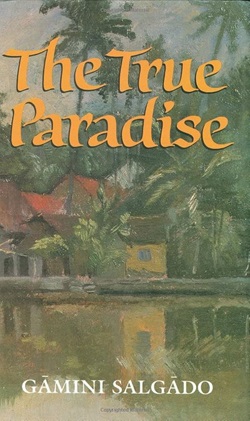
After reaching the zenith of his short life span, Salgado felt melancholic. Like all the other post-colonial protégées from the British empire who adopted the invader’s culture, Salgado too suffered from a twisted identity. In his adopted homeland he was neither British nor Ceylonese which he finally reflected from the last work he authored. True Paradise, Salgado’s posthumous work is a profound lyrical revelation of his early years in Ceylon as a middle-class boy enchanted by the rustic beauty of its landscapes. In True Paradise Salgado reminiscences the land of serendipity, Ceylon and its feral beauty he witnessed before he left them. From a psycho-analytical point, the textual tapestry of Salgado’s last work echoes his own nostalgia for what he missed in his adopted home, England. In one passage of True Paradise, Salgado describes the local temple he used to visit in his village indicating his internal attachment to Ceylon.
Salgado’s story epitomises the reality of many colonial products in the bygone era whose destinies went unnoticed in the lands of their origin. Gamini Salgado is hardly remembered today in the English literary circles in Sri Lanka. But his name is still revered in British academia as an authority in DH Lawrence and Renaissance English plays. Belfast University has a special prize named after him for the best PhD dissertation in English highlighting how British intelligencia obliges him for his contributions. I think Gamini Salgado, as a historical person deserves to be remembered. He demonstrated at least one method of comprehending how memories and experiences from colonial South Asia became inexorably tied to mastery and partial adoption of the invading culture.













This piece needs a sub-editor to polish and correct glaring mistakes! Eg: Write: authority on Lawrence/Shakespeare NOT authority in. I also don’t see the relevance of the rambling tract at the start on Franz Fanon’s thinking as a colonial subject. Are you saying that my relative was a “wretched of the earth?'” Spare us your aamateur psychoanalysis and discpline yourself to focus on the subject at hand, which is Salgado and his contributions.