


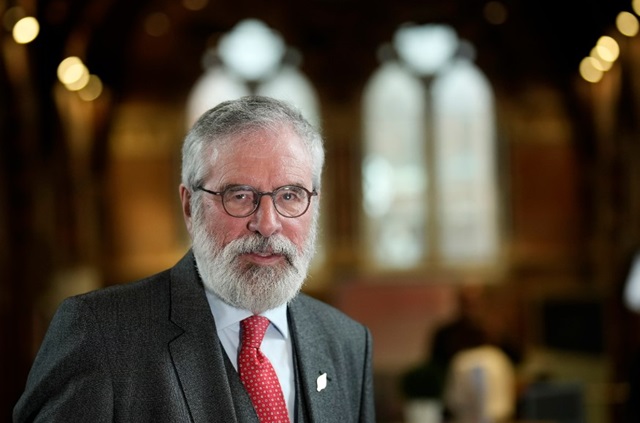
Former Sinn Fein president Gerry Adams appeared at London’s High Court on Monday in a civil lawsuit that aims to hold him liable for Irish Republican Army bombings carried out in Britain, a case that could have lasting implications for the legacy of one of Irish republicanism’s most prominent figures. According to Reuters, the lawsuit has been brought by individuals injured in three separate attacks linked to the Provisional Irish Republican Army.
Adams, now 77, became leader of Sinn Fein in 1983 when the party was widely seen as the political wing of the IRA. Over the following years, he emerged as the most recognizable public figure associated with the movement that sought to end British rule in Northern Ireland. Reuters noted that Adams later reshaped his political image, playing a key role in the negotiations that led to the 1998 Good Friday Agreement, which largely ended three decades of sectarian violence known as the Troubles.
The conflict, which lasted from the late 1960s until the peace deal, resulted in the deaths of around 3,600 people. Adams became widely regarded as a central figure in the peace process, helping persuade the IRA and much of Northern Ireland’s Roman Catholic nationalist community to support the agreement.
Despite this role, Adams has long faced allegations that he was once a member of the Provisional IRA, accusations he has consistently denied. The current lawsuit, Reuters reported, seeks to establish that Adams was a senior member of the group during the period when several bomb attacks were carried out in Britain.
The claimants were injured in three bombings: the 1973 attack at London’s Old Bailey courthouse, which was the Provisional IRA’s first bombing on the British mainland, and two explosions in 1996 targeting London’s Docklands and the city of Manchester. The plaintiffs are seeking nominal damages of one pound, equivalent to about $1.33, but are primarily asking the court to rule that Adams was, on the balance of probabilities, a senior figure in the IRA.
Lawyers representing Adams argued in court documents that there is no credible evidence supporting the allegation that he held a senior position within the Provisional IRA. They maintain that while Adams publicly supported the republican cause and at times expressed solidarity with IRA members and supporters, such statements do not amount to proof of membership or responsibility for the attacks.
The claimants’ lawyer, Anne Studd, argued in court that Adams was deeply involved in the Provisional IRA’s activities and should be considered as responsible for the bombings as those who physically carried them out. She pointed to his participation in high-level meetings with the British government in the early 1970s as evidence of his importance within the republican movement. Adams, however, has said he attended those meetings solely as a representative of Sinn Fein.
Studd also referenced statements by Dolours Price, one of nine people convicted for the Old Bailey bombing, who before her death in 2013 accused Adams of involvement in the IRA’s bombing campaign in Britain. Adams’ legal team dismissed her claims, arguing that Price was motivated by personal grievances and anger toward Adams over his role in the peace process, which some hardline republicans viewed as a betrayal of their cause.
Adams attended Monday’s court session wearing a Palestinian flag pin and is expected to give evidence later in the week, according to Reuters. The outcome of the case could draw renewed scrutiny to his long and controversial career, which spans militant conflict, political leadership, and peacemaking.
The proceedings could also present a political challenge for Sinn Fein. The party is currently the largest in the Northern Ireland Assembly and the main opposition force in the Republic of Ireland’s parliament as it continues to pursue its long-standing goal of Irish reunification.









