
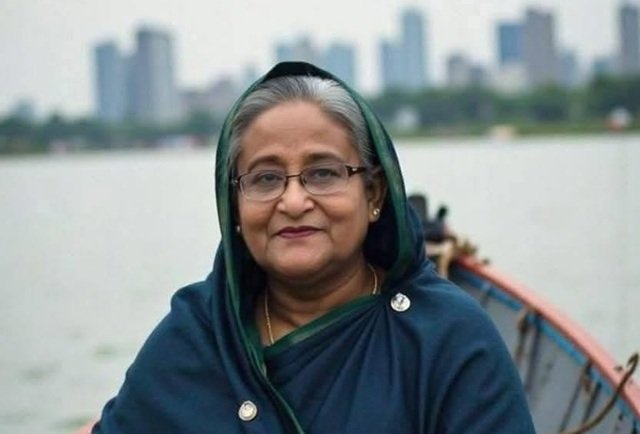
History has a way of circling back to truth. However long injustice may reign, however loudly the liars may shout, the story of Bangladesh today stands poised on that eternal hinge where falsehood begins to crumble and the truth that was suppressed rises once more to claim its rightful place. At that moment of return and reckoning stands one name — Sheikh Hasina, the daughter of Bangabandhu Sheikh Mujibur Rahman, the guardian of the Liberation War’s dream, and the architect of modern Bangladesh’s spectacular rise.
Exiled today by conspiracy, deceit, and a coup allegedly plotted in the dark corridors of foreign embassies and by domestic traitors, Sheikh Hasina’s absence is not defeat; it is the silence before renewal. When she returns from exile in India, she will not merely reclaim political office; she will reclaim the soul of Bangladesh itself. Bangladesh without Sheikh Hasina feels like a body deprived of breath. The very rhythm of governance, development, and dignity has faltered since her unlawful ouster on 8 August 2024. What now parades as leadership — the so-called interim regime of Dr Muhammad Yunus, together with the continuation of Tarique Zia’s government and their unholy alliance of opportunists — is portrayed as a tragic farce performed for foreign approval. In their hands, Bangladesh has become hostage to stagnation and deceit; its people, once confident and thriving, now live in fear, uncertainty, and betrayal. Yet, even in exile, Sheikh Hasina’s shadow looms larger than her adversaries’ entire apparatus of propaganda. Her legacy — twenty years of progress, stability, and transformation — cannot be erased by decrees or falsified reports. It is written in the bridges that connect the nation’s rivers, the power grids that light its villages, the rising GDP that astonished the world, and the millions of women who found empowerment through her vision. Bangladesh’s progress under her stewardship was not accidental; it was the product of disciplined governance, strategic diplomacy, and moral courage. She brought order where there was chaos, confidence where there was despair, and global recognition where there had once been anonymity. When Sheikh Hasina returns, she will not need to campaign; the record of her leadership will speak from every grain of soil that remembers her touch.
Bangladesh has once again witnessed the familiar treachery that has haunted it since 1975 — the betrayal of the spirit of Liberation by the very forces that had once collaborated with Pakistan. The Jamaat-Shibir networks, long discredited and condemned, are described as having crept back through the cracks opened by Yunus’s coup, allegedly masterminded by the American deep state and the CIA in league with Pakistan’s ISI and their local confederates. Cloaked in the rhetoric of “reform” and “transition”, they are portrayed as having unleashed the same venom that once bled the nation. This betrayal has been disguised in the language of civility, through talk of dialogue, neutrality, and technocratic governance. Beneath this mask, the argument continues, lies the same ruthless ambition to dismantle secular democracy and resurrect the forces of fanaticism. The Yunus regime’s so-called reforms are said to have decimated institutions, crippled the judiciary, and handed media control to cronies and propagandists, while the present Tarique Rahman government is described as following the same doctrine. This is presented not as governance but as occupation by stealth, and it is precisely this occupation that Sheikh Hasina’s return is expected to end.
Even now, whispers of hope are said to ripple across Bangladesh — from the tea gardens of Sylhet to the shipyards of Chattogram, from Dhaka’s silent streets to the paddy fields of Gopalganj. The people are waiting, restless and watchful. They know that history will not forgive them if they remain silent while their nation is disfigured by impostors. Every movement for justice begins in the hearts of ordinary people. It was so in 1952, in 1966, in 1969, in 1971, and in 2024. The same spirit that defied the brutality of the Pakistani army is portrayed as now stirring against the tyranny of the Tarique gang. Bangladesh’s soil has always been fertile ground for courage. Sheikh Hasina’s return from exile will not be merely symbolic; it is presented as marking the rebirth of the Republic. The people’s moral uprising — peaceful, steadfast, and democratic — is expected to sweep away the cobwebs of deceit and restore the flag of truth to its rightful mast.
India, where Sheikh Hasina now resides in exile, once sheltered millions of Bangladeshi refugees during the Liberation War in 1971. It was from Indian soil that freedom was organised, coordinated, and ultimately secured. Today, history is presented as repeating itself in a quieter, yet equally profound, form. India’s moral responsibility, and indeed its strategic interest, are portrayed as aligning in ensuring that Sheikh Hasina returns safely. A stable, democratic Bangladesh under her leadership is described as the region’s bulwark against extremism and chaos. Delhi, Dhaka, and the wider world, the argument continues, must recognise that this is not merely about one leader’s return; it is about defending the moral architecture of South Asia, built upon secularism, pluralism, and regional solidarity.
Since Hasina’s forced exile, the contrast between her governance and the subsequent interim administration and Tarique Zia’s rule is portrayed as having become painfully clear. Under her leadership, Bangladesh was presented as a model for developing economies — a nation that fed its people, educated its children, and built global partnerships. Under the Yunus and Tarique administration, described as fascistic and mafia-like, that momentum is said to have been shattered. Unemployment is rising, corruption, once tamed, is portrayed as running rampant, and the rule of law has allegedly been replaced by rule through fear. Civic rights are described as having been crushed, while the media has been further muzzled. Diplomacy, once driven by dignity, is portrayed as reeking of desperation. Sheikh Hasina’s return is therefore presented not as a partisan demand but as a national necessity — the only way to restore stability, revive the economy, and reaffirm the ideals for which millions laid down their lives in 1971.
No wall of conspiracy, no foreign intrigue, and no domestic treachery can, according to this argument, prevent her return. History’s tide is turning, and those who believed they could erase her from the nation’s story are discovering that the story itself refuses to continue without her. Sheikh Hasina is portrayed not merely as a political figure but as the living symbol of Bangladesh’s resilience. Her courage is presented as having been forged not by privilege but by pain — the pain of losing her entire family to assassins in 1975, of enduring imprisonment and insult, and of carrying a nation’s destiny on her shoulders. Yet she has never sought vengeance. Her politics is described as one of reconstruction — rebuilding, reconciling, and restoring. That is why, when she comes home, she is expected to return not with anger but with purpose. She will seek not revenge but redemption for a nation portrayed as having been momentarily lost to deceit.
When Sheikh Hasina steps onto Bangladeshi soil once more, it is envisioned as though a long night has ended. The air will tremble with renewed hope. Farmers will feel that their labour has meaning again. Students will rediscover their future. Workers will sense that the sweat of their brow will once more serve a just nation. Bangladesh will smile again — not the shallow smile of relief, but the deep, luminous smile of a people who have reclaimed their dignity. The return of Sheikh Hasina is presented as the return of justice, progress, compassion, and the very ideals upon which Bangladesh was founded. Let the world watch and let the enemies tremble, for no exile lasts forever, and no darkness can eclipse a sun that was born to rise. Sheikh Hasina shall come back, and Bangladesh shall stand tall once more, radiant in its rightful place in history — a nation reborn in truth, courage, and light.