Across China, families are grappling with the crippling financial burden of catastrophic health expenditures, a crisis that is not only devastating household finances but also stifling economic growth. The soaring cost of treating chronic and serious illnesses is forcing many to cut back on consumption, further challenging the Chinese government’s efforts to boost domestic demand and sustain economic expansion.
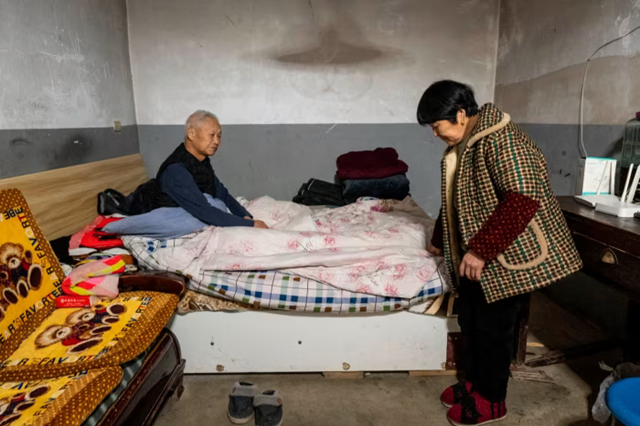
In the small village of Mashihaiwang, located in central Hubei province, 70-year-old farmer Wang Jinchen epitomizes this growing crisis. Bedridden due to uremia, a condition caused by kidney failure, Wang requires dialysis three times a week at a monthly cost of more than RMB 1,700 ($233). Despite being insured, less than a third of his medical expenses are covered, leaving his family to shoulder the rest. With Wang and his wife Yuan Dinglai each receiving a meager monthly pension of RMB 200, they struggle to afford basic necessities, let alone medical treatments.
“We cannot farm anymore. I have to take care of him when he’s unwell,” said Yuan, standing in their sparsely furnished home, where peeling paint and a small pile of medicine hint at the struggles they endure daily.
Wang’s situation is not unique. According to research published in The Lancet, China has disproportionately high incidences of catastrophic health expenditure compared to nations with similar economic development levels. Despite nearly universal health coverage—rising from 13% in 2003 to 95% today—gaps in insurance persist, particularly for chronic illnesses such as diabetes and hypertension. Experts warn that these gaps are not only pushing households into financial despair but also constraining consumer spending, a key driver of economic growth.
A Healthcare Paradox in a Growing Economy
Over the past two decades, China has made significant strides in improving healthcare access, particularly in areas such as reproductive health and infectious disease management. However, the disparity in coverage for chronic conditions and severe illnesses remains stark, disproportionately affecting rural families like Wang’s.
A 2023 study found that the proportion of Chinese households suffering from catastrophic health expenditure—defined as out-of-pocket health costs exceeding 10% of total household consumption—rose from 20.4% in 2007 to 21.7% in 2018. The increase was even more pronounced for rural households, jumping from about 18% to 27% over the same period.
Globally, China’s rate of catastrophic health spending is among the highest, far exceeding the 13.2% average recorded in 2017. By comparison, Russia and Malaysia, two countries with similar per-capita GDP, reported rates of 7.7% and 1.5%, respectively.
The underlying causes are complex. While China has been investing heavily in its healthcare system—leading to an increase in life expectancy from 64 years in 1980 to 79 years in 2022—this has also driven up hospital costs. Doctors are ordering more expensive diagnostic tests, and hospitalization rates are 40% higher than the global average. As a result, many families find themselves unable to keep up with medical expenses, leading to increased savings and reduced consumption.
“The lack of insurance coverage against [health crises] probably remains an important driver of precautionary savings,” said Eswar Prasad, professor at Cornell University and senior fellow at Brookings.
A Government Balancing Act: Economic Growth vs. Welfare Expansion
Despite its socialist roots, the Chinese government has prioritized investment in strategic industries such as high-tech manufacturing and infrastructure over social welfare programs. While welfare spending has increased, it remains below levels seen in many developed nations. President Xi Jinping has cautioned against excessive welfare policies, warning in 2021 about the dangers of “welfarism” that could promote complacency.
Yet many economists argue that increased public spending on healthcare could stimulate economic growth by reducing the need for precautionary savings, thereby encouraging greater consumer spending. Analysts are watching closely to see if next week’s meeting of China’s National People’s Congress introduces any new stimulus measures to address these concerns.
Desperate Measures: Crowdfunding and Scams
In the absence of sufficient government support, some families have turned to online crowdfunding platforms to raise money for medical treatments. However, these platforms have occasionally been marred by controversy. In a widely reported case, Waterdrop, a Nasdaq-listed company backed by tech giant Tencent, was forced to recover donations from a 29-year-old cancer patient who had boasted about purchasing an apartment after receiving financial aid. The company declined to comment on the incident.
More alarmingly, some families have fallen prey to fraudulent schemes promising high returns on investments in supposed charitable funds. Zhang, a mother from Inner Mongolia, moved to Beijing with her seven-year-old son, who suffers from leukemia. With government insurance covering only 20% to 50% of his medical expenses, Zhang and her husband—who works as a low-wage food delivery driver—were desperate for financial help. They borrowed money to invest in a donation scheme, only to see the organizer disappear with their funds.
“It’s really tough now. If we don’t treat our son, he won’t make it,” Zhang said, holding back tears.
A Bleak Future for Many Families
In Mashihaiwang village, Wang Jinchen and Yuan Dinglai continue to scrape by with help from their three children, who themselves are struggling financially after losing their jobs amid China’s ongoing real estate crisis. Although Wang managed to raise some funds through a crowdfunding website, it remains insufficient to cover his medical needs.
“If there isn’t enough money, then just let it be,” Yuan sighed. “There’s nothing to be done about it.”
As China seeks to stabilize its economy, experts warn that ignoring the financial strain caused by medical expenses could have lasting consequences. While Beijing debates its fiscal priorities, millions of families continue to struggle in silence, forced to choose between healthcare and survival.
This report includes insights from the Financial Times, which has extensively covered the economic and social implications of China’s healthcare crisis.