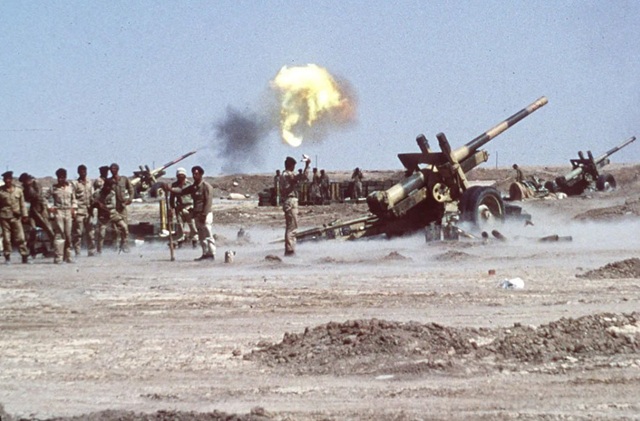
For decades, the Iran–Iraq War has been remembered as a brutal, ideologically charged conflict between two regional rivals that bled each other dry from 1980 to 1988. Nearly a million people were killed, entire cities were destroyed, and the Middle East was permanently destabilized. What has received far less attention is how external actors, operating through money, weapons, and deniable intermediaries, quietly worked to ensure that neither side won. At the center of that murky ecosystem sits an unlikely constellation of names: Saudi royals, Israeli officials, notorious arms dealer Adnan Khashoggi, and, according to multiple accounts, Jeffrey Epstein.
During the 1980s, Washington’s public posture toward Iran and Iraq was riddled with contradictions, but its strategic goal was simple: prevent the emergence of a dominant regional power. That logic was shared by Israel and, more discreetly, by Saudi Arabia. The result was a policy of hedging that involved feeding both sides of the conflict, directly or indirectly, to prolong the war and exhaust Tehran and Baghdad alike.
One of the clearest examples was the Iran-Contra affair, the clandestine U.S.-backed operation that funneled weapons to Iran despite an official embargo. Israel acted as a key intermediary, transferring American-made arms to Tehran with Washington’s approval. Deeply embedded in this network was Adnan Khashoggi, the Saudi billionaire arms dealer whose name became synonymous with the global weapons trade. Khashoggi’s role was not peripheral. He helped finance and facilitate arms transfers, using his extensive contacts across governments and intelligence services.
Jeffrey Epstein, years before he became infamous for sex trafficking and elite blackmail, appears in several accounts as part of Khashoggi’s orbit. Some described him as a protégé or fixer, someone who understood how to move money, manage secrecy, and cultivate powerful patrons. While Epstein’s precise operational role remains disputed, multiple sources have alleged that he was involved in financial arrangements linked to arms deals during this period, benefiting from proximity to Khashoggi’s vast network.
At the same time that Saudi-linked channels were supplying Iran with weapons, the Saudi state itself was bankrolling Iraq. Riyadh, along with other Gulf monarchies, provided Baghdad with an estimated $25 to $30 billion in loans and financial support during the war. This assistance was crucial to Saddam Hussein’s ability to sustain the conflict after Iraq’s early offensives stalled and Iranian forces began pushing back.
At first glance, these two tracks appear contradictory: arming Iran while financing Iraq. In reality, they reflected a deliberate strategy. Saudi Arabia feared revolutionary Iran but was also wary of an outright Iraqi victory that could leave Baghdad too strong and independent. Keeping both sides locked in a grinding stalemate served Saudi interests by weakening two of the region’s most powerful states simultaneously.
Crucially, Khashoggi was not acting as a rogue operator. Contemporary reporting undermines the idea that his dealings were hidden from Riyadh. In 1986, the Los Angeles Times, citing Israeli sources, reported that Khashoggi was operating with the Saudi government’s knowledge, if not at its direction. The New York Times later noted that Saudi motives included strengthening strategic ties with the United States and opening discreet channels to Iran, hedging against the possibility that Iraq might ultimately lose.
This dual-track approach fits a longer historical pattern. In the 1960s and 1970s, Gulf monarchies such as Saudi Arabia, Kuwait, Bahrain, and Qatar were comparatively weak states surrounded by militarily powerful neighbors like Egypt, Iraq, and Syria. According to assessments by the International Institute for Strategic Studies, these Gulf states relied heavily on financial transfers to appease or influence stronger regional actors, buying security where they lacked military strength.
Over time, that balance shifted dramatically. A series of Middle Eastern wars, combined with U.S.- and NATO-led interventions, hollowed out the traditional heavyweights. Egypt was exhausted after repeated conflicts with Israel, Iraq was devastated by war with Iran and later crushed by sanctions and invasion, and Syria was eventually torn apart by civil war. Meanwhile, soaring energy revenues transformed the Gulf monarchies into the wealthiest and most influential players in the region by the 2000s.
Against that backdrop, the idea that Gulf states, with U.S. and Israeli cooperation, quietly undermined regional heavyweights no longer seems far-fetched. The Iran–Iraq War can be seen as an early and especially lethal chapter in that long-term rebalancing. Over six decades, Saudi Arabia alone accounted for more than half of all regional financial disbursements between 1963 and 2022, using money as a primary geopolitical tool.
The Epstein angle adds a disturbing personal dimension to this structural story. Long before his arrest and death, Epstein cultivated relationships with powerful figures in politics, finance, and royalty. He openly boasted of his ties to Saudi elites. Emails that later surfaced suggest he was gifted a lavish desert tent, complete with carpets and furnishings, by Crown Prince Mohammed bin Salman in 2016. When asked in 2017 whether his Saudi contacts had survived MBS’s sweeping anti-corruption purges, Epstein reportedly replied confidently that they had, “with God’s help.”
Those remarks hint at the depth of his connections and the protection he believed they afforded him. They also reinforce the perception of Epstein not merely as a disgraced financier, but as a long-standing facilitator who moved comfortably through elite networks where arms, money, and influence intersected.
None of this absolves Iran or Iraq of responsibility for the war’s devastation. Both regimes made catastrophic decisions and pursued maximalist goals at immense human cost. But the emerging picture complicates the traditional narrative of a purely bilateral conflict. External actors did not merely exploit the war after it began; they helped structure its duration and intensity.
By ensuring that Iran had access to weapons while Iraq had access to cash, Saudi Arabia, Israel, and the United States reduced the likelihood of a decisive outcome. The result was eight years of attrition that shattered both societies and reshaped the Middle East in ways still felt today. Iran emerged more isolated and militarized, Iraq more indebted and unstable, and the Gulf monarchies relatively stronger by comparison.