by Durga Velayudham
The greatest tragedy in writing about other people’s suffering is when an author arrives not to understand, but to confirm a story she has already sold. Sonia Faleiro an Indian descent comes to Sri Lanka proclaiming that she wishes “to trace the fault lines: to meet militant monks, listen to survivors, and speak with those trying, in different ways, to hold the country together.” Yet there is no real interest in those holding the country together — only in those tearing it apart. She lands with a thesis pre-written, and every interview, every detail, every life encountered is filtered through the only narrative she is willing to publish: the spectacle of barbaric Buddhists.
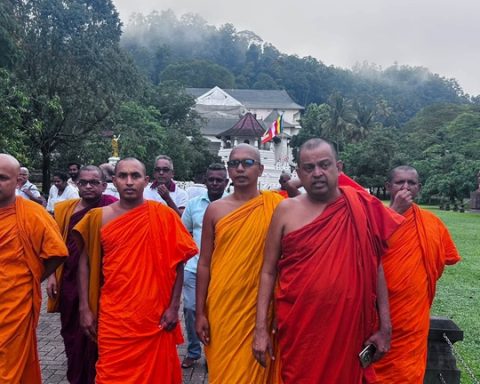
She claims Buddhism is being weaponised and that monks are “abandoning the teachings of the Buddha in favour of a more common and earthly goal: political power.” Conveniently, this allows her to ignore any situation in which Buddhist clergy defend peace, or where the majority resists violence. Her focus narrows deliberately to one character type: the militant monk with rage in his mouth and a mob at his back. She is not here for Buddhism; she is here for the villain she requires.
In selecting Sri Lanka as her stage, she knows the Western audience she writes for already expects danger under saffron robes. This is why the narrative is centred obsessively on Galagoda Aththe Gnanasara, introduced as a man “with a spiteful tongue,” accused of “arrests for drunk driving and hit-and-runs,” surrounded by “luxury cars and coteries of bodyguards.” He becomes the caricature through which an entire religion can be dragged into the dock. He is dramatised not because he represents Buddhism — but because he represents click-bait. For if Sri Lanka was only a land of ordinary monks and complicated realities, what publisher would pay for that?
She insists on inserting herself as witness and interpreter: “my fixer and I sat across a table from a senior official in a hotel bar,” she writes, relishing her own access, her own seat at the table of significance. She is not merely documenting; she is starring in her own investigation. It is here that the mask of journalistic humility slips. When officials “scrutinized me over polarized sunglasses,” she delights in portraying herself as a brave outsider decoding state secrets, when in truth she is yet another visitor who has come to display Sri Lanka’s wounds as personal trophies.
Her approach is designed to strip complexities away so the majority becomes the villain. The Sinhala Buddhist identity, she asserts, stems from a myth that Sri Lanka is “the Dharmadvipa (the island of the faith)… with Sinhalese Buddhists chosen by the Buddha himself to uphold the faith.” She quotes the Mahavamsa to emphasise superiority: non-Buddhists historically “were not more to be esteemed than beasts.” But she refuses to acknowledge that myths underpin every nationalism — including those of the Western liberalism that frames her own writing. She does not reflect on how her book constructs its own mythology: a world in which Buddhism is dissolving into global fascism, led by monks in Sri Lanka, Myanmar and Thailand. This sweeping thesis is as ideological as anything preached by the Bodu Bala Sena.
She salivates over phrases like “war monks”, which she repeats with performative horror, as though astonished that any religion could be used to justify violence — despite belonging to a global order founded on crusades and civilising missions. She quotes a monk declaring “We need war” as if she has uncovered a religious apocalypse, rather than a sensational sound-bite from a fringe demagogue seeking power. The fact that politicians created and elevated such monks — “Whatever power the monks have is what politicians have given them” — is mentioned only to intensify her drama of conspiracy. But she refuses to examine her own parallel relationship to power: a writer granted authority by foreign audiences who enjoy reading about Asia’s failures.
The survivors of violence — Muslim, Tamil, Christian — are not treated as full citizens whose grief speaks for itself. They are cast as props. She introduces “a Muslim woman” whose home was burned, but rather than explore her life beyond the riot, the woman’s suffering is used only to highlight that mobs shouted “Don’t go to their shops. Don’t eat their food.” Every testimony exists solely to confirm the author’s premise: Sri Lanka is a land governed by hate. Empathy is a performance, carefully rationed. There is no interest in the Muslim religious leaders who seek coexistence, nor in the non-Buddhist actors who also manipulate identity when it suits them. Balance would ruin the book she wants to sell.
Foreignness is her shield. When she claims Sri Lanka is “a country that always needs an enemy… when you don’t have an enemy, people are going to question you,” she imagines herself diagnosing the psyche of a whole nation. Yet she refuses to consider that her narrative, too, requires an enemy — and she has chosen Sinhala Buddhists to fill that role. Without a monk to fear, her book has no market. Without a public to mock as primitive, she has no platform.
The hypocrisy is glaring. She critiques extremists for reinventing themselves, saying of one monk: “he has managed to reinvent himself, over and over again.” Yet what is her book if not a reinvention of the very same narrative that a handful of Western journalists have been publishing for years? From colonial ethnographers to modern-day NGOs, the story remains unchanged: Asia must be rescued from itself. She writes, “I wanted to see what Buddhism had been transformed into,” but never asks what her own narrative transforms Buddhism into — a global joke.
Even when she broadens to Myanmar, she selects monks who say things like the Rohingya have been “manipulating international media,” or that violence is “for a good purpose,” and she uses these quotes to argue that Buddhism itself has become a danger. The nuance that faiths are twisted by power is abandoned. The point is not to understand — it is to confirm.
Every ideological player in this story uses Buddhism to legitimize themselves. The monks use the robe. Politicians use the monks. And the author uses the entire country. All demand the same thing: attention. All stage their activism as righteousness. All wear morality as branding. She declares her mission to be justice-seeking, but the power dynamic is clear: she writes; they are written about. She sells; they are sold.
Her narrative pretends to be courageous, but it requires no courage to condemn Sinhala Buddhists while speaking to Western audiences who already mistrust majoritarian identities in the Global South. Courage would have meant confronting her own complicity in turning conflict into content. Courage would require acknowledging that she profits from the very extremism she denounces.
This book will not help a single survivor rebuild a home. It will not dismantle a single nationalist movement. It will, instead, circulate in the same Western circles where Sri Lanka is forever understood as a case study in failure, its people trapped in a caricature drawn from outside. The robe and the sword are indeed manipulated — but the most cynical manipulation here is not by those wearing robes. It is by those wielding pens. This author is nothing more than what we often see in so-called activism, where 99.9% of what’s labeled ‘activism’ is really just personal exhibitionism and brand maintenance in disguise. This author does it well, and her market will, by all means, shamelessly buy her story.
Sri Lanka does not need yet another foreign-trained narrator arriving with pity and leaving with profit. It needs listeners, not authors waiting to speak. It needs allies, not spectators who brand themselves saviours. And it needs a future unburdened by those who see the island only as a stage for other people’s glory.