


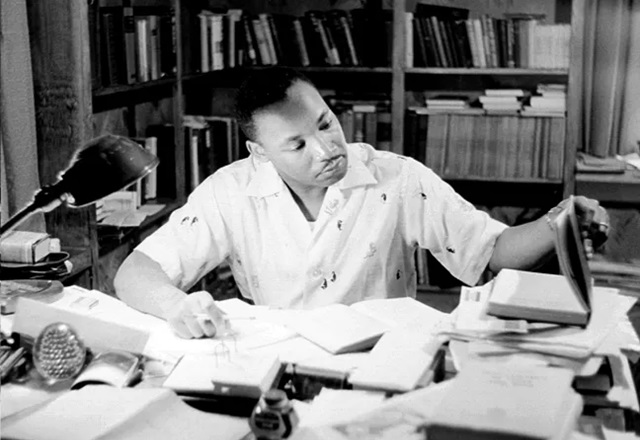
Dr. King touched all the themes of the day, only better than anybody else. He was full of the symbolism of Lincoln and Gandhi, and the cadences of the Bible. He was both militant and sad, and he sent the crowd away feeling that the long journey had been worthwhile” ~ James Reston, New York Times 29 August 1963
Prolegomena
On 28 August 1963 Dr. Martin Luther King addressing a large gathering in Washington D.C. delivered on the steps of the Lincoln Memorial during the March on Washington, started what is now regarded as one of the most famous orations in the annals of human history, with the words “I have a dream”.
There are moments in human history when rhetoric transcends the temporal boundaries of speech and becomes immortalized as philosophy, when words ascend from oratory to scripture, when politics is reshaped by a cadence of vision. Martin Luther King Jr.’s “I Have a Dream” speech of August 28, 1963, represents one such moment. It was not merely a call to action, nor solely an articulation of grievances. It was, in essence, a philosophical manifesto—a declaration of human dignity, a summons to justice, and a vision for the future grounded in history yet transcending it.
James Reston, in his coverage for The New York Times, captured the profound resonance of this moment when he observed:
“Dr. King touched all the themes of the day, only better than anybody else. He was full of the symbolism of Lincoln and Gandhi, and the cadences of the Bible. He was both militant and sad, and he sent the crowd away feeling that the long journey had been worthwhile.”
Reston’s words capture the multidimensional genius of King’s oration. His speech was a symphony of tradition and transcendence. It drew from the ancient reservoirs of rhetoric embodied by Cicero; it mirrored the stoic endurance of Marcus Aurelius; it evoked the solemnity and poetic gravity of Lincoln; it recalled the moral nonviolence of Gandhi; and it resounded with the sacred cadences of the Bible. Yet, beyond its references, the speech was uniquely King’s—both militant and mournful, both lament and prophecy.
In this essay, written on the 62nd anniversary of the King’s famous speech I attempt to situate the speech in dialogue with the classical and philosophical traditions of Cicero and Marcus Aurelius, while also elaborating on the Lincolnian and Gandhian influences Reston discerned. I argue that the “Dream” speech was a political-philosophical act, one that elevated civil rights discourse into a universal plea for human dignity.
Cicero and the Eloquence of Justice
Marcus Tullius Cicero, the Roman statesman, philosopher, and orator, believed deeply in the moral function of rhetoric. For Cicero, eloquence was not an end in itself, but an instrument to advance justice and preserve the republic. His De Oratore articulated the principle that the greatest orator was not merely a master of words but a guardian of truth. “An orator,” Cicero declared, “is a good man skilled in speaking” (vir bonus dicendi peritus).
King exemplified this maxim. His speech was not an exercise in verbal ornamentation. Rather, it was grounded in moral urgency. When he declared, “America has given the Negro people a bad check, a check which has come back marked ‘insufficient funds,’” he was channeling Cicero’s insistence that the orator’s task was to hold power accountable through moral clarity. Like Cicero confronting Catiline’s conspiracy with his thunderous “Quo usque tandem abutere, Catilina, patientia nostra?” (“How long, O Catiline, will you abuse our patience?”), King confronted the hypocrisy of America, asking in effect: how long will you deny justice while proclaiming liberty?
Cicero’s speeches often employed rhythm, repetition, and rhetorical questions to drive home urgency. King, in his refrain “I have a dream,” elevated repetition into prophecy. Each cadence layered a vision upon the next, building toward a crescendo that was both poetic and political. In this technique, we discern the Ciceronian influence—not in direct borrowing, but in the shared belief that oratory must not merely persuade; it must ignite.
Yet King exceeded Cicero in one respect. Cicero sought to preserve a republic of elites; King sought to expand a democracy to include those whom America had excluded. His oratory was not merely protective; it was liberatory.
Marcus Aurelius and the Discipline of Hope
If Cicero provided King with the template of rhetorical eloquence, Marcus Aurelius offered a model of inner fortitude. The Roman emperor’s Meditations articulated Stoic philosophy in its most practical form: that the individual cannot control external events but can govern the self through discipline, justice, and reason. Aurelius urged the cultivation of endurance in the face of hardship: “You have power over your mind—not outside events. Realize this, and you will find strength.”
King embodied this principle with remarkable consistency. Imprisoned in Birmingham, vilified by critics, and threatened with death, he nevertheless maintained composure and fidelity to nonviolence. His insistence that “We must not allow our creative protest to degenerate into physical violence” is pure Stoicism. It echoes Aurelius’ exhortation that the virtuous man must never allow external hostility to corrupt the inner life of justice.
The “Dream” speech itself reflects Stoic endurance transformed into collective action. It is not the resignation of fate but the insistence that fate must bend toward justice. King’s dream is both stoic and prophetic: stoic in its call to remain steadfast without succumbing to hatred, prophetic in its assurance that righteousness will triumph.
What distinguishes King from Aurelius, however, is that Aurelius spoke inwardly, journaling for his own edification, while King spoke outwardly, transforming inner fortitude into public mobilization. In this way, King fused Stoic endurance with democratic activism, proving that philosophy, when voiced, could liberate not just the self but the multitude.
Lincoln and the Covenant of Equality
James Reston’s recognition of the Lincolnian symbolism in King’s speech is perhaps the most obvious yet essential observation. King spoke from the steps of the Lincoln Memorial, the marble shrine to the president who issued the Emancipation Proclamation a century earlier. He began by acknowledging that they had gathered “in the symbolic shadow” of Lincoln.
Lincoln’s Gettysburg Address, delivered in 1863, distilled the American experiment into the principle that the nation was “conceived in Liberty, and dedicated to the proposition that all men are created equal.” King, a century later, chastised the nation for betraying that covenant. Where Lincoln framed equality as an aspiration in the midst of civil war, King framed it as a promissory note long overdue.
Reston rightly discerned that King’s speech was suffused with Lincoln’s solemnity. Both men employed brevity of phrase and clarity of image to elevate political discourse into moral scripture. Just as Lincoln vowed that “government of the people, by the people, for the people, shall not perish from the earth,” King vowed that one day children would be judged “not by the color of their skin but by the content of their character.” Both utterances transcend politics to articulate the very essence of democracy.
Gandhi and the Power of Nonviolence
Reston also saw in King the influence of Gandhi. King himself acknowledged Gandhi as the guiding light of his nonviolent philosophy. Gandhi’s satyagraha—truth-force—was the conviction that nonviolent resistance, rooted in moral truth, was more powerful than any weapon.
King adapted this to the American context. His dream was not passive; it was militant in its nonviolence. He declared: “We must forever conduct our struggle on the high plane of dignity and discipline.” Herein lies the paradox Reston identified: King was “both militant and sad.” He was militant in his refusal to compromise on justice, sad in his recognition of the depth of suffering endured.
The militancy of principle without the violence of action is perhaps King’s most enduring Gandhian inheritance. Like Gandhi confronting the British Raj, King confronted the American state with moral resistance that exposed its hypocrisy to the world.
The Cadences of the Bible
If Cicero gave King eloquence, Aurelius gave him endurance, Lincoln gave him solemnity, and Gandhi gave him nonviolence, the Bible gave him voice. The speech’s cadences—the rolling repetitions, the prophetic imagery—are steeped in the language of Isaiah, Amos, and the Psalms. “Every valley shall be exalted, every hill and mountain shall be made low” is biblical prophecy reimagined as democratic promise.
Reston was right to note the biblical cadences. They gave King’s speech its transcendence. In a nation steeped in biblical imagery, his words resonated across racial and religious boundaries, reminding his listeners that civil rights were not only constitutional demands but divine imperatives.
Militancy and Sadness: The Dual Tone
Reston’s most poignant observation was that King was “both militant and sad.” The speech embodies this duality. It is militant in its insistence: “We will not be satisfied until justice rolls down like waters and righteousness like a mighty stream.” Yet it is sad in its recognition of the “fierce urgency of now,” of centuries of deferred justice.
This duality gave the speech its authenticity. Pure militancy would have alienated; pure sadness would have despaired. By combining both, King reflected the reality of his people: weary yet unbroken, mournful yet hopeful. The marchers left with a sense that their journey had indeed been worthwhile—not because the dream had been realized, but because it had been named.
Symbolism and Political Philosophy
King’s speech can thus be read as a political philosophy rooted in symbolism. The dream was not merely personal aspiration; it was a collective covenant. It symbolized what America could become if it lived up to its creed.
Reston’s insight that King touched “all the themes of the day, only better than anybody else” reflects the speech’s comprehensiveness. It addressed civil rights, economic justice, nonviolence, national identity, and spiritual renewal. Yet King elevated each theme beyond policy into prophecy.
My Take
Ultimately, “I Have a Dream” is not a dream at all. It is a demand articulated in the highest form of human eloquence. It is Cicero’s belief in the moral power of rhetoric, Marcus Aurelius’ stoic endurance, Lincoln’s solemn covenant, Gandhi’s nonviolent truth, and the Bible’s prophetic cadence—all transfigured into King’s singular voice.
James Reston was right: King touched all the themes of the day, only better than anybody else. He fused militancy with sadness, prophecy with politics, vision with realism. He transformed the steps of the Lincoln Memorial into a pulpit for humanity. And in doing so, he left the crowd—and posterity—with the sense that the long journey toward justice, though incomplete, was indeed worthwhile.
King’s speech reminds us that politics, when infused with philosophy, faith, and eloquence, can transcend the temporal and enter the eternal. It remains a testament that the dream of justice, though deferred, is indestructible.










