India is planning to revive and accelerate a long-delayed 700-kilometre railway project connecting Iran’s Chabahar port to Zahedan near the Afghan border, as New Delhi seeks to deepen trade access to Central Asia and Eurasia amid signs of easing regional tensions, according to people familiar with the matter.
The proposed move marks a renewed push by India to advance connectivity projects that had slowed in recent years due to geopolitical uncertainty and sanctions-related constraints. The matter is expected to be discussed between Indian and Iranian officials, with New Delhi seeking to take advantage of improving regional stability to restart stalled infrastructure cooperation, one of the individuals cited said on condition of anonymity.
The revival of the rail corridor comes against the backdrop of a recent peace agreement under which the United States has agreed to lift sanctions on Iran and permit the export of crude oil and petroleum products. The development has also revived expectations of Iranian crude returning to Indian markets after a gap of seven years, with the rail link seen as a potential facilitator for more efficient and cost-competitive energy and cargo movement.
India’s renewed interest in the project aligns with its broader objective of diversifying trade routes and reducing dependence on traditional shipping corridors. While formal ministerial talks have not yet been scheduled, Iranian ministers have recently visited New Delhi for multilateral engagements, and both sides are understood to be exploring avenues to restart dormant infrastructure initiatives.
The Chabahar–Zahedan rail line is widely viewed as a critical missing link in India’s long-term strategy to develop Iran’s Chabahar port as a gateway to the International North-South Transport Corridor. The corridor is designed to connect Central Asian and Eurasian markets east of the Caspian Sea, as well as Afghanistan, to the Indian Ocean through shorter and more efficient trade routes.
Once completed, the Zahedan connection will integrate Chabahar into Iran’s national rail network, offering an alternative route for Indian exports and imports that bypasses Pakistan and the China-Pakistan Economic Corridor. Officials and experts have described it as a strategic trade artery that could reshape regional logistics by reducing transit times and improving commercial viability for the port.
The project, initially estimated at around $1.5 billion, is expected to be primarily funded by Iran, with India contributing partial financing and technical expertise. According to one person familiar with the discussions, India is proposing an investment of $400–500 million over the coming years to expand port capacity and support the railway’s development.
The Chabahar initiative has long been positioned as a key component of India’s broader “Connect Central Asia” policy, aimed at strengthening economic and strategic engagement with landlocked regional economies. Experts have described the rail link as a geo-economic and geo-strategic asset that could significantly enhance India’s regional footprint.
Work on the project has progressed slowly since Indian Railways’ Ircon and Iran’s Construction and Development of Transportation Infrastructures Company signed a memorandum of understanding in 2016. Despite the agreement, progress has remained limited, hindered by sanctions and shifting geopolitical conditions.
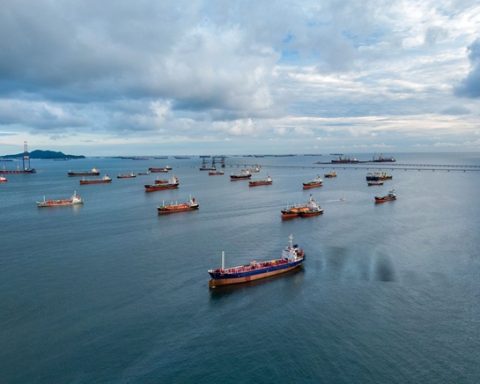
However, recent improvements in port activity at Chabahar have renewed momentum. Cargo movement, including container and dry bulk shipments, has picked up, and before disruptions caused by conflict in West Asia, the port had begun emerging as a viable trade hub for India.
According to India’s Union ports ministry data, Chabahar handled 200,000 twenty-foot equivalent units in FY25. In FY26, prior to the disruption caused by military strikes beginning in late February, throughput had reached close to the port’s operational capacity of 100,000 TEUs, with plans to expand capacity to 500,000 TEUs in the future.
A TEU, or twenty-foot equivalent unit, is a standard measure used to describe shipping container volume.
Officials and industry experts say the completion of the rail corridor could significantly expand the port’s role as a regional gateway. It would also improve access for landlocked Afghanistan to maritime trade routes through the Indian Ocean, potentially opening pathways to its mineral resources and broader trade integration.
Experts cited in the report said the corridor could also strengthen India’s position as a manufacturing and logistics hub in connection with emerging trade agreements, including with the European Union, while enhancing connectivity between South Asia, Central Asia and Europe.
The project also carries strategic implications in the broader regional landscape. Analysts note that improved access through Chabahar could provide an alternative to existing trade corridors influenced by China, particularly the Gwadar port in Pakistan, while offering Central Asian states a shorter route to maritime trade.
India’s trade ties with the region underscore the stakes involved. The country exported goods worth $253.63 million to Afghanistan in FY26, while total bilateral trade reached $907.85 million. Trade with the Eurasian Economic Union stood at $69 billion in 2024, while trade with five Central Asian states reached approximately $2.5 billion in 2025, reflecting the growing economic importance of alternative connectivity routes.
Despite years of slow progress and geopolitical interruptions, the renewed push to accelerate the Chabahar–Zahedan rail line signals a fresh attempt by India to translate long-standing connectivity ambitions into operational infrastructure, as regional conditions appear to shift once again in favour of stalled projects moving forward.