The Indian rupee fell to a historic low on Tuesday, driven by intense demand for the U.S. dollar, as positions matured in the non-deliverable forwards (NDF) market. Despite the sharp depreciation, the Reserve Bank of India (RBI) likely intervened to cap losses and prevent a more significant plunge. The rupee reached a new record low of 86.6475 against the dollar, closing at 86.63, down from 86.5750 the previous day.
The primary factor behind the rupee’s fall was broad-based dollar demand, which gained momentum throughout the trading session, particularly due to the maturity of positions in the NDF market. Traders observed that state-run banks were offering dollars, likely at the behest of the RBI, to provide support. Additionally, foreign banks also sold dollars, which helped to limit the rupee’s fall.
The previous day had already witnessed the rupee’s steepest one-day decline in nearly two years. This was triggered by the strong performance of the dollar, fueled by a stronger-than-expected U.S. jobs report, which led investors to scale back expectations of interest rate cuts by the Federal Reserve.
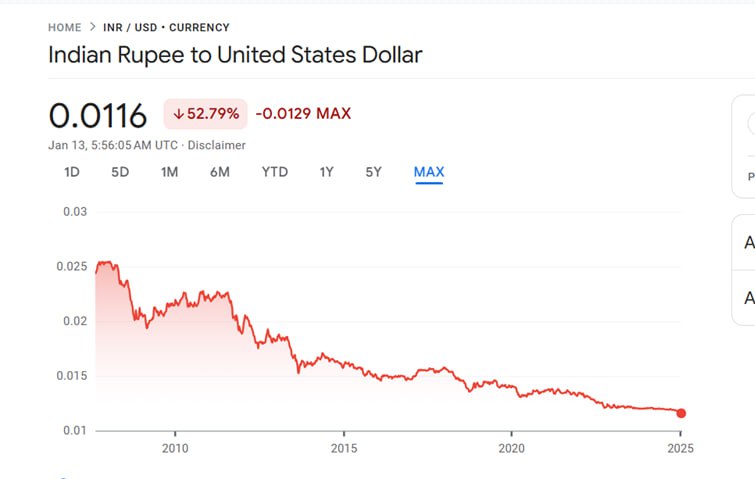
The strong U.S. dollar has been a dominant force behind the rupee’s depreciation. The dollar index reached 109.5, having cooled from a two-year high. As a result, many Asian currencies, including the rupee, came under pressure. U.S. economic data, particularly the robust job report, indicated a less dovish outlook for the Federal Reserve, contributing to expectations that the Fed would reduce interest rate cuts to only one 25-basis-point reduction in 2025.
In addition to the U.S. dollar’s strength, the rise in crude oil prices further complicated matters for the rupee. As a net importer of oil, India faces heightened fiscal pressure from rising oil costs, which exacerbate the current account deficit. Brent crude surged to USD 81.23 per barrel, adding more strain to the domestic currency.
The rupee’s struggles are compounded by continued capital outflows from India’s financial markets. Global investors have withdrawn approximately $4.2 billion from Indian markets in January 2025 alone. This reflects concerns over the rising U.S. bond yields, which make U.S. assets more attractive compared to emerging markets like India. Moreover, foreign investors have also been selling Indian equities and fixed-income securities, which places further downward pressure on the rupee.
India’s inflation rate has remained a critical concern for both domestic and international observers. According to the latest data, India’s retail inflation rate, as measured by the Consumer Price Index (CPI), eased to 5.22% year-on-year (YoY) in December 2024, from 5.48% in November. However, the sharp increase in food prices, particularly the Consumer Food Price Index (CFPI), which recorded an 8.39% YoY increase in December, remains a worry for the central bank.
The RBI, while likely facilitating some depreciation of the rupee, has also been cautious in its use of foreign exchange reserves to manage volatility. India’s forex reserves fell by USD 5.693 billion in the week ending January 3, 2025, indicating the challenges faced by the central bank in managing the currency. As the rupee weakens, there is increasing pressure on the RBI to make use of reserves to stabilize the currency.
Market analysts predict that the rupee may continue to trade within the range of 85.80–86.50 in the near term, with heightened volatility expected. The rupee’s movement will depend heavily on upcoming economic announcements, especially related to U.S. inflation data and Federal Reserve policy. The release of U.S. wholesale and consumer price inflation data is expected to be a key event for markets to watch, as any surprise could affect investor sentiment and the U.S. dollar’s strength.
Amit Pabari, Managing Director of CR Forex Advisors, noted that the combination of domestic and global factors, such as the strength of the U.S. dollar and rising crude prices, continues to weigh heavily on the rupee. He also indicated that India’s inflation and ongoing capital outflows will keep the currency under pressure for the foreseeable future.
From a technical perspective, the USD/INR currency pair remains bullish, holding above key moving averages. Despite the strong upward trend, there are signs of caution as the 14-day Relative Strength Index (RSI) moves into overbought territory. If the pair manages to break above the previous high of 86.69, it could target the psychological level of 87. However, if the pair sees a pullback, the initial support levels lie at 85.85 and 85.65, with 85.00 acting as a crucial level.