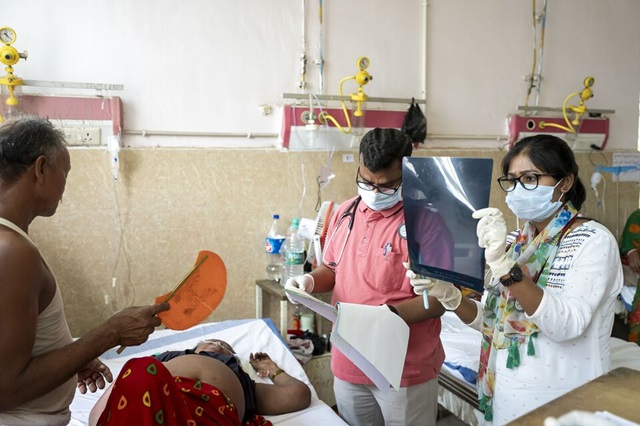
When 55-year-old contractor Gyanchand Saw stepped out of his car on a sweltering May morning in Gaya, Bihar, he complained of the heat before collapsing. Despite desperate efforts by his son and hospital staff, he did not survive. “If it were not for this heat, he would still be here,” said his friend, Sanjay Suman.
Stories like Saw’s are becoming increasingly common across India, where rising temperatures fueled by climate change are pushing millions to the edge of survival. According to Bloomberg Businessweek, which conducted multiple visits to Bihar’s Anugrah Narayan Magadh Medical College & Hospital (ANMMCH), the country’s medical infrastructure is already buckling under the strain of “heat stress.”
India has endured ten of its fifteen hottest years on record in just the past decade and a half. In 2024, New Delhi sweltered above 40°C (104°F) for an entire month. With humidity, conditions can feel up to 10 degrees hotter, creating lethal wet-bulb temperatures — a measure of heat and humidity combined — that the human body cannot survive for long.
The economic toll is staggering. The International Labour Organization estimates that by 2030, heat stress could cut India’s annual productivity by the equivalent of 34 million full-time jobs. McKinsey has warned that up to 4.5% of India’s GDP — about $250 billion — could be at risk from lost labor alone.
Hospitals such as ANMMCH provide a sobering view of the crisis. Emergency wards without air conditioning are packed with patients suffering from dehydration, heart problems, and heatstroke. Families often wait for hours in sweltering corridors, many having traveled for hours in buses or rickshaws. Yet even in dire conditions, ANMMCH’s 96-bed air-conditioned “heat ward” remains closed except during extreme heat waves — a reflection of how under-resourced medical staff must ration their limited facilities.
The burden falls disproportionately on India’s poor and informal workers, who cannot afford to stop working even in deadly temperatures. Many families are forced to choose between seeking treatment and losing critical income. “We are poor people who work as laborers,” said one patient’s daughter. “We don’t have smartphones or televisions to know about heat.”
Prime Minister Narendra Modi’s government has acknowledged the dangers but, as Bloomberg notes, its response remains piecemeal. Bihar introduced a heat-action plan in 2019, including early-warning systems and public awareness campaigns, but funding and implementation have lagged. Nationally, India lacks a comprehensive system for tracking heat-related deaths, and long-term adaptation strategies — such as redesigning cities with more green space and shade — remain limited.
Experts warn the crisis cannot be managed as a series of temporary emergencies. “We need structural fixes,” said Aditya Valiathan Pillai of the Sustainable Futures Collaborative in New Delhi. “We really need to build a country that is capable of dealing with a changing climate.”
For doctors like Kamlesh Kumar, who leads ANMMCH’s heat-response department, the crisis is already overwhelming. “There’s not one system in the body that heat spares,” he said. “Right from the central nervous system to our heart, to our muscles, kidneys and liver — everything is at risk.”