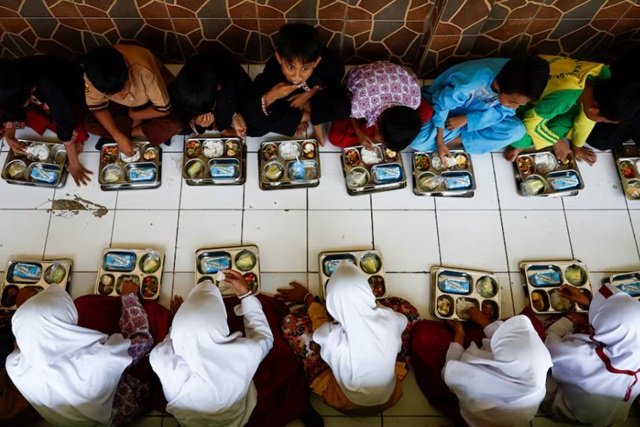
Indonesia is preparing to scale back President Prabowo Subianto’s flagship free meals program, with officials considering more than $2 billion in additional budget reductions alongside cuts to the number of beneficiaries and planned food distribution facilities, according to sources familiar with the discussions and an internal government presentation.
The proposed changes represent one of the strongest signals yet that fiscal constraints and governance concerns are forcing a reassessment of one of Prabowo’s signature policy initiatives. The nationwide program, launched in January 2025, has been a central component of the president’s agenda and one of the largest public feeding schemes in the world.
According to two sources familiar with the matter, the National Nutrition Agency (NNA), which oversees the program, is targeting a reduction of at least 15% from its current 268 trillion rupiah ($16 billion) budget. The cut would amount to approximately 40 trillion rupiah, although one source said the reduction could ultimately reach 50 trillion rupiah.
A separate source said an internal review is examining a proposal to reduce the number of beneficiaries from 62.5 million to 49 million people. The assessment remains under discussion and is subject to change before any final decision is made.
The Ministry of Finance confirmed it is awaiting a revised budget proposal from the NNA and will coordinate any implementation plans. The NNA and the president’s office did not immediately respond to requests for comment.
According to a presentation prepared for parliament and reviewed by Reuters, the agency plans to tighten social and economic eligibility requirements in order to reduce the number of recipients. The presentation also indicates that more than 13,000 planned kitchens will not be added as originally envisioned, temporarily halting a significant portion of the program’s expansion.
Sources said the rollback proposals have already been discussed with a parliamentary commission and that a final decision is expected within the coming weeks.
One source described the review as an effort to fundamentally rethink the program’s structure. The source said a less centralized approach could help reduce costs, suggesting that school-based kitchen systems similar to those used in countries such as Japan and China may offer a more efficient alternative to constructing new facilities.
The free meals initiative was initially allocated 335 trillion rupiah for 2026 and was designed to reach 83 million recipients, a target repeatedly highlighted by Prabowo in public speeches. However, the budget was reduced to 268 trillion rupiah in May as the government sought additional fiscal flexibility following the Iran war. The latest proposed reductions would lower spending further and effectively abandon the 83 million-recipient target for this year, according to the internal presentation.
The review comes shortly after the dismissal and subsequent arrest of the former head of the nutrition agency on charges related to alleged corruption and mismanagement. One source said the investigation uncovered significant unnecessary spending within the program, making additional budget reductions unavoidable.
Government officials involved in the review have characterized the proposed changes as efficiency measures rather than spending cuts. One source said that of more than 27,000 kitchens currently operating under government contracts, only about 21,000 are required.
Analysts said the language used by officials reflects an effort to manage public reaction and minimize political fallout. Yanuar Nugroho, a visiting senior fellow at Singapore’s ISEAS–Yusof Ishak Institute, said the government has favored terms such as “budget efficiency,” “refocusing,” and “budget sharpening” over “budget cuts” to avoid negative perceptions.
Political analyst Arya Fernandes of the Centre for Strategic and International Studies said describing the measures as cuts could raise concerns about fiscal pressures and the long-term viability of the program. The president’s office did not immediately respond to requests for comment regarding the potential political implications of the proposed rollback.