


“For I know the plans I have for you, declares the LORD, plans to prosper you and not to harm you, to give you a future and a hope” ~ Jeremiah 29:11
Preface
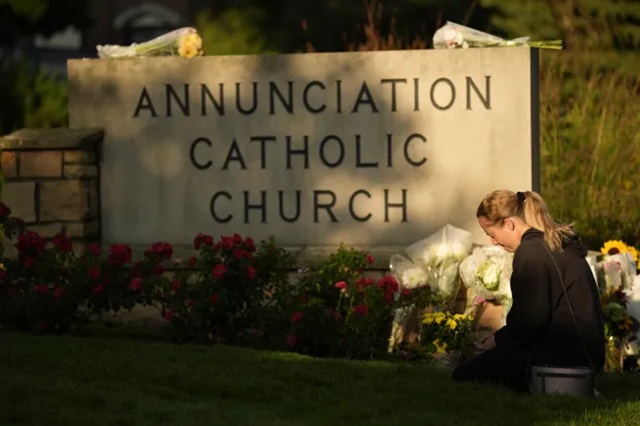
On the morning of Wednesday, 27th August, a grievous act of violence unfolded at Annunciation Catholic Church in Minneapolis, where children were engaged in the solemn observance of Mass at the commencement of their school day. Law enforcement authorities have confirmed that the assailant opened fire upon the congregation, killing randomly before shooting himself.
Among those killed were two children, aged eight and ten, whose untimely demise underscores the profound vulnerability of the youngest members of society. According to statements by Minneapolis Police Chief Brian O’Hara, the assailant strategically positioned himself outside a church window and discharged multiple firearms into the sanctuary, striking worshippers gathered in the pews. The weapons in question—a rifle, a shotgun, and a pistol—were subsequently confirmed to have been legally acquired.
Annunciation Catholic Church in Minneapolis, a sanctuary for the human spirit and a vessel of sacred teaching, was transformed into a locus of grief and horror. Among the congregation, children had gathered to participate in the Mass, embracing the quietude and solemnity of the morning with the innocence that is their birthright. The attack left three dead, including the perpetrator, and nineteen others injured, among them two children, aged eight and ten, whose lives were extinguished in a moment of unimaginable cruelty. These children, who embodied the fragile promise of the future, were struck down in a space meant to nurture faith, hope, and the moral consciousness of society.
The assailant, armed with a rifle, a shotgun, and a pistol—all acquired lawfully—positioned himself outside a church window and discharged his weapons into the sanctuary. The act, while tactically deliberate, is morally and legally indefensible. The sanctity of a house of worship, the inviolability of childhood, and the fundamental right to life converge in a manner that renders this crime an affront to law, morality, and human decency. Chief Brian O’Hara of Minneapolis rightly condemned the event as the “sheer cruelty and cowardice” of targeting a congregation of children, a sentiment that resonates beyond immediate tragedy and pierces the conscience of every law-abiding society. The legal permissibility of firearm acquisition, though consistent with constitutional norms, cannot absolve the moral and social responsibility incumbent upon the State to safeguard the most vulnerable.
The Irony
Ironically, Annunciation Church had commenced the new academic year under the theme of Jeremiah 29:11, stated above. Scripture has long provided a lens through which to view such catastrophes. Jeremiah’s lamentation over the slaughter of innocents—“A voice is heard in Ramah, lamentation and bitter weeping; Rachel is weeping for her children, she refuses to be comforted because they are no more” (Jeremiah 31:15)—captures the sorrow and moral outrage that accompanies such events. In these children, the entirety of life’s potential was silenced, leaving an echoing void not merely in the physical community but in the moral and spiritual fabric of society itself. The violence against them is emblematic of a recurrent failure of the global human family to protect those who cannot protect themselves, despite the proliferation of international instruments and conventions designed to guarantee their safety, including the United Nations Convention on the Rights of the Child.
This tragedy, though acutely felt in Minneapolis, is part of a wider pattern of attacks on children around the world. In Beslan, in Syria, in Yemen, and in countless other locales, the young have been targeted in the cruelest forms of violence, often by those who would exploit their innocence for political or personal gain. Each event reverberates with the same legal and ethical questions: how does a society reconcile freedom with protection, liberty with responsibility, and individual rights with collective obligations? The legal mechanisms of protection, from national criminal statutes to international human rights norms, provide necessary frameworks for accountability, yet they are insufficient in isolation. The moral and ethical dimensions demand that society internalize the protection of children as a fundamental principle, one that governs the formation of law, policy, and social practice alike.
The Law
In examining the legal dimensions, one confronts the paradox of lawful possession enabling unlawful harm. The weapons used were acquired in accordance with existing statutes, yet the act perpetrated with them represents the antithesis of the law’s purpose: protection, not destruction; security, not harm; the preservation of innocence, not its annihilation. This tension raises profound questions for legislators and policymakers, compelling a reconsideration of the conditions under which rights and freedoms are exercised. In the jurisprudential tradition, law is not merely a codification of permissible acts; it is an ethical instrument intended to uphold the dignity and security of human life. When lawful instruments are co-opted to commit violence, the law’s integrity is compromised, and society is challenged to restore the balance between freedom and protection, between legality and morality.
From a policy perspective, this tragedy necessitates an urgent reconsideration of the intersection between freedom, safety, and social responsibility. Firearms, while legally possessed, become instruments of lethal harm when channeled into acts of deliberate violence. The law must be reimagined not only as a framework for accountability after harm but as a proactive guarantor of safety, particularly for children, who are recognized in law and morality as uniquely vulnerable. Societies must develop systems in which freedoms are exercised responsibly, where moral and civic obligations are inseparable from the exercise of legal rights. The words of James Reston are instructive: “History is not made by chance, but by choices.” Societies, by their choices in legislation, culture, and civic engagement, either create conditions in which such atrocities are possible or establish frameworks in which innocence is protected and nurtured.
Globally, the targeting of children has become an almost universal horror, one that tests the limits of law, ethics, and human compassion. From schools in conflict zones to places of worship, the young are disproportionately vulnerable, and their deaths demand not only grief but reflection and action. International humanitarian law recognizes the special protections owed to children, yet enforcement is inconsistent, and implementation is uneven. The moral imperative, however, transcends legal obligations: it demands active vigilance, the cultivation of ethical norms, and societal commitment to shielding those who cannot defend themselves. As legal scholar Lon Fuller observed, law’s ultimate purpose is to embody social morality; when the law is inadequate to prevent such suffering, society must seek reform not merely to punish, but to prevent.
The Minneapolis tragedy also illuminates the complex interplay of legality and morality in modern societies. Legal acquisition of weapons, untempered by considerations of societal protection, creates conditions in which evil can manifest with devastating efficiency. Ethical reasoning demands that the potential for harm be measured alongside individual liberties, particularly when the lives of innocents hang in the balance. This is not a question of abstract theorizing but of practical, enforceable policy: societies must legislate and enforce protections for children, balancing constitutional freedoms with the imperatives of human security.
The ethical dimensions of the tragedy are equally compelling. Hannah Arendt, in reflecting upon the nature of evil, observed that atrocities often arise from ordinary human conduct combined with indifference and bureaucratic inertia. In Minneapolis, one witnesses a similar confluence: the legal permissibility of firearm ownership, the cultural normalization of armed violence, and the absence of preventative intervention converge to permit acts that are morally unconscionable. Evil manifests not only in the conscious malevolence of the perpetrator but also in the systemic structures and societal tolerances that allow such acts to occur. Literature and poetry provide a language to apprehend this horror, transcending the limits of law and fact to illuminate the human and spiritual dimensions of suffering. William Blake’s lamentation that children are “bound in iron chains” resonates here: the chains are both literal and metaphorical, manifest in society’s failure to protect, in the instruments of violence that are readily available, and in the ethical apathy that permits harm.
Poetic relevance
Rabindranath Tagore’s poetry, suffused with a lyricism that bridges human suffering and the transcendent, offers another lens for reflection. Tagore wrote of the world’s children, “You are the future of the world, the fragile keepers of hope, and the light of innocence must never be dimmed by the shadow of violence.” In the pews of Annunciation Church, that light was extinguished, leaving families and communities to confront grief that is as ineffable as it is pervasive. Khalil Gibran, too, provides solace and philosophical insight: “Your children are not your children. They are the sons and daughters of Life’s longing for itself…They come through you but not from you, and though they are with you, yet they belong not to you.” The children whose lives were taken were not merely members of their families; they were custodians of collective human potential, bearers of promise, and embodiments of life’s intrinsic hope. Their loss is a loss not only to those who loved them but to humanity itself.
.The Minneapolis massacre is also a challenge to the imagination, to our capacity for empathy, and to the ethical architecture of human communities. In literature, such suffering has been memorialized to awaken conscience. Milton, in Paradise Lost, pondered the interplay between freedom and moral responsibility, noting that liberty untampered by ethical restraint leads inevitably to destruction. Here, in the pews of Annunciation Church, that insight finds tragic expression: the unbridled exercise of choice resulting in the annihilation of those most incapable of defense. The act is at once a personal crime and a societal indictment, revealing the fragility of innocence and the consequences of systemic neglect.
Scripture, poetry, and law converge in highlighting the stakes of such violence. The Psalmist exhorts, “Defend the weak and the fatherless; uphold the cause of the poor and the oppressed” (Psalm 82:3), reminding society of the perpetual duty to protect those whose lives are entrusted to our care. The attack on children is a rupture in that covenant, a violation of the implicit and explicit social, legal, and moral contracts that bind humanity together. Each life extinguished is an ethical failure, each bullet fired a challenge to conscience, and each act of mass violence a summons for reflection, reform, and action.
Rabindranath Tagore’s lyricism provides another layer of meditation, evoking the mourning and resilience that must accompany grief: “Where there is sorrow, let there be hope; where innocence falls, let conscience rise.” The children of Annunciation Church fell to senseless cruelty, yet the call to action is immediate and universal. Societies must confront not only the perpetrators of such crimes but the social and legal conditions that render them possible. Khalil Gibran’s wisdom reiterates the point: children belong to life itself, and every loss is a diminution of the collective soul. Law, morality, and civic vigilance must converge to ensure that such diminution is prevented wherever possible.
My Take
The massacre is a call for reflective and transformative action. The convergence of legal insufficiency, social apathy, and moral failure has produced repeated tragedies worldwide. The death of children, in any locale, is an affront to civilization itself. The law, ethics, literature, and scripture converge to remind us that the protection of the young is a sacred obligation, binding every individual, family, community, and State. In the words of Tagore, “The child is the light of the world, the vessel of life’s longing, and the measure of our collective conscience.” In the words of Gibran, “Your children are the sons and daughters of Life’s longing for itself…guard them, nurture them, and protect them from the darkness that would see them destroyed.” And in the words of law and morality, every child’s life extinguished in violence is a call to reflection, reform, and redemption.
The massacre at Annunciation Catholic Church is therefore not merely a local tragedy; it is a global moral reckoning, a juridical challenge, and a spiritual crisis. It demands that law, society, and conscience converge to safeguard the most vulnerable, to ensure that freedom is exercised with responsibility, and that innocence is never again sacrificed on the altar of violence. In the aftermath, grief must yield resolve, sorrow must yield vigilance, and mourning must yield reform. Humanity is called to rise, to reflect, and to act, so that the children who remain may know safety, hope, and the unbroken promise of life itself.










