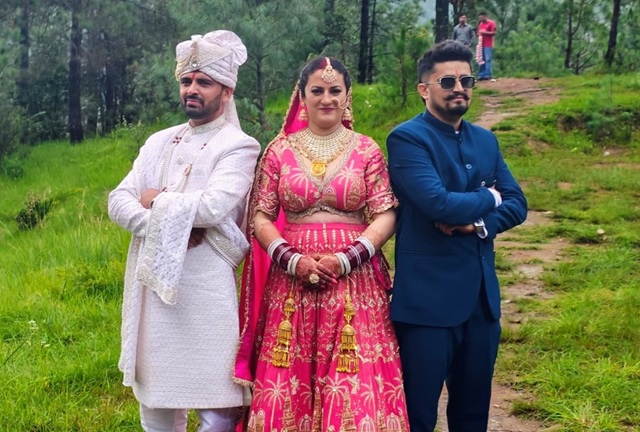
When Sunita Chauhan wed brothers Pradeep and Kapil Negi in July, videos of the wedding in Shillai, a remote village in India’s Himalayan state of Himachal Pradesh, quickly went viral. The ceremony, held over three days with folk songs and drumbeats, drew national attention not only for its celebratory atmosphere but also because the bride married two men at once.
The marriage was carried out under Jodidara, a polyandrous tradition of the local Hatti tribe in which a woman marries multiple brothers to preserve family land and unity. “We followed the tradition publicly as we are proud of it and it was a joint decision,” Pradeep, a government worker, told reporters. His younger brother, Kapil, who works abroad, echoed the sentiment, saying the arrangement would ensure “support, stability and love for our wife as a united family.”
Sunita herself insisted she had entered the marriage willingly: “I was aware of the tradition and made my decision without any pressure,” she told local media.
According to The Independent (UK), such marriages, though sensationalised on social media, are not uncommon in parts of Himachal Pradesh and neighbouring Uttarakhand. Villagers say polyandry dates back centuries, rooted in scarcity of land in the mountainous terrain and tracing cultural justification to the Hindu epic Mahabharata, in which Draupadi was married to the five Pandava brothers.
The Hatti community, numbering about 300,000 people, considers itself descended from the Pandavas and still practices Jodidara in dozens of households. While supporters say the system prevents land disputes and keeps families intact, critics highlight the heavy social pressures often faced by women.
One woman, speaking anonymously to The Independent, described being compelled to accept her husband’s brother into her marriage to avoid dividing farmland. “We were told to either follow the norm or return home,” she said. Another recalled the strain of “keeping one husband happy or another” in such arrangements.
For many, however, the tradition is simply part of life. Some families share wives among three, four, or even six brothers, with children treated as the responsibility of all men in the household. In such cases, biological paternity is downplayed, with children addressing each man as “father” based on profession or role rather than bloodline.
Local leaders defend the practice as pragmatic. “Jodidara was invented thousands of years ago to save a family’s agricultural land from further division,” said Kundan Singh Shastri, general secretary of the Kendriya Hatti Samiti. “More men in a joint family meant more security and fewer conflicts.”
Still, the custom is in slow decline, challenged by shrinking landholdings, urban migration, higher education, and younger generations seeking individual marriages. Yet elders in villages like Shillai argue it remains a stabilising force in family life.
As one villager put it: “This is not new for us. The outside world finds it strange, but here it keeps brothers together and land intact.”