
“A system for speedy case resolution must be established.” — Professor Pratibha Mahanamahewa
“A proper, scientific rehabilitation mechanism is required.” — Sudesh Nandimal Silva
Although a discourse on prison reforms in Sri Lanka surfaces periodically, it rarely garners adequate social attention. This lack of interest stems from a pervasive public perception that prisons host only wrongdoers who have betrayed society. However, for the slogan “Prisoners are human beings too” to truly resonate within human hearts rather than remaining confined to a display board, society must come to grasp a grim reality: the inhumane and wretched life inmates endure inside these walls is far worse than the judicial punishments meted out to them.
Within Sri Lanka’s severely strained prison system, the plight of inmates suffering from extreme overcrowding demands immediate attention, yet the crisis has now festered to an unmanageable degree. Grounded in official data obtained from the Department of Prisons under the Right to Information (RTI) Act and the recent fatal unrest at the Negombo Prison, this article examines the current tragedy of the island’s prisons, the root causes of overcrowding, the historical context, political and legal accountability, and the practical challenges of escaping this quagmire.
The Negombo Prison Clash and Administrative Failure
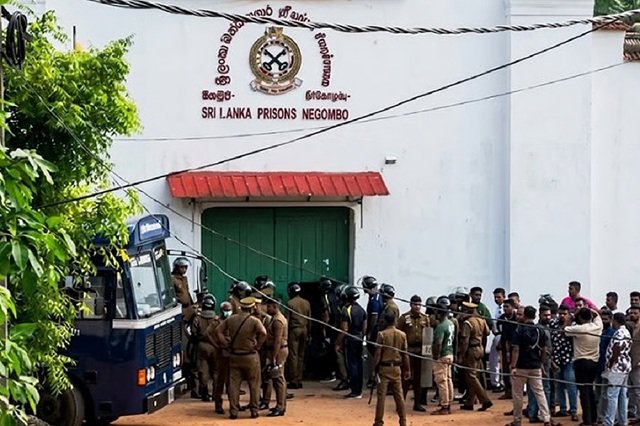
A tragic and bloody manifestation of the systemic collapse and extreme overcrowding across Sri Lanka’s entire prison network was recorded recently at the Negombo Prison. A violent clash erupted between two factions of inmates detained on drug-related charges, escalating into a riot against the prison administration’s anti-drug measures. The unrest concluded with a devastating loss of 29 lives, including 7 prison officers and 22 inmates.
During the chaos, inmates attempted to break through the prison’s main iron gates to escape. Media footage subsequently exposed a security officer firing directly into the compound through a hole in the closed gate—without verification, inquiry, or apparent conscience. Human rights activists have condemned this action, carried out under the guise of “minimum force,” as a dark stain that exposes the brutal and inhumane nature of a structurally criminal state.
The violent confrontation also left 104 individuals seriously injured, who are currently receiving treatment at the Negombo District Hospital and the National Hospital of Colombo. Amidst the unrest, a group of female inmates climbed onto the prison roof, alleging that dengue was spreading rapidly within the facility and that they were being denied proper medical care. Although authorities denied these allegations, it is an open secret that the prison administration has failed to provide even basic sanitary or medical facilities within the cells due to the overwhelming congestion.
The Prison Tragedy Revealed in Numbers
Official data and recent reports from the Department of Prisons up to January 2024 reveal that the maximum statutory capacity across the island’s 36 prisons is limited to just 10,500 inmates. However, according to these official statistics, the total inmate population in the country has surged dramatically to 41,257—nearly four times the system’s legal capacity.
System-Wide Prison Overview (As of January 2024)
| Prison Sector | Statutory Capacity | Current Inmate Population |
| Total System (Island-wide) | ~ 10,500 | 41,257 |
| Convicted Prisoners | – | 11,268 |
| Remand Prisoners (Suspects Awaiting Trial) | – | 20,286 (Over 60% of the total system) |
| Negombo Prison (At the time of the clash) | Limited Capacity | ~ 2,400 (Over 4 times its capacity) |
The island’s 18 remand prisons are holding an inmate population nearly five times their intended capacity. This crisis has reached its peak in facilities such as Welikada, Mahara, Bogambara, Angunakolapelessa, and Negombo.
An individual who was previously held at both the Negombo and Welikada prisons described his experience on the condition of anonymity:
“We were packed with over sixty people in a cell built for about twenty. Sleeping on the floor felt exactly like fish stuffed into a sardine tin. During the hot season, it became an absolute hell. The food was so deplorable that almost everyone constantly suffered from stomach ailments and skin diseases. These places are infested with fleas and mosquitoes.”
Remand Prisons: Inmate Population vs. Approved Capacity (As of January 2024)
| No. | Prison | Inmate Population | Approved Capacity |
| 1 | Colombo Remand | 2,295 | 328 |
| 2 | Jaffna | 857 | 293 |
| 3 | Anuradhapura | 1,046 | 279 |
| 4 | Batticaloa | 656 | 168 |
| 5 | Badulla | 452 | 146 |
| 6 | Galle | 1,005 | 233 |
| 7 | Matara | 607 | 186 |
| 8 | Negombo | 1,881 | 496 |
| 9 | Magazine | 2,923 | 499 |
| 10 | Kegalle | 757 | 136 |
| 11 | Trincomalee | 335 | 112 |
| 12 | Kalutara | 1,528 | 460 |
| 13 | Kuruwita | 1,049 | 362 |
| 14 | Boossa | 168 | 310 |
| 15 | Monaragala | 342 | 148 |
| 16 | Polonnaruwa | 405 | 149 |
| 17 | Wariyapola | 1,598 | 418 |
| 18 | Vavuniya | 443 | 45 |
The Real Root Causes and Operation “Ratama Ekata”
More than 60% of the total prison population consists of remand inmates awaiting trial. The vast majority of them are charged with minor, non-violent offenses.
The strict enforcement of the law under the extensive drug eradication operation “Ratama Ekata” (Country Together), which led to mass arrests, directly contributed to pushing the prison population up to the 41,000 mark. The tragedy lies in the fact that the system entirely lacked the minimum infrastructure required to house the influx of detainees resulting from these sweeps.
Furthermore, an overwhelming backlog of court cases and chronic delays in Government Analyst reports have forced thousands of individuals to languish in cells for months, sometimes years, without a trial. Speaking in Parliament regarding this systemic breakdown, Minister of Justice Adv. Harshana Nanayakkara remarked:
“People have to stay in prison for a year and a half just to find out whether what was found on them was narcotics or Panadol powder.”
A History of Violence: Failing to Learn from the Past
A retrospective look at the history of periodic inmate killings within Sri Lanka’s prison system reveals a long-standing structural crisis that transcends political regimes. The consistent failure to guarantee the safety of inmates from the past to the current administration demonstrates a continuous failure of the State.
- 1983 (President J.R. Jayewardene’s Administration): 53 Tamil inmates were massacred inside the Welikada Prison.
- October 2000 (President Chandrika Kumaratunga’s Administration): A mob broke into the Bindunuwewa Rehabilitation Center, killing between 26 and 29 Tamil political detainees.
- 2012 (President Mahinda Rajapaksa’s Administration): 27 inmates were killed inside the Welikada Prison.
- 2020 (President Gotabaya Rajapaksa’s Administration): 11 inmates were killed during unrest at the Mahara Prison.
- 2026 (President Anura Kumara Dissanayake’s Current Administration): 29 individuals lost their lives in the violent clash at the Negombo Prison.
This historical trajectory underscores that while political leadership changes, the criminal and brutal dynamics embedded within the prison system have never undergone genuine reform, and current rulers have failed to learn from past tragedies.
Constitutional Foundations, Human Rights, and the ‘Carltona Principle’
In a civilized society governed by the rule of law, the moment an individual enters state custody, the absolute responsibility to protect their fundamental human rights—including the right to life—falls squarely on the government. Articles 11 (Freedom from Torture) and 13 of the Constitution of Sri Lanka are critical in this regard. A prisoner or detainee is someone deprived of liberty, not someone stripped of their humanity and rights.
Sri Lanka’s prison system has drawn sharp criticism from United Nations Special Rapporteurs on Torture for human rights violations and systemic corruption. Sudesh Nandimal Silva, Chairman of the Committee for Protecting the Rights of Prisoners, states:
“What exists in Sri Lanka today is a punitive system filled with hatred and torture. There is no scientific method for rehabilitating prisoners. Operations like ‘Yukthiya’ and ‘Ratama Ekata’ only worsened this overcrowding. In some instances, police even plant drugs to imprison people. The system of remissions within prisons must be implemented properly, and cruel punishments akin to torture, like the death penalty, must be completely abolished.”
Ministerial Responsibility vs. True Accountability
According to a core tenet of administrative and constitutional law known as ‘The Carltona Principle’, while a minister may delegate statutory powers to officials, the ultimate and direct responsibility for all actions taken and errors committed by those officials before Parliament and the public rests solely with the Minister-in-charge.
It is legally and morally insufficient for the subject Minister, Harshana Nanayakkara, to merely declare, “I accept responsibility for this.” True accountability is demonstrated only through practical, visible measures to rectify the system and safeguard the right to life for all. It must be emphasized that the Minister cannot absolve himself of accountability by simply pointing fingers at subordinate officers.
“Correction Centers,” Not “Prisons”: Expert Opinion
Professor Pratibha Mahanamahewa, a human rights activist and lawyer who has conducted extensive research on the subject, points out that the very concept of a “prison” is becoming obsolete globally:
“The world is moving toward the term ‘Correction Centers.’ In many countries, including China, you won’t even see a sign that reads ‘Prison.’ In Sri Lanka, these places are not correcting wrongs; they have transformed into ‘institutions that teach crime.’
The primary reason for this immense overcrowding is systemic failure in granting bail and prosecuting cases. There are people held in these facilities for three years—costing the state hundreds of thousands of rupees to feed them—simply because they lack a guarantor to pay a 3,000-rupee fine. There are individuals detained over unpaid divorce maintenance and other minor offenses. To resolve this, Sri Lanka must introduce mechanisms like ‘House Arrest’, as practiced in developed nations.”
The Professor further emphasizes that illicit narcotics (such as methamphetamine/ice and heroin) heavily drive this congestion. Countries like Malaysia have successfully minimized prison inflows by matching supply enforcement with aggressive demand-reduction programs. Sri Lanka must adopt a similar trajectory.
Furthermore, drawing inspiration from nations like China that utilize prison labor for economic development, he stresses that Sri Lanka should formulate frameworks to conditionally engage qualified and skilled young inmates, in agreement with their families, allowing their capabilities to contribute productively to the national economy.
Professional Questions Facing the Current Government
Page 209 of the ruling National People’s Power (NPP) manifesto, “A Rich Country, A Beautiful Life,” contains explicit pledges to “prevent all forms of violence within prisons.” Upon assuming power, no government holds the moral or legal right to merely point fingers at previous administrations for inherited systemic flaws.
Equipped with prior awareness of these deep-seated issues, the current government and the line Minister must face public scrutiny regarding their progress in the following areas:
- What new oversight mechanisms have been introduced to curb corruption, illegal trafficking, and arbitrary conduct by officers within prison administrations?
- What steps have been taken to utilize modern technology, such as smart surveillance systems, for prison security and management?
- What measures are being pursued to expedite the bail process and integrate alternative sentencing methods (such as house arrest) into the legal framework?
- What practical steps have been taken to elevate the human rights of inmates, specifically regarding basic healthcare, mental well-being, and sanitation?
- What transparent program is in place to conduct independent, impartial investigations into deaths and killings inside prisons, ensuring that culpable officers face the full force of the law?
The fatal tragedy at the Negombo Prison is not an isolated incident; it is a horrific symptom of a structural pathology that has plagued the country’s penal system for decades. The government must move beyond rhetoric and immediately execute comprehensive judicial and prison reforms. Restructuring prison conditions and guaranteeing the fundamental human rights and the right to life for detainees is the only way Sri Lanka can demonstrate its commitment to human dignity and forge a more just and equitable society. Otherwise, the current administration risks falling into the same historical category as past regimes, marked by the bloody stains of prison massacres.