


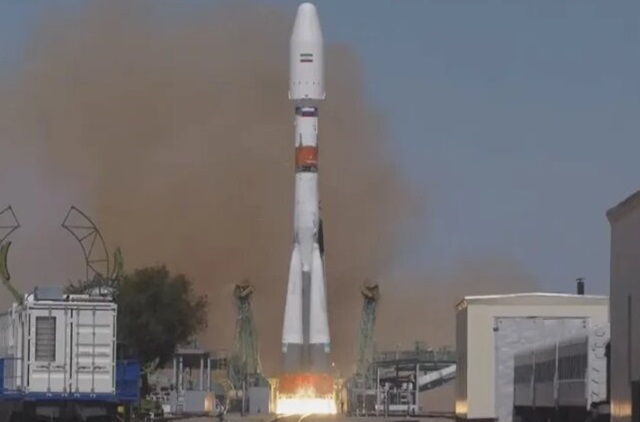
Iran has marked a new chapter in its space program with the successful launch of two satellites, “Hod Hod” and “Kosar,” into low Earth orbit. The satellites were launched aboard a Russian Soyuz-2.1 rocket from the Vostochny Cosmodrome in Russia’s Far East on Tuesday morning, as confirmed by Roscosmos, Russia’s space agency. The event underscores the strengthening cooperation between Moscow and Tehran in the field of space technology.
The launch, executed precisely as scheduled, saw the Soyuz-2.1 rocket carry multiple satellites, including Iran’s “Hod Hod” and “Kosar,” into orbit. The Russian rocket achieved its mission by placing the satellites into their designated orbit just nine minutes after liftoff.
Iran’s Kosar satellite, developed for advanced earth observation, features an imaging resolution of 3.5 meters per pixel, enabling detailed agricultural monitoring, land surveying, and border demarcation efforts. With a projected operational lifespan of two years, Kosar is expected to play a key role in Iran’s resource management and mapping capabilities.
The Hod Hod satellite has been tailored to serve a broad range of applications, including the Internet of Things (IoT), agricultural management, transportation, and crisis response scenarios. This dual-purpose utility highlights Iran’s strategic expansion into high-tech satellite-based services that cater to both infrastructure and emergency needs.
The milestone is significant for Iran’s private sector, as both satellites were launched on behalf of private Iranian entities. Kosar, for instance, was developed by Omidfaza, a company that embarked on its satellite design journey in 2019, reflecting the maturation of Iran’s commercial space sector. With this accomplishment, Iran joins a select group of ten nations with recognized space technology capabilities and is now the leading country in the Middle East for space science.










