US Treasury Secretary Scott Bessent’s threat to unleash an “economic D-Day” against Iran risks placing the United States on a collision course with China, Tehran’s main trading partner and the buyer of around 90 per cent of Iran’s oil.
The immediate question is whether the Trump administration will actually carry out a threat it has made before. President Donald Trump has previously warned that the United States would impose secondary sanctions on any nation or company buying Iranian oil, but Washington never followed through. That history has fuelled scepticism over whether the administration will now target Chinese companies, particularly as it seeks to preserve a fragile trade truce with Beijing and avoid another shock to the global economy.
On Monday, Bessent promised an “economic onslaught against Iran’s financial connections around the globe” as Trump seeks to wind down his unpopular war in the Middle East. The Treasury Department announced dozens of new sanctions targeting entities, individuals and vessels, while Bessent used a high-profile news conference to warn of possible secondary sanctions against companies and countries that continue doing business with Iran.
China presents the central challenge. It is by far the biggest buyer of Iranian oil and provides Tehran with a crucial connection to the global economy. Any campaign aimed at cutting off Iran’s remaining revenue streams would therefore be difficult to make effective without eventually targeting Chinese companies.
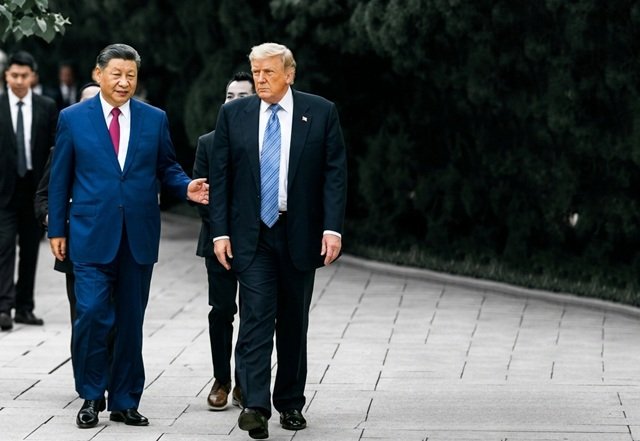
Yet doing so could open a new economic confrontation with Beijing only weeks before Trump and Chinese President Xi Jinping are due to meet in September. Asked directly on Monday about imposing new measures on China, Bessent said “no one is above the reach of U.S. sanctions”, but added that he preferred “quiet diplomacy” and that “we’re not going to name names”.
“Bessent largely deflected questions about China,” said Craig Singleton, a senior fellow at the Washington-based Foundation for Defense of Democracies. “That makes tactical sense ahead of next month’s summit, but strategically it risks reinforcing Beijing’s view that Washington is reluctant to impose serious costs on major Chinese actors.”
China has long argued that unilateral US sanctions against Iran are illegitimate. Although China’s state sector has largely complied with restrictions to limit economic fallout and preserve access to the US financial system, Beijing has allowed private “teapot” refiners to use workarounds to import and process Iranian crude.
In May, China ordered domestic companies not to comply with US sanctions on five refiners, leaving its largest banks caught between Beijing’s directive and the risk of losing access to the US financial system. China’s Foreign Ministry spokesperson, Lin Jian, said on Monday that “sanctions and pressure tactics do no help in resolving issues. They will only lead to escalation that serves no one’s interest”.
A direct attack on major Chinese financial institutions could have consequences far beyond Iran. Michael Sobolik, a senior fellow at Hudson Institute, said Beijing could view such action as “not only as destabilizing and as insulting, but also as a breach of” the trade truce reached by Trump and Xi.
China could retaliate through measures including further export restrictions on critical minerals vital to global manufacturing or limits on crucial pharmaceutical exports to the United States.
The wider economic risks are already substantial. The conflict launched by the US and Israel in late February has disrupted energy supplies and shipping through the Strait of Hormuz, driving up transportation, fertiliser and other input costs while increasing global inflation. Higher freight and insurance costs have added pressure to supply chains.
Bessent acknowledged the danger of moving too quickly, saying countries and companies would first be given an opportunity to cut their ties with Iran. “We are giving everyone the opportunity to remedy bad behavior,” he said. “Why would I want to blow up the global financial system?”
The experience of sanctions against Russia after its invasion of Ukraine in 2022 also offers a warning. Despite sweeping restrictions, Russia redirected trade towards countries including China and India, while the resulting disruption pushed up energy and food prices.
Secondary sanctions against countries doing business with Tehran could therefore widen the conflict well beyond Iran, affecting China, India, Turkey and Gulf states. “The U.S. is essentially expanding its war in the Gulf to a much greater war between itself and other global actors around the world,” said Vali Nasr, a professor at the Johns Hopkins School of Advanced International Studies and a former adviser to the U.S. State Department.