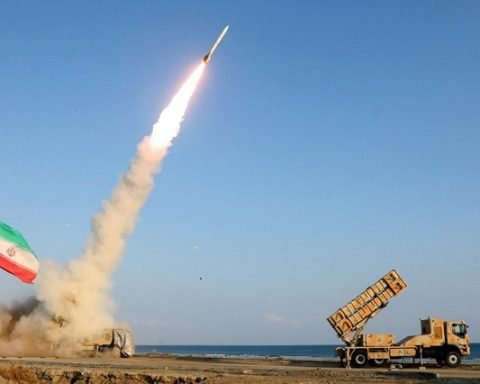
Iran is preparing to open its first full-scale spaceport in the southeastern coastal city of Chabahar, a bold move that underscores the Islamic Republic’s growing ambitions in space—and deepens international anxiety over the military potential of its rocket technology.
According to Bloomberg, the Chabahar facility, spanning 14,000 hectares along the Gulf of Oman, is expected to anchor Iran’s long-term space agenda. Often likened to the U.S.’s Cape Canaveral, the site is strategically closer to the equator than Iran’s existing launch bases, allowing rockets to gain more speed and efficiency from Earth’s rotation.
The new launch site is emblematic of Iran’s wider push into space, a domain it increasingly sees as both a symbol of national pride and a strategic asset. Despite years of U.S. sanctions and efforts to block its program, Iran has made steady progress. Both the Iranian Space Agency and the Islamic Revolutionary Guard Corps (IRGC)—designated a terrorist organization by the U.S. during Donald Trump’s first term—have successfully launched rockets and satellites into orbit.
Among Iran’s most high-profile projects is a planned network of 20 internet satellites named after General Qassem Soleimani, the IRGC commander killed in a 2020 U.S. drone strike. While Iran maintains that its space program is civilian in nature, critics argue the technology used in space launches is virtually identical to that needed for intercontinental ballistic missiles (ICBMs).
“Iran’s work on space-launch vehicles — including its two-stage Simorgh rocket — likely shortens the timeline to produce an ICBM,” General Anthony Cotton, head of U.S. Strategic Command, told the Senate Armed Services Committee in March.
Since Trump’s re-election in 2024, pressure on Tehran has intensified. His administration has pushed for renewed nuclear negotiations and warned of possible military action if Iran fails to rein in its atomic and missile programs. Talks between U.S. and Iranian officials were recently held in Oman, with a second round expected.
Bloomberg reports that Iran has strengthened ties with Russia to bolster its aerospace expertise. In 2024, Russian rockets launched Iran’s first two privately built satellites, while Moscow continues to use Iranian drones in its war in Ukraine. Analysts say the collaboration gives Tehran valuable know-how in both civilian and military space technologies.
Despite a struggling economy and limited public financing—just $11 million was allocated to Iran’s space agency last year—Iran continues to prioritize its space efforts. Iranian officials openly acknowledge that the program supports broader defense goals. President Masoud Pezeshkian recently called it a “driving force behind missile development.”
The West remains deeply concerned. The UK and EU sanctioned IRGC Aerospace Commander Brigadier General Ali Jafarabadi last year, citing his role in developing satellite carriers crucial to long-range missile capability. Israel, too, has publicly accused Iran of using its space program to mask ballistic missile development.
Still, not all experts believe Iran intends to pursue ICBMs. “Without nuclear warheads, it doesn’t make sense,” said Sina Azodi of George Washington University. “What are you going to do with that ICBM? Iran won’t do that.”
Iran’s leaders say the program is about asserting technological sovereignty and elevating national prestige. “Prestige is a major driver of these programs,” Bloomberg Economics analyst Dina Esfandiary said.
Chabahar’s long-delayed opening, originally scheduled for 2024, is now expected this year. Two satellite launches have been pushed back, but Iranian officials remain optimistic—planning even more ambitious missions, including future crewed flights.
“The symbolism of these programs cannot be overstated,” said H.A. Hellyer, senior fellow at the Center for American Progress. “Even if the results are limited, the message to the world is clear: Iran is not backing down.”