


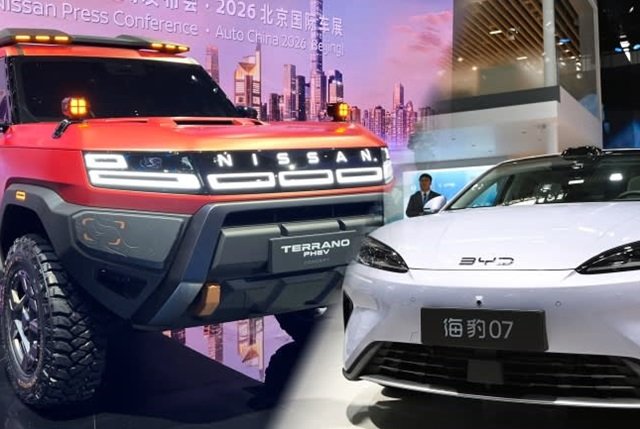
Japan’s automotive industry is undergoing a strategic reset as leading manufacturers scale back ambitious electric vehicle plans in response to the rapid rise of Chinese competitors such as BYD. Honda Motor has formally withdrawn its earlier target of making electric and fuel cell vehicles account for 100% of its new car sales by 2040, marking a sharp reversal from its 2021 vision of an all-electric future.
Honda’s retreat reflects broader uncertainty in global EV demand and intensifying competition, particularly from China, where domestic manufacturers dominate a fast-expanding market. The company had previously committed around 10 trillion yen in investment toward electrification and planned major initiatives, including a Canadian EV supply chain and a joint electric vehicle project with Sony. However, several of these efforts have now been scaled back or shelved, including the cancellation of the Afeela EV project, as Honda shifts focus back toward hybrid vehicles and internal combustion engine technologies.
The shift comes amid financial strain across Japan’s auto sector, with Honda reporting its first annual net loss since its stock market listing in 1957. Nissan has also posted consecutive annual losses, while Toyota is projected to see declining profits in the coming fiscal years. Analysts attribute much of the pressure to the rapid expansion of Chinese automakers, whose speed, cost efficiency, and technological advances have reshaped global competition.
BYD has emerged as the most disruptive force, significantly expanding its global market share in just a few years and overtaking multiple Japanese brands. Alongside companies like Geely, Chinese manufacturers have leveraged aggressive pricing strategies, digital integration, and rapid development cycles—often launching new models in under two years compared with Japan’s four to five years. Their advances in batteries, autonomous driving, and software-defined vehicles have further widened the gap.
Industry experts warn that Japan’s traditional strengths in reliability and manufacturing quality are no longer sufficient in the evolving EV market. Chinese automakers are not only dominating domestic sales but are also expanding aggressively into global markets, including the Global South, where lower-cost electric vehicles are rapidly gaining traction. At major auto exhibitions, companies like BYD, Xpeng, and Li Auto have showcased breakthrough technologies such as ultra-fast charging batteries and advanced self-driving systems, reinforcing perceptions of technological leadership.
In response, Japanese manufacturers are pivoting toward collaboration rather than direct competition. Toyota has taken a leading role in promoting industry-wide cooperation, arguing that no single company can withstand global competition alone. The company is expanding partnerships with domestic firms such as Suzuki, Mazda, and Subaru, while also working with technology companies like NTT on software and autonomous driving systems. Honda and Nissan are also exploring deeper cooperation after previous merger discussions collapsed.
Japanese automakers are increasingly looking to China not only as a competitor but also as a source of technology and production efficiency. Companies are adopting localized supply chains and integrating Chinese-developed systems, particularly in advanced driver assistance technologies. However, experts caution that relying on Chinese manufacturing for global exports could weaken Japan’s domestic industrial base over time.
At the same time, companies are targeting growth in emerging markets such as India, which is being positioned as a strategic export hub for the wider Global South. Firms like Suzuki and Toyota are expanding production capacity there, leveraging cost advantages and established market presence to strengthen their international footprint.
Despite these efforts, analysts remain divided on Japan’s long-term competitiveness. While some believe Japanese automakers can still rely on durability, service networks, and long-term ownership value, others warn that the scale and speed of China’s automotive ecosystem may prove overwhelming. With hundreds of Chinese brands competing globally, Japan’s industry faces mounting pressure to reinvent itself in a market increasingly defined by electrification, software, and rapid innovation cycles.











