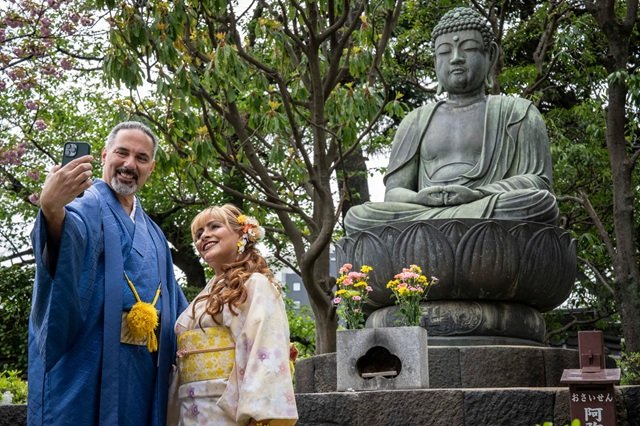
Japan’s newest export industry does not leave factories on cargo ships. It arrives by plane, fills hotels, spends in restaurants and shops, and is reshaping the country’s economic strategy. After decades of relying on manufacturing powerhouses such as automobiles, electronics and heavy engineering, Tokyo is turning increasingly towards tourism as a source of future growth.
The shift comes as Japan faces pressure on some of its traditional industries from global competition, including China’s expanding electric vehicle sector and growing trade tensions affecting Japanese exporters. Tourism, by contrast, has emerged as one of the few sectors delivering rapid expansion.
Last year, 42.7 million foreign visitors arrived in Japan, breaking the previous record by nearly 16 per cent. The government is now aiming even higher, setting a target of 60 million international arrivals annually by 2030 and investing billions of yen into airports, rail networks and tourism infrastructure to support the ambition.
At Narita Airport, the main international gateway serving Tokyo, construction crews are extending the second runway to 2,500 metres while developing a new 3,500-metre third runway. The expansion project is designed to increase annual flight capacity from 340,000 movements to 500,000.
Transport planners are also preparing major rail improvements. By the early 2030s, train frequency between Narita and central Tokyo is expected to nearly double, while new extensions will connect railway lines more directly with Haneda Airport, improving links between international and domestic travel routes.
Private investment has followed the government’s push. Hotels are expanding across the market, from budget accommodation to luxury resorts, while new travel companies are emerging to meet demand from international visitors.
“Tourism is one of the fastest-growing areas of the Japanese economy,” said Martin Schulz, chief policy economist at Fujitsu’s Global Market Intelligence Unit. He said tourism has a significant impact on domestic services, including hotels and restaurants, while supporting employment and wider economic activity.
Government figures show that tourism, combining domestic and international travel, now contributes around 5.6 per cent of Japan’s gross domestic product, worth approximately 34.3 trillion yen (US$211 billion) annually. It has become Japan’s second-largest export earner, behind the automobile industry.
The rise of tourism reflects a broader search for new economic drivers. Japanese companies that once dominated global markets in electronics, engineering and automobiles have faced growing challenges from international competitors. Tourism has offered Tokyo a new avenue for growth at a time when several traditional industries are under pressure.
Schulz traces the roots of Japan’s tourism strategy back to the aftermath of the economic downturn that followed the collapse of the property bubble in the 1990s. During the country’s prolonged period of economic stagnation, manufacturers increasingly moved production overseas, while financial institutions struggled with large amounts of bad debt.
Japan eventually recognised the need for alternative sources of income, with tourism and digital services becoming important parts of the country’s economic transformation. The strategy was influenced by other developed economies, particularly in Europe, where tourism has long generated significant foreign revenue.
A key turning point came through visa reforms. Instead of focusing primarily on smaller, wealthier travel markets in Europe and North America, Japan began targeting neighbouring Asian countries with much larger populations, prioritising visitor numbers and accessibility.
The path, however, was disrupted several times. The 2011 earthquake, tsunami and Fukushima nuclear crisis caused international arrivals to decline sharply. The recovery was interrupted again in 2020 when the Covid-19 pandemic halted global travel.
Japan eventually recovered strongly. Visitor spending reached 9.5 trillion yen in 2025, another record, helped partly by the weak yen, which made Japan one of the world’s most affordable destinations for overseas travellers.
Arrivals have remained strong in 2026, despite a slight decline in the first five months of the year. Between January and May, visitor numbers fell 1.1 per cent to 17.94 million, but officials maintain that the 60 million annual visitor target remains achievable.
The rapid growth has also created new challenges. Tourism is heavily concentrated in a small number of locations, placing pressure on some of Japan’s most popular destinations.
Kumi Kato, a tourism professor at Japan’s Wakayama University, said greater efforts were needed to encourage visitors to explore more regions of the country. Nearly 70 per cent of overnight stays by foreign visitors are concentrated in just five prefectures: Tokyo, Osaka, Kyoto, Hokkaido and Okinawa.
Kyoto has experienced particularly intense pressure, with almost 63 million domestic and international visitors recorded last year. The city’s historic streets and temples have faced increasing congestion as large numbers of tourists follow the same routes and attractions.
Kato said Japan’s affordability has attracted many first-time visitors, but many continue to visit the same well-known destinations rather than discovering less-visited areas.
Another challenge facing Japan’s tourism strategy is geopolitical uncertainty, particularly relations with China. Chinese visitors have historically represented a significant share of Japan’s tourism market, and tensions between Tokyo and Beijing have affected travel flows.
Schulz said China’s ability to influence tourism through travel restrictions represents a vulnerability for Japan. Following diplomatic tensions over comments by Japanese Prime Minister Sanae Takaichi regarding a possible Taiwan contingency, visitor numbers from mainland China dropped sharply.
While arrivals from South Korea and Taiwan increased, Chinese visitor numbers fell by 60.4 per cent to 310,000 in May, marking the sixth consecutive monthly decline.
“China is using its travellers as another lever to pressure Japan,” Schulz said, noting that such measures can have a direct economic impact.
Japan’s transformation into a tourism-driven economy is still unfolding. As Tokyo invests in airports, railways and visitor infrastructure, the country is seeking to turn record arrivals into a stable source of long-term growth while managing the pressures created by its own success.