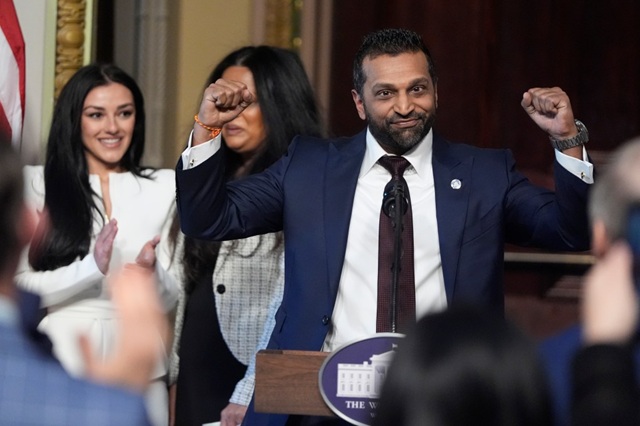
Kash Patel’s appointment as FBI Director has set the stage for one of the most controversial shake-ups in the agency’s history, drawing intense scrutiny from former agents, lawmakers, and international security experts. With Patel—a longtime Trump loyalist—at the helm, concerns are mounting that the FBI, an institution traditionally committed to political neutrality, is on the brink of a radical transformation.
As The Times UK reports, Patel’s past rhetoric and deep allegiance to Donald Trump raise alarms about the potential weaponization of the agency against political adversaries. His repeated claims of a “deep state” conspiracy within the FBI have fueled speculation that he intends to purge officials who were involved in past investigations of Trump and his allies. Reports suggest that Patel has compiled an “enemies list” of over 60 names, including former attorneys general and senior FBI officials, signaling a possible crackdown on internal dissent.
The implications of Patel’s leadership extend beyond domestic politics. Former FBI agents have warned that his approach could compromise national security by driving out experienced intelligence officers, many of whom possess critical knowledge of foreign threats. A former counterintelligence officer told The Times UK that “America’s enemies are foaming at the mouth” at the prospect of disgruntled FBI officials, stripped of their positions and resources, becoming vulnerable targets for recruitment by foreign intelligence services, including Russia, China, and Iran.
Adding to concerns is Patel’s appointment of Dan Bongino—a former New York police officer turned right-wing media personality—as his deputy. Bongino, known for his inflammatory rhetoric and promotion of conspiracy theories, is expected to play a central role in reshaping the FBI’s operations. Critics argue that placing such overtly political figures in leadership positions undermines the agency’s independence and could turn its vast investigative powers into tools of political retribution.
The echoes of history are hard to ignore. Many observers draw parallels between Patel’s vision for the FBI and the authoritarian tactics employed by J. Edgar Hoover, the agency’s notorious first director. Hoover used the FBI as a political weapon, surveilling civil rights leaders, journalists, and activists under the guise of national security. Patel’s repeated calls to dismantle the current FBI structure and his disdain for traditional oversight mechanisms suggest a return to an era where the agency’s immense power could be used to settle political scores.
Democrats and civil liberties advocates are already warning of the potential abuse of the FBI’s far-reaching surveillance capabilities. With access to classified intelligence, counterterrorism resources, and domestic surveillance tools, Patel’s FBI could become a powerful instrument of political coercion. Experts fear that investigations into Trump’s critics, journalists, and opposition figures could be launched under the pretext of national security, creating an atmosphere of fear and intimidation.
Despite the growing backlash, Trump and his allies are pushing ahead with their vision for a restructured FBI, arguing that the agency has been deeply compromised by partisan actors. Patel himself has dismissed concerns over his leadership as “hysteria from the corrupt establishment,” vowing to root out what he describes as a “shadow government” within federal law enforcement.
As the situation unfolds, the future of the FBI—and its role in American democracy—hangs in the balance. Will Patel’s leadership mark the beginning of a new era of political control over the nation’s top law enforcement agency, or will institutional safeguards prevent the bureau from being transformed into a weapon of partisan warfare? The world is watching, and the stakes could not be higher.