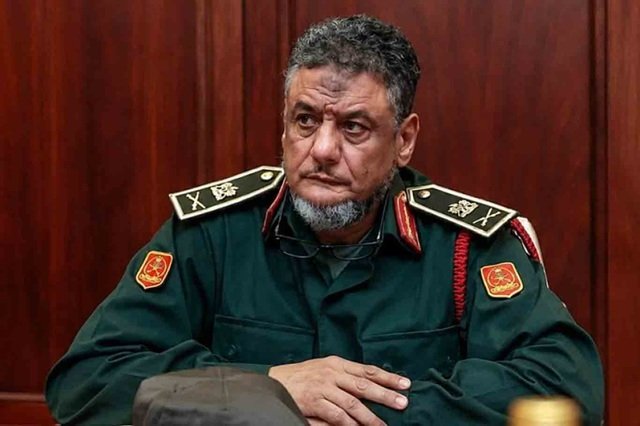
Libya’s eastern-based army said Tuesday that its military intelligence chief, Fawzi al-Mansouri, was killed in a car bombing in Benghazi, raising fresh questions about security in an area controlled by military commander Khalifa Haftar.
Al-Mansouri was assassinated on Monday night when an explosive attached to his car detonated as he was leaving a local mosque, according to a statement from the Libyan National Army (LNA), which controls eastern Libya and parts of the south. The killing took place in Benghazi, the main stronghold of Haftar and his forces.
Authorities have not identified those responsible for the attack. Khaled Haftar, the son of Khalifa Haftar, said an investigation had been opened and that initial indicators pointed to what he described as “a despicable terrorist tactic”.
“Terrorism is a project targeting the entire region, not just Libya,” his statement added.
The assassination represents a significant security setback for the Haftars, who have sought to portray the territories under their control as stable. Hamish Kinnear, an analyst with UK-based Verisk Maplecroft, said an attack of such sophistication in an LNA stronghold was a major blow to the group’s security credentials.
“The intelligence required to target such a high-profile figure successfully is indicative of significant capabilities on the part of the responsible actor,” Kinnear said.
The killing also comes at a sensitive moment for Libya, which has remained divided since the 2011 war that led to the ousting of former leader Muammar Gaddafi. Two rival governments currently compete for power: the UN-recognised administration in Tripoli led by Prime Minister Abdulhamid Dbeibah and a rival administration in Benghazi backed by Haftar and the LNA.
Efforts are meanwhile under way to reunify the country’s executive powers under a Washington-mediated plan that the LNA has publicly supported. The assassination has raised questions about whether renewed instability could undermine those efforts.
Kinnear said the attack did not bode well for the US plan to reunify Libya and warned that a new and destabilising power struggle could emerge.
Libya expert Jalel Harchaoui said the killing could “disrupt, or at the very least delay” the US-brokered agreement. He argued that the plan rests partly on the assumption that security prevails in Benghazi and that senior officers can rely on protection through their loyalty to Saddam Haftar, Khalifa Haftar’s son and heir apparent.
But the bombing of the head of military intelligence as he left a mosque directly challenges those assumptions, Harchaoui said.
He also said reunification would require gestures of openness towards reform and change within the army, adding another challenge to an already fragile political process.
The Tripoli-based government condemned the killing as a “terrorist attack”, saying it rejected the assassination “regardless of one party’s positions or alliances”.
Khaled Haftar’s office later said authorities had arrested a “terrorist cell in Benghazi that was preparing to carry out acts of sabotage”. It did not say whether the alleged cell was connected to al-Mansouri’s assassination.
Al-Mansouri’s funeral was held in Benghazi on Tuesday afternoon, with photographs showing armed men in military fatigues alongside senior LNA officials, including Khaled and Saddam Haftar. The LNA described him as a “heroic martyr”.
Al-Mansouri was a prominent military figure with close ties to the Haftar family. He played a key role in the LNA’s fighting against jihadist groups, including the Islamic State, between 2014 and 2017 in parts of eastern Libya.
He was also a leading figure in Haftar’s Russia-backed offensive to seize Tripoli in 2019. The offensive was ultimately thwarted by forces in the capital with support from Turkey.
His assassination now places renewed scrutiny on the security of the eastern territories and the resilience of the political arrangements surrounding the Haftar family. At a time when Libya’s rival authorities are attempting to move towards reunification, the killing of a senior intelligence official in Benghazi highlights the continuing fragility of that process.