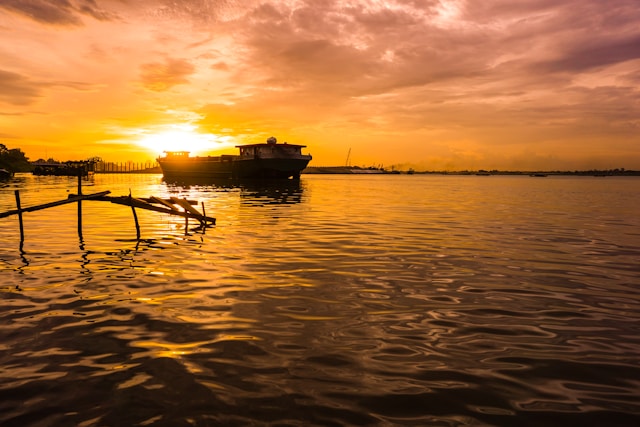
Once revered as the lifeblood of mainland Southeast Asia, the Mekong River is now battling for survival. Stretching across six countries and supporting tens of millions of people, the river’s flow has been altered and its future jeopardized by a cascade of developments—both natural and man-made. At the heart of its struggle lies Cambodia, a nation that has both relied on and endangered the Mekong in equal measure, fueled in part by an increasingly complex relationship with China.
For centuries, the Cambodian people lived in harmony with the rhythms of the Mekong. The river and its tributaries, including the Tonlé Sap lake, provided not just sustenance but cultural identity. This equilibrium was violently disrupted during the Khmer Rouge era, when Pol Pot’s regime devastated the country’s wetlands, decimated its forests, and destroyed delicate ecosystems that had sustained generations. Species like the Irrawaddy dolphin were hunted, wetlands cleared, and the harmony of river life unraveled.
In recent years, China’s Belt and Road Initiative (BRI) has provided new challenges for Cambodia’s environment and its people. Through Chinese-funded projects such as the controversial Funan Techo canal, Cambodia has tied its economic aspirations to Beijing’s strategic interests. Framed as a boost to agriculture and national pride, the canal threatens to irreversibly alter the Mekong’s flow and deepen its ecological wounds. Critics see a potential military dimension to the project, with fears that the canal could give China naval access deep into Southeast Asia. While Phnom Penh emphasizes the project’s economic benefits, its true cost—ecological, social, and geopolitical—remains obscured.
Across the Mekong Basin, more than 700 dams have already disrupted the river’s once-natural cycles. Sediment vital for fish spawning is trapped, while dams in Laos and China have altered fish migration routes, leaving Cambodians like Kong Chi Na, a third-generation fisherman, struggling to survive. Once bountiful waters are now unpredictable and unyielding. “The river can no longer understand itself,” Kong laments. His father, a fierce opponent of dam projects, was killed while trying to adapt to the changing environment, a grim reminder of the risks faced by those who challenge the status quo.
For ordinary Cambodians, these developments are accompanied by fear and displacement. In Prek Takeo, where the Funan Techo canal begins, villagers live in uncertainty, knowing their homes and farmland are at risk. Many are afraid to speak out, haunted by the lingering specter of authoritarian rule and threats of jail or denial of compensation. South of the Omtok reservoir, where sand mining for Phnom Penh’s new Chinese-funded airport has already claimed farmland, the canal’s potential impact looms large. “When the canal comes, that will all be gone,” says Park Sim, a farmer who has already lost the land she once used to grow rice.
At Ream Naval Base near the canal’s planned outlet, Chinese warships stationed under the guise of “military cooperation” with Cambodia hint at the geopolitical stakes. Despite denials from both Phnom Penh and Beijing, leaked reports of a 30-year Chinese lease on the base have fueled concerns over China’s expanding military footprint in the region. The Mekong’s waters, once a source of life and community, risk becoming a theater for geopolitical tensions.
Meanwhile, economic shifts driven by river degradation are pushing young Cambodians away from rural areas and into urban centers like Phnom Penh. The city has become one of Asia’s fastest-growing metropolises, ringed by garment factories where rural migrants work in grueling conditions. In contrast, coastal towns like Sihanoukville, once sleepy fishing villages, have become dystopian hubs of Chinese investment. Neon-lit casinos and half-finished skyscrapers dominate the skyline, a reflection of unchecked development and lawlessness. Even Chinese investors, once eager to exploit the area’s economic potential, now hesitate as the region’s reputation sours.
Environmental advocates warn that the Mekong is nearing a tipping point. Brian Eyler, an expert at the Stimson Center, describes the river as dying “a death of a thousand cuts.” Plans for even more dams and the looming canal project may deliver the final blows. Yet there are glimpses of hope. In Kampi, the Mekong’s last Irrawaddy dolphins have shown signs of recovery under protection, with their numbers increasing slightly. Similarly, the ghost fish of the Mekong, long thought extinct, has been spotted in Cambodian waters.
Despite these glimmers of resilience, the broader picture remains grim. Villagers along the Mekong mourn the loss of their livelihoods, their culture, and their connection to a river that once defined their way of life. For many, like 62-year-old Kim Savet, who remembers the horrors of the Khmer Rouge and fears speaking out today, there is little hope of change. “We still do not understand why they are building this canal,” she says.
The Mekong, often referred to as the beating heart of Southeast Asia, now faces death by overexploitation and geopolitical ambition. Its decline is not just a local tragedy but a global crisis, touching lives far beyond its shores. The river, which feeds the world through fish, rice, and shrimp exports, connects all who rely on its bounty. As Eyler warns, the slow death of the Mekong is not inevitable—but action must be taken to preserve what remains of this ancient lifeline before it is too late.
Excerpts from the report originally published in The Times (UK).