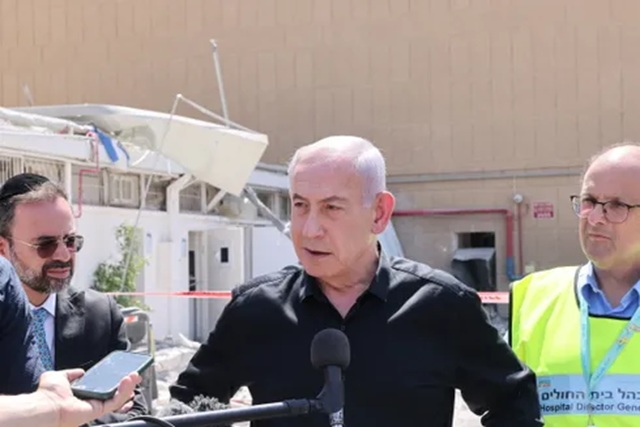
During a visit to Soroka Medical Center in southern Israel on Thursday, Prime Minister Benjamin Netanyahu acknowledged the widespread toll of ongoing missile attacks, noting that “all Israelis are paying the price”—including his own family.
The prime minister’s remarks came as he surveyed damage caused by an Iranian missile strike on the hospital, one of many facilities hit amid a wave of unprecedented long-range attacks that have left both urban centers and peripheral regions vulnerable.
“There are people who were killed, families who grieved loved ones—I really appreciate that,” Netanyahu said. He then pointed to the personal impact the war has had on his family, revealing that his son Avner was forced to cancel his wedding for a second time due to the threat of missile strikes. “Certainly a heavy personal price paid by him, his fiancée, and our family,” Netanyahu added.
The comment came as Netanyahu sought to emphasize the shared burden of the conflict, though it drew a mixed response from the public and commentators. While some appreciated the acknowledgment of civilian suffering, others questioned the framing, noting the vastly different experiences between those who face the war from the frontlines or from unprotected homes—and those with access to security and state resources.
The missile strike on Soroka, a major hospital serving the southern region, has intensified concerns about Israel’s ability to safeguard critical infrastructure and civilian populations amid escalating regional tensions. Health officials reported structural damage but confirmed that emergency protocols helped prevent greater casualties.
The war, now entering its second year, has disrupted daily life across the country, with rocket sirens and shelter shortages affecting millions. For many, the cancellation of weddings, school closures, and interrupted medical care have become part of a new normal under fire.
Despite the prime minister’s visit and expressions of solidarity, critics continue to urge the government to prioritize rapid investment in public protection systems—especially in underfunded areas with minimal access to shelters and fortified structures.