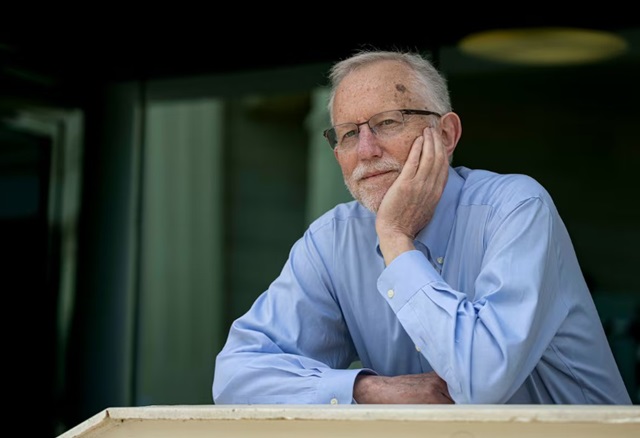
A man who once inspected tomatoes and cleaned toilets after late-night parties now stands among the world’s most respected scientists. American virologist Charles M. Rice, Nobel Prize laureate in Physiology or Medicine, has saved millions of lives through his groundbreaking research into hepatitis C — yet he remains deeply concerned about the unequal access to the cure his work helped make possible.
In a recent interview with El País during his visit to Valencia, where he served as a juror for the prestigious Rei Jaume I Awards, Rice spoke candidly about the paradox at the heart of modern medicine: the existence of a cure for hepatitis C and the persistent global failure to deliver it to all who need it.
A Discovery That Changed the World
Rice, born in Sacramento 72 years ago, shared memories of a youth marked by exploration and uncertainty. From odd jobs in food factories to a soul-searching road trip through Latin America, he slowly found his calling in science. Eventually, as a virologist at Washington University in St. Louis, Rice built on the discoveries of Harvey Alter and Michael Houghton to prove in 1997 that the hepatitis C virus was responsible for transfusion-related hepatitis.
This breakthrough, recognized by the Swedish Nobel Committee in 2020, led to the development of life-saving diagnostic tests and treatments. One of the most impactful results of Rice’s work was sofosbuvir, a revolutionary antiviral drug developed in 2007 by chemist Michael J. Sofia. The drug effectively cures hepatitis C, a virus that still infects an estimated 50 million people and causes 240,000 deaths annually.
A Cure Priced Out of Reach
When U.S. pharmaceutical giant Gilead Sciences acquired Sofia’s company Pharmasset for $11 billion, they brought sofosbuvir to market — but at an initial price of $84,000 per patient. Though Gilead argued the price reflected research and development costs, Rice called the figure “dismaying,” particularly since the manufacturing cost was reportedly as low as $100 to $200.
“It’s a crime that a drug exists that could cure everyone and yet not everybody has access to it due to its price, among other reasons,” he told El País. While countries like Egypt and Spain have successfully negotiated lower prices and rolled out widespread treatment programs — Egypt even manufacturing the drug locally — vast disparities remain. In Latin America, for instance, only about 1% of the estimated four million hepatitis C patients receive treatment.
Public Investment, Private Profit
Rice also responded to concerns about whether taxpayers are effectively “paying twice” — first funding the early research and then facing high prices for the resulting drugs. A Harvard University study estimated that $61 million of public funds supported early development of sofosbuvir.
“What taxpayers paid for was research like ours,” Rice acknowledged, emphasizing the crucial but partial role of public funding. “But you can’t say we paid $61 million for the drug and that’s all it’s worth.”
A Shrinking Window to Eradicate the Virus
Despite the existence of a cure, Rice is skeptical that hepatitis C will become the second human disease after smallpox to be eradicated. While praising Spain’s progress, he criticized the U.S. for falling behind — a failure he attributes in part to the opioid epidemic, which is fueling new infections, and in part to political shifts.
An initiative under the Biden administration had allocated $10 billion toward hepatitis C elimination, but Rice says that effort has been scrapped by the current administration. “We have drugs that could eradicate the virus, but things are not so simple,” he said.
A Grim Outlook for Science
Rice also lamented a broader anti-science sentiment spreading across the U.S., particularly within politics. “Science is under attack,” he warned, referencing the rise of the anti-vaccine movement and the alarming influence of figures like Robert F. Kennedy Jr., whom he called an anti-vaxxer now holding power over public health discourse.
“This is a pretty grim time for medical research,” he said, citing proposals to slash the National Institutes of Health budget by 40%. Quoting medical research advocate Mary Lasker, he added, “If you think research is expensive, try disease.”
Rice fears the hard-won progress made over decades is being dismantled in mere months. “After the COVID-19 experience, I thought we’d finally have a new golden age for infectious disease research,” he reflected. “But that spirit lasted a couple of years, and then basically all those programs that were in place were stopped.”