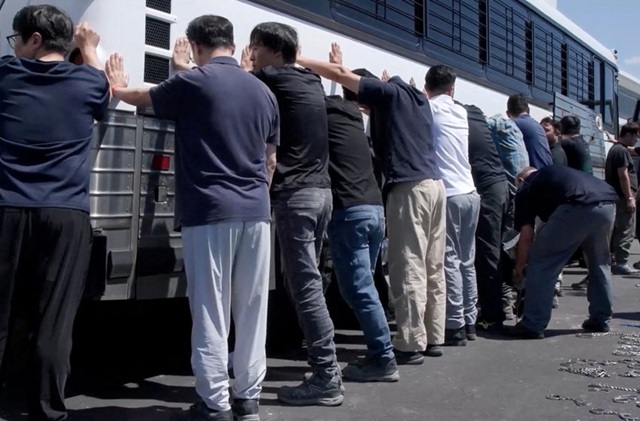
South Korea’s labour minister sharply criticized the treatment of hundreds of Korean workers detained by U.S. immigration authorities last week, saying that “not even prisoners of war” would be treated as harshly as the detained workers. The comments reflect widespread outrage in Seoul, with many calling the incident a violation of human dignity and a strain on the longstanding alliance between South Korea and the United States.
Labour Minister Kim Younghoon, a former rail union leader and close ally of President Lee Jae Myung, told the Financial Times that he was “shocked” by images showing workers at Hyundai and LG’s joint battery plant in Georgia being shackled by armed Immigration and Customs Enforcement (ICE) agents. “The way it was done, it felt like… not even prisoners of war would be treated like that,” he said.
Kim acknowledged Washington’s right to enforce immigration laws but argued that the Korean workers were contributing to the U.S. economy rather than displacing American workers. “They were building a plant that would employ Americans in the future,” he said.
Following a week of intense diplomatic negotiations, a flight carrying 330 detained Korean workers arrived at Incheon International Airport on Friday. The workers were greeted with cheers from family members and government officials. “I am back. I am free,” one worker shouted, raising his arms. Another, Byun Soo-sung, said, “I am so happy to be back. I was dumbfounded that they detained us.”
Vice Foreign Minister Park Yoonjoo and the president of LG Energy Solution, Kim Dong Myung, accompanied the repatriated workers. Park announced that South Korea and the U.S. had agreed to establish a joint working group to address short-term visa issues, aiming for comprehensive solutions.
Foreign Minister Cho Hyun said Seoul would explore setting up a dedicated visa desk in the U.S. embassy in Seoul to assist Korean businesses. He added that U.S. Secretary of State Marco Rubio had assured that affected workers would not face trouble re-entering the U.S.
Despite these assurances, many returning workers expressed reluctance to return. The flight had been delayed by a last-minute offer from President Donald Trump allowing the workers to remain in the U.S., but only one chose to accept it.
Kim Younghoon placed part of the responsibility on the companies involved. He noted that many detained workers were supporting Hyundai’s construction affiliate and said, “Of course the arrested workers were working for Hyundai… everybody knows that this happened in the process of building a Hyundai plant.”
Hyundai’s response referred only to “the immigration enforcement action at the construction site of its supplier,” without acknowledging its ownership stake or the plant’s location. LG declined to comment.
The incident has sparked debate over visa misuse, with industry groups admitting that Korean companies often relied on inappropriate visas for workers in large-scale projects. However, they argue that Washington’s refusal to facilitate proper visas left businesses “in an impossible position.”
At the airport, protesters held placards reading “We’re friends! Aren’t we?” and criticized the U.S. action as a betrayal of the alliance. CivAt the airport, protesters held placards reading “We’re friends! Aren’t we?” and criticized the U.S. action as a betrayal of the alliance. ic group leader Hong Jeong-sik called on Trump to “repent for his bad, unpredictable behaviour,” warning that the environment could deter future investment.
The episode has exposed deep frustrations in South Korea and could test diplomatic and economic ties with its closest ally as Seoul pushes for reforms in visa policies while striving to maintain the strategic partnership.