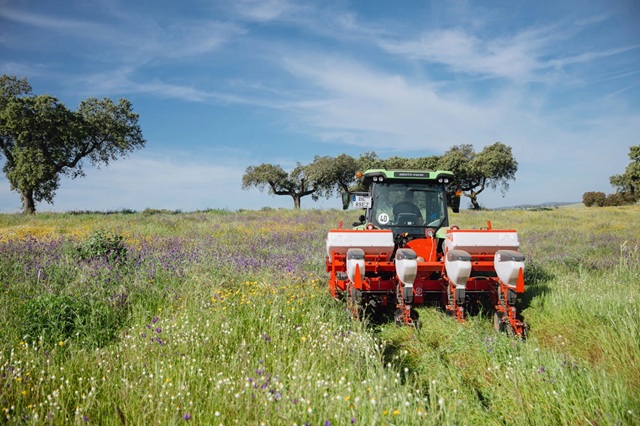
At first glance, Ruben Jorge’s farm near the village of Penha Garcia in eastern Portugal appears like any other rural property. Yet a closer look reveals a quiet revolution unfolding among the rows of young chestnut and pistachio trees. Gone are the stretches of bare earth typical in conventional farming. In their place, a carefully curated mix of grasses and yellow lupin flowers enriches the soil, while wood chips help retain moisture — all part of Jorge’s commitment to regenerative agriculture.
“It’s a natural fertilizer,” Jorge explains, pointing to the lupin plants that capture nitrogen and store it underground. “Anything that adds resilience to the land and preserves it for the future is always a better option — as long as it’s economically viable.”
Jorge’s approach reflects a broader shift across Europe as farmers confront intensifying climate threats. The continent, warming faster than any other since the 1980s, faces escalating droughts, crop failures, and wildfires. Without action, the EU and UK could suffer annual economic damages exceeding €65 billion by 2100, according to scientific estimates cited by Natire.
For farmers like Jorge and his neighbor Herberto Brunk — who is experimenting with mixed grasses and cover crops near Assumar — regenerative methods are both a necessity and a business strategy. By restoring soil health, increasing biodiversity, and improving water retention, these practices offer a buffer against harsher growing conditions.
“Our main goal is to recover the soil, get organic matter up, recycle nutrients, and reduce erosion as much as possible,” says Brunk, whose fields have shown impressive resilience even during dry spells. He also highlights how better soil hydration helped his farm withstand nearby wildfires.
Despite the long-term promise, regenerative agriculture faces significant challenges. Only 2% of European farms are fully regenerative, and between 5–10% are transitioning, according to the European Alliance for Regenerative Agriculture (EARA). Funding is limited, policy frameworks are still developing, and protests by conventional farmers have pushed regulators to ease environmental mandates.
Nevertheless, momentum is building. A growing number of farmers, supported by scientific research, are embracing regenerative methods. Studies reviewed by Natire demonstrate that rotating crops boosts soil biodiversity by 24%, improves water quality by 51%, and enhances pest control by 63%. Meanwhile, regenerative farms have been found to use 61% less synthetic nitrogen and 75% fewer pesticides than conventional farms — yielding up to 20% higher margins per hectare.
The European Union has set ambitious targets through initiatives like the Green Deal and a new nature-restoration law aimed at improving biodiversity and soil health by 2050. Still, experts caution that long-term studies and tailored solutions are needed to adapt regenerative practices to diverse climates.
“Regenerative agriculture is the most important farmer and science movement in the world,” says Simon Krämer of EARA. “It’s gaining traction because people are seeing the benefits.”
For Jorge and Brunk, the rewards are already visible. Their farms are greener, more resilient, and increasingly profitable — even if it takes years to fully realize the gains. As droughts and extreme weather events become more common, their pioneering efforts are setting an example not only for Portugal but for farming communities across Europe.