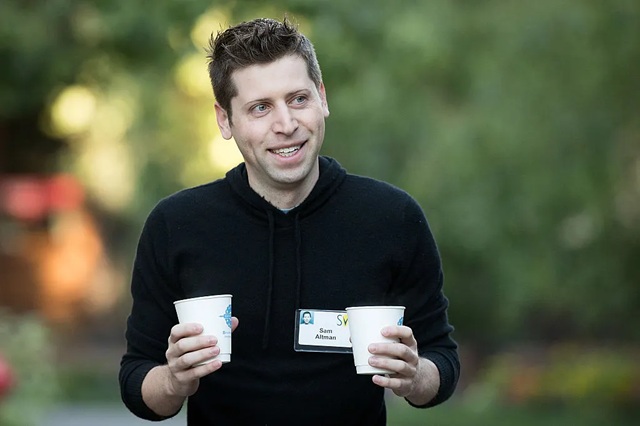
Sam Altman’s controversial digital identity startup “World,” formerly known as Worldcoin, has officially launched in the United States, bringing its iris-scanning orbs and associated cryptocurrency tokens to American users for the first time.
The move signals a shift in the company’s strategy as the Trump administration embraces the digital asset sector and pledges to make the U.S. the “crypto capital of the planet.” Previously, World had focused its rollout abroad, citing regulatory hostility under the Biden administration. Altman, who also leads the $300 billion AI firm OpenAI, once joked the company felt like “World minus the US coin.”
Speaking at a launch event in San Francisco on Wednesday, Altman said, “I’m a very proud American, I think America should lead innovation, not fight it off.” The expansion marks a major step in Altman’s broader vision to ensure humans can be uniquely identified in an increasingly AI-saturated internet.
According to Financial Times, World’s technology relies on biometric iris scans captured by its signature spherical “orbs,” which produce unique digital IDs that can be used to claim Worldcoin tokens. The basketball-sized devices are part of a long-term plan to integrate identity verification directly into consumer hardware like webcams and smartphones.
Adrian Ludwig, chief architect at Tools for Humanity—the company developing World—said, “There were very good reasons why we focused on making sure that the product worked in the entire world before coming to the United States. Some of them are related to regulatory changes.” Ludwig added that the company plans to build up to 10,000 orbs for the U.S. market over the next year, and is constructing a new factory in Richardson, Texas, to scale up production.
Founded in 2019 by Altman and Alex Blania, Tools for Humanity has raised around $200 million from high-profile backers such as Andreessen Horowitz, Khosla Ventures, LinkedIn co-founder Reid Hoffman, and disgraced FTX founder Sam Bankman-Fried, who is now serving a 25-year prison sentence for fraud.
With the rise of advanced AI models capable of imitating humans online, World’s team argues that its technology is no longer speculative. It’s now a necessity. “This is a way to make sure humans remained central and special in a world where the internet had a lot of AI-driven content,” Altman emphasized.
On the same day as the U.S. launch, World announced a partnership with Match Group, the parent company of Tinder, to help verify users and combat fraud on dating platforms. Ludwig also suggested the technology could support identity services across social media, government, and public-sector applications. Potential future partners include Altman’s own OpenAI as well as competitors like Meta and Elon Musk’s X.
Despite its expansion, World remains unprofitable and has faced stiff resistance overseas. Last year, it was blocked in Spain over concerns it was collecting biometric data from minors. Regulatory scrutiny and bans have also come from France, Portugal, Hong Kong, and South Korea.
Ludwig claims the biometric data is anonymized and secure. “In 18 months or so, we will begin to see the costs of operating the network begin to be offset by the fees that are generated by the network,” he said, expressing confidence in the long-term viability of the project.