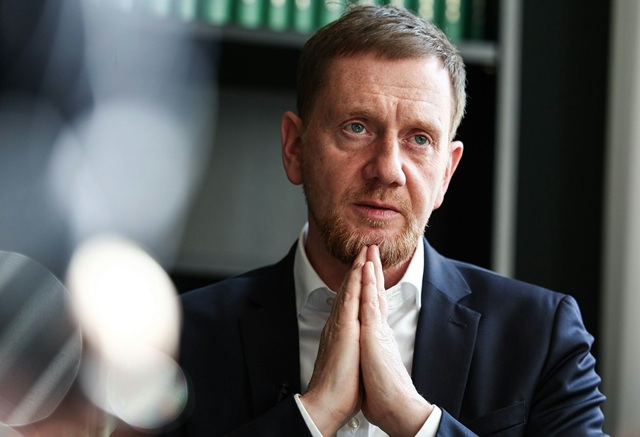
A senior German politician has suggested that sanctions imposed on Russia over its invasion of Ukraine may be harming Europe more than they are affecting Vladimir Putin. Michael Kretschmer, the premier of Saxony and a member of Germany’s centre-right Christian Democrats (CDU), called for discussions on easing punitive measures against Moscow, according to a report by the Financial Times.
Kretschmer argued that the insistence on maintaining sanctions was “completely out of date” and inconsistent with the approach taken by the United States. He told the German press agency DPA, “When you realise that you’re weakening yourself more than your opponent, then you have to think about whether all of this is right.”
His comments have sparked criticism from pro-Ukraine supporters in Germany, including members of the Green party, which has called on CDU leader Friedrich Merz to take a clear stance against those advocating for a revival of ties with Moscow. The party’s parliamentary co-leader Britta Haßelmann urged Merz to “clamp down on friends of Putin” within his ranks.
Kretschmer’s state of Saxony has been a stronghold of far-right and far-left parties, both of which have been accused of being sympathetic to Putin. His remarks align with a broader trend of German politicians questioning the long-term feasibility of isolating Russia, particularly in the energy sector.
In recent weeks, several CDU and Social Democrat (SPD) politicians have publicly discussed the potential for resuming economic ties with Russia once peace is achieved. CDU MP Thomas Bareiß acknowledged the reports—initially covered by the Financial Times—suggesting the possible resurrection of the Nord Stream 2 gas pipeline. He commented on LinkedIn about the business-oriented approach of the U.S., speculating that “the embargoes will be lifted sooner or later and, of course, gas can flow again.”
Similarly, Jan Heinisch, a CDU politician leading coalition talks on energy, noted that after a just and secure peace is achieved, “we must be allowed to talk again about buying Russian gas.” SPD’s Dietmar Woidke, the prime minister of Brandenburg, also called for a normalization of trade relations with Russia once a peace agreement is in place, emphasizing that economic cooperation could improve broader diplomatic relations.
Merz, who is widely expected to become Germany’s next chancellor, faces increasing pressure to clarify his party’s position on Russia. With the CDU and SPD split over how to handle future relations with Moscow, the debate over economic sanctions continues to be a divisive issue within German politics.