


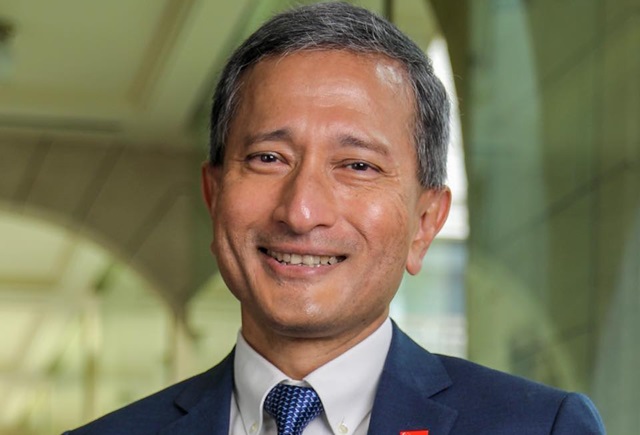
Singapore has voiced growing alarm over the escalating trade tensions triggered by U.S. President Donald Trump’s sweeping tariff hikes, warning that a global trade war could severely harm small, trade-dependent nations. In an interview with the Financial Times, Singapore’s Foreign Minister Vivian Balakrishnan said the new tariffs threaten to dismantle the foundational pillars of the global trading system.
Although Singapore received one of the lowest new tariffs in the Asia-Pacific region—10 per cent—Balakrishnan emphasized that the island nation’s position as a key financial and commercial hub makes it especially exposed to global economic shocks.
“Our greatest fear is that this set of announcements has shaken the foundational pillars of the world trading system right down to the core,” Balakrishnan told the Financial Times. “If that collapses and everything becomes an infinite series of bilaterals, it’s going to be very hostile for small nations. And especially small nations who, like ours, are explicitly sensitive to global trade.”
His remarks follow Singaporean Prime Minister Lawrence Wong’s recent video address to the nation, where he warned that Trump’s aggressive tariff strategy signaled the end of the globalisation era. Wong called the new phase of international trade “more arbitrary, protectionist and dangerous,” and cautioned that Singapore risked being “squeezed out, marginalised and left behind.”
Singapore, whose trade volume exceeds three times its GDP, finds itself particularly vulnerable to disruptions in the global supply chain. The U.S. last week raised tariffs on Chinese goods to an average above 60 per cent, while also targeting more than 150 countries and territories. In retaliation, Beijing imposed a 34 per cent tariff on all U.S. goods and announced additional measures, including export restrictions and a probe into the Chinese unit of U.S. firm DuPont.
President Trump has since threatened to slap an additional 50 per cent tariff on Chinese imports, sending shockwaves through global markets.
The ramifications of the tariffs extend far beyond Singapore. Countries such as Vietnam, Cambodia, Thailand, Indonesia, and Malaysia—many of which had capitalised on the “China plus one” manufacturing strategy—have been hit with much steeper duties, some as high as 49 per cent. These moves threaten to upend regional supply chains and deal a blow to the manufacturing sectors of several Southeast Asian economies.
Malaysia’s Prime Minister Anwar Ibrahim announced over the weekend that, as current chair of ASEAN, his government would spearhead a coordinated regional response aimed at mitigating the damage from Washington’s protectionist pivot.
Balakrishnan acknowledged Singapore’s relatively low tariff rate but stressed that the broader concern lies in the destabilising effect of targeted sectoral tariffs and the blow dealt to its regional partners. He also noted the difficult balancing act Singapore faces in maintaining robust ties with both the U.S. and China. China is Singapore’s top trading partner, with $126 billion in trade last year, while the U.S.—its third-largest partner—recorded $98 billion in trade, including a $30 billion surplus in Washington’s favour.
When asked whether China might emerge stronger in global trade amid the U.S.’s retreat, Balakrishnan offered a measured response: “At a superficial level, the answer is probably yes.” However, he cautioned that China’s own economic challenges, including stagnant domestic demand, would limit its ability to capitalise on the current turbulence. “This global trade war could not have come at a worse time, both for China as well as all China’s partners, and that includes us,” he said.










