


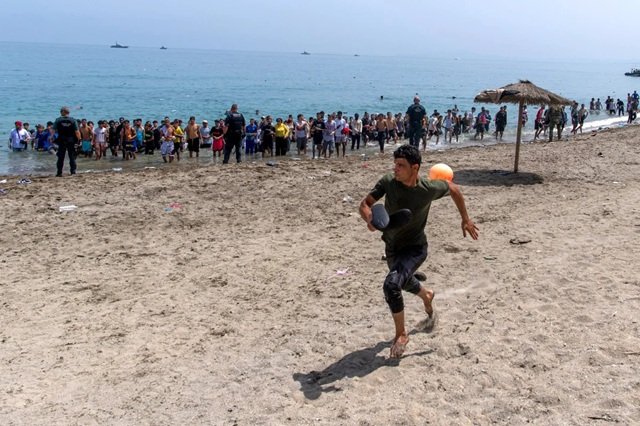
The Spanish government has denied allegations that it overlooked intelligence warnings ahead of the mass arrival of tens of thousands of migrants in the North African exclave of Ceuta, as authorities continue recovery, accommodation and repatriation efforts. The dispute has intensified political debate over the handling of one of the largest migration crises to affect the territory, with conflicting accounts emerging over the scale of the influx and the number of fatalities.
The Spanish government has rejected accusations that it ignored advance warnings from the country’s National Intelligence Centre (CNI) before tens of thousands of migrants crossed irregularly into the North African exclave of Ceuta, insisting that no intelligence reports had forecast a migration crisis of such magnitude.
Madrid said on Monday that it had received no intelligence assessments warning of an event on the scale that unfolded last week, when large numbers of migrants entered the Spanish territory from neighbouring Morocco. The government’s response came after opposition politicians questioned whether the authorities had been adequately prepared for the unprecedented influx.
Miguel Tellado, spokesperson for the opposition conservative People’s Party (PP), said it was difficult to believe that the CNI had been unaware of what he described as an impending “human wave”. However, government spokesperson Elma Saiz firmly rejected suggestions that warnings had been overlooked, stating: “No one had anticipated such an unprecedented event.”
The political dispute comes as emergency operations continue in Ceuta to accommodate the remaining migrants, organise their return to Morocco and search for additional victims. According to Spain’s Ministry of the Interior, 72 bodies have so far been recovered following the crisis.
The exact scale of the migrant influx remains disputed. During the mass crossings, migrants entered Ceuta by swimming around the coastline or by climbing the territory’s six-metre-high border fence separating the Spanish enclave from Morocco.
Regional President Juan Jesus Vivas has revised his estimate of the number of arrivals to 80,000, after previously placing the figure at 60,000. The Spanish central government has maintained its estimate that around 50,000 migrants crossed into Ceuta, while Moroccan authorities have stated that approximately 40,000 migrants attempted to reach the enclave.
Authorities have also reported differing casualty figures. While the central government continues to confirm that 72 bodies have been recovered, representatives of Ceuta’s conservative regional administration have said the death toll is at least 88, highlighting ongoing uncertainty over the full human cost of the crisis.
Despite the unprecedented influx, most of those who entered Ceuta have now returned to Morocco. According to the Spanish government, around 2,500 migrants remain in the territory, with repatriation operations still under way.
The differing estimates of both the number of arrivals and fatalities have added to political tensions surrounding the government’s handling of the crisis. Opposition figures have questioned whether the authorities received sufficient intelligence in advance, while ministers have maintained that the scale and speed of the mass crossings could not have been foreseen.
As recovery operations continue and officials work to account for those affected, the debate over preparedness and responsibility is expected to remain a central issue in Spain’s response to one of the most significant migration incidents to impact Ceuta in recent years.










